

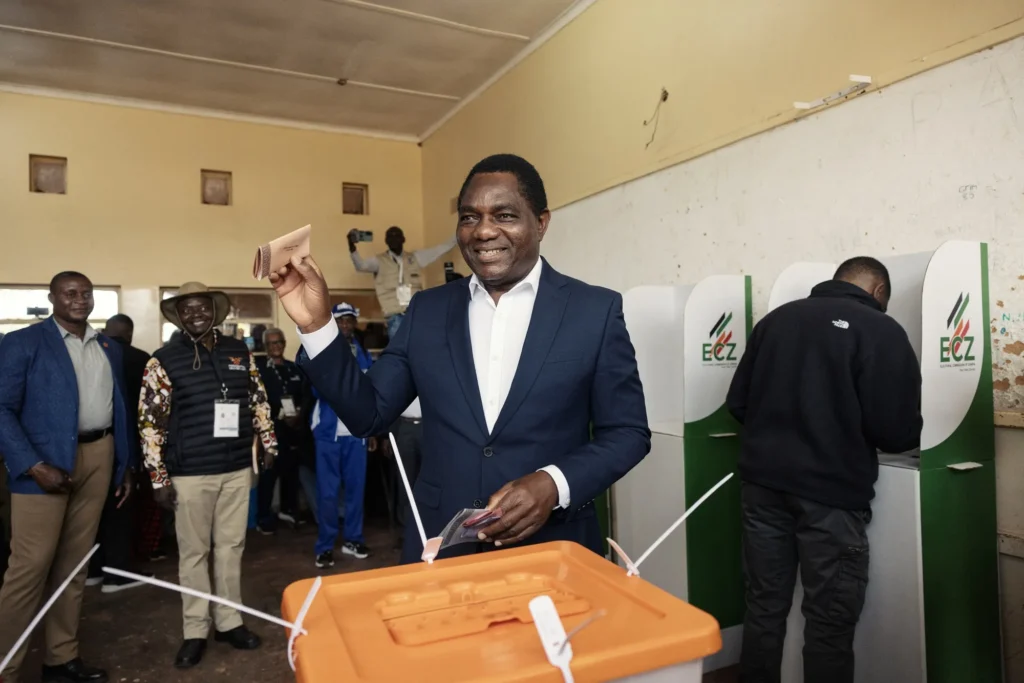
President Secures Another Five Years.
Zambian President Hakainde Hichilema has won a second five-year term after securing about 60–61 percent of the vote in the country’s presidential election, according to official results released on 18 August 2026. His main challenger, Brian Mundubile, received roughly 38 percent. Hichilema’s victory gives him another mandate to pursue his economic reform agenda in one of Africa’s most important copper-producing economies.
The result is significant for Zambia because Hichilema’s first term was dominated by efforts to stabilise an economy that had been struggling with debt, inflation and weak investor confidence. His re-election provides continuity at a time when the government is seeking to consolidate economic reforms and negotiate a potential new programme with the International Monetary Fund. Reuters reported on 18 August that investors broadly view the result as positive because it reduces uncertainty over Zambia’s economic policy direction.
Investors Welcome Continuity but Want Growth.
Hichilema, who first took office in 2021 after defeating then-president Edgar Lungu, campaigned on economic reform, investment and improved governance. His administration has made debt restructuring and restoring relations with international financial institutions central elements of its economic strategy.
The re-election is therefore being interpreted by investors as a vote for policy continuity. However, continuity alone will not be enough to satisfy the private sector. Zambia continues to face the difficult task of translating macroeconomic stabilisation into stronger economic growth, higher household incomes and more employment.

Reuters reported that negotiations over a possible new IMF programme will provide an early test of Hichilema’s second-term economic strategy. The government will have to demonstrate that fiscal reforms can be maintained while creating enough economic activity to improve living standards.
Copper Remains at the Centre of Zambia’s Economy.
One of Hichilema’s biggest challenges will be Zambia’s continued dependence on copper. The country is one of Africa’s major copper producers, and the mineral remains critical to government revenues, exports and foreign-exchange earnings.
The global energy transition has created additional opportunities because copper is essential for electric vehicles, renewable-energy infrastructure, power transmission and other technologies. Zambia therefore has the potential to benefit substantially from rising long-term demand for the metal.
The challenge is ensuring that increased copper production translates into broader economic benefits. Zambia needs investment not only in mining but also in processing, manufacturing, infrastructure and other industries capable of creating employment beyond the mining sector.
Opposition Challenges the Election Process.
Although Hichilema has been declared the winner, the opposition has raised concerns about the electoral process. Mundubile has disputed aspects of the results, alleging voting irregularities and discrepancies. Those allegations could become an important part of the post-election political debate.
The authorities and the ruling United Party for National Development have presented the election as a demonstration of Zambia’s democratic continuity. Hichilema has also thanked voters and portrayed the result as a mandate to continue his programme.
The coming weeks will therefore be important for determining whether the opposition accepts the final outcome and whether the electoral dispute develops into a broader political confrontation.
A Stronger Mandate Comes With Higher Expectations.
Hichilema enters his second term with an advantage that many African leaders do not enjoy: he now has the opportunity to build on an established economic programme without facing another presidential election for several years.
That also means expectations will be considerably higher. During his first term, many Zambians experienced the effects of economic pressures despite improvements in some areas of macroeconomic management. The president’s second mandate will be judged increasingly on whether reforms translate into tangible improvements in employment, purchasing power, public services and investment.
The government will also need to manage the expectations surrounding Zambia’s natural resources. As international demand for copper grows, citizens will expect the country to capture a greater share of the value generated by its mineral wealth.
Hichilema’s Second Term Begins With a Difficult Balancing Act.
The election gives Hichilema five more years to reshape Zambia’s economy, but the political mandate comes with significant responsibilities. Investors want stability, the IMF wants credible reforms, businesses want improved conditions and ordinary Zambians want stronger economic opportunities.
The president’s second term will therefore be less about proving that his administration can change direction and more about demonstrating that the direction it chose during the first term can produce measurable results.
For Zambia, the stakes are particularly high. The country has the mineral resources, agricultural potential and strategic position to become a stronger regional economy. The question now is whether Hichilema’s second term can convert that potential into sustained and broadly shared growth.
Hichilema has won another five years. The harder task now is turning political continuity into economic prosperity

Comments (0)
No comments yet — be the first to share your thoughts.