

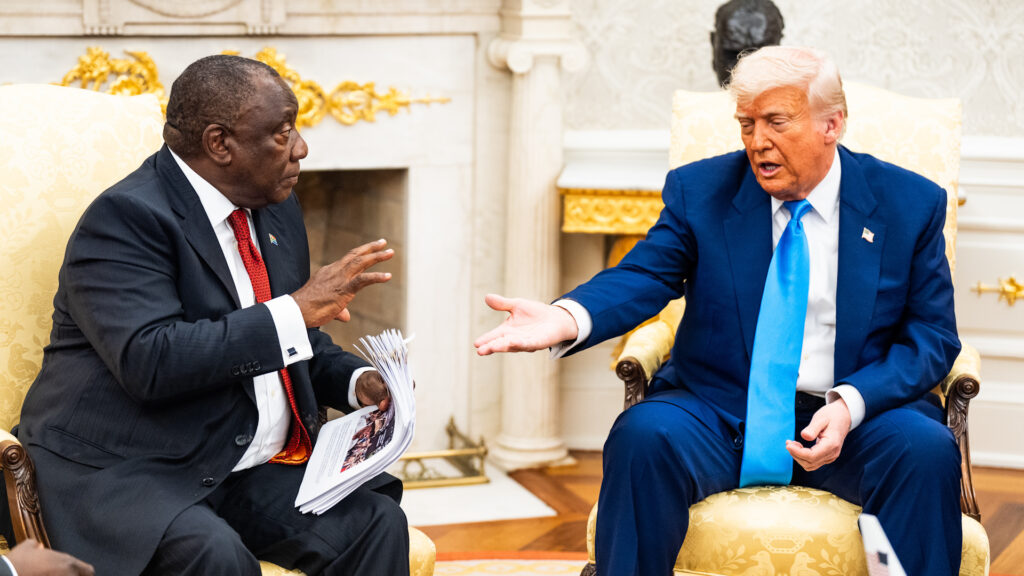
A new dispute between South Africa and the United States is putting immigration policy, race and national sovereignty at the centre of an increasingly difficult relationship between the two countries.
The latest tension began after U.S. Secretary of State Marco Rubio announced new visa restrictions affecting certain South African nationals. Washington said the measures target people involved in policies it considers discriminatory, including policies relating to race, land and alleged incitement of violence against minorities. The United States did not publicly identify individual South Africans affected by the restrictions when they were announced.
Pretoria has now rejected the interpretation behind the measures, arguing that the United States is misrepresenting South Africa’s domestic policies.
Pretoria says Washington is getting its policies wrong.
South Africa’s Department of International Relations and Cooperation said on September 16 that Minister Ronald Lamola had expressed concern about the unilateral visa restrictions announced by Rubio.

Lamola’s ministry said the measures were based on what it described as a mischaracterisation of South Africa’s domestic policies and stressed that the country has the sovereign right to develop laws addressing the consequences of its history of racial inequality.
The South African government has linked those policies to its constitutional commitment to address the legacy of apartheid and promote social justice.
That position directly conflicts with Washington’s interpretation. The U.S. government says the restrictions are connected to people involved in racial discrimination or other policies that Washington considers harmful to minority groups.
The disagreement goes beyond visas.
The visa restrictions are only the latest development in a relationship that has experienced several disputes.
U.S. President Donald Trump has previously criticised South Africa over its land policies and has made claims about the treatment of white South Africans that Pretoria strongly rejects. Washington has also taken other measures affecting bilateral relations, while South Africa has continued to defend its domestic policies and foreign-policy positions.
The two governments therefore enter this latest dispute with very different interpretations of what is happening inside South Africa.
For Pretoria, the central issue is sovereignty and the right of a democratically elected government to address inequalities created by apartheid. For Washington, the stated concern is whether particular policies or actions amount to discrimination or threats against racial minorities.
Land reform remains one of the pressure points.
South Africa’s land policy is particularly sensitive because ownership patterns remain heavily influenced by the country’s apartheid-era history.
The government has pursued land reform as part of its effort to address historical inequalities, while the United States has raised concerns about policies involving land seizures and compensation.
These disagreements have repeatedly produced different interpretations of the same legislation and its intended consequences.
South African authorities maintain that their policies are designed to correct historical inequalities rather than discriminate against a racial group. Washington has taken a different position on some of those measures, which has contributed to the latest diplomatic confrontation.
Why the timing matters.
The latest dispute comes as South Africa continues to play an active role in international diplomacy, including through its membership of BRICS and its wider engagement with countries outside the traditional Western alliance system.
South African Foreign Minister Ronald Lamola is also travelling to the United States for the United Nations General Assembly period, meaning the dispute is unfolding while senior officials from both countries are operating in the same international diplomatic environment. Reuters reported that Lamola was due to attend the UN General Assembly amid the growing disagreement.
That could provide an opportunity for direct diplomatic engagement, even as the public statements from both sides remain sharply different.
Washington says more measures could follow.
The dispute could also extend beyond the latest visa restrictions.
The U.S. ambassador to South Africa has indicated that the visa measures may be part of a broader series of actions, according to Reuters. That raises the possibility that the current disagreement could affect other areas of the bilateral relationship if the two governments fail to narrow their differences.
For South Africa, however, the government’s response has remained focused on defending its sovereignty and rejecting what it considers inaccurate descriptions of its domestic policies.
The Department of International Relations and Cooperation has called for continued engagement while maintaining that South Africa will continue to address the country’s historical inequalities through its own democratic institutions.
A diplomatic dispute with wider consequences.
The latest confrontation is therefore about more than who can receive a U.S. visa. It exposes a deeper disagreement over how South Africa’s post-apartheid policies should be understood and who has the authority to judge them.
Washington is using visa restrictions as a foreign-policy instrument based on its stated concerns about discrimination and minority rights. Pretoria is responding by defending its constitutional framework and its right to determine how the country addresses the legacy of apartheid.
The immediate question is whether the disagreement remains limited to visa restrictions or develops into a wider diplomatic dispute.
For South Africa and the United States, the next stage will depend on whether diplomatic engagement can prevent disagreements over domestic policy from producing further consequences for the relationship between the two countries.

Comments (0)
No comments yet — be the first to share your thoughts.