

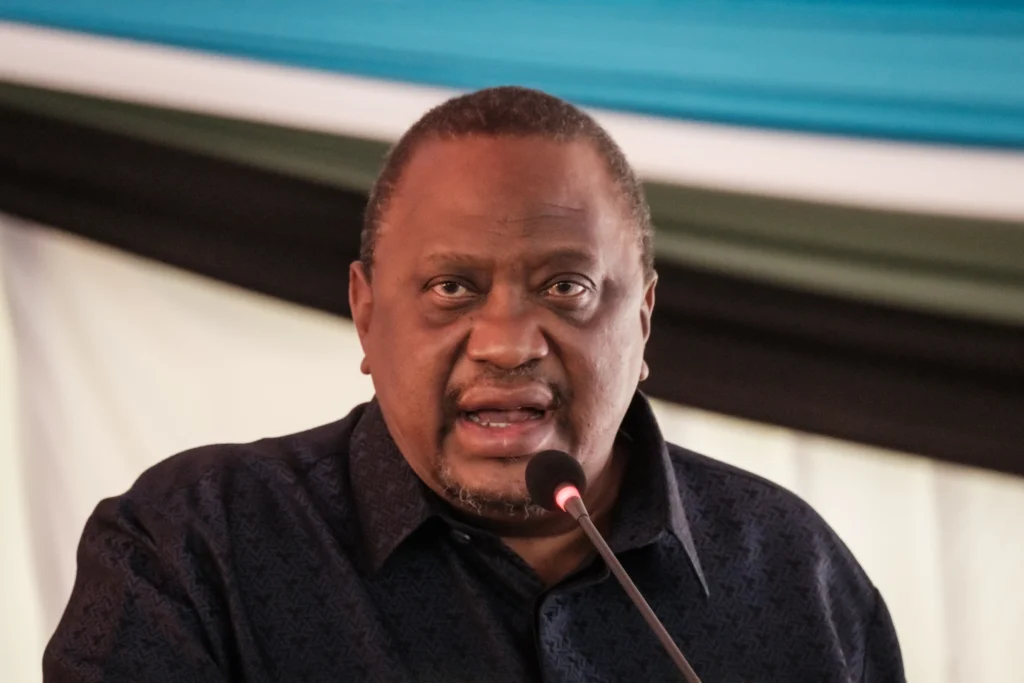
Former President Rejects Claims He Is Funding the Opposition.
Former Kenyan President Uhuru Kenyatta has pushed back against President William Ruto’s repeated claims that he is financing opposition politicians seeking to challenge the government ahead of the 2027 general election. Speaking at the 23rd memorial service of former Vice President Michael Kijana Wamalwa in Kitale, Kenyatta defended his right to participate in Kenya’s political affairs and warned against attempts to restrict political freedoms. His remarks, made public on August 24, come as the political contest surrounding the 2027 election begins to take shape.
Kenyatta rejected the description of himself as a political “sponsor” and maintained that he has no intention of returning to electoral politics or seeking another political office. Instead, he argued that as a former president and Kenyan citizen, he retains the right to express his views and participate in national political discussions. He also stressed that Kenyans should ultimately be free to choose the leaders they want through democratic elections.
Ruto Accuses Uhuru of Backing His Political Opponents.
The dispute follows increasingly direct attacks from President Ruto, who has accused his predecessor of supporting political figures and movements seeking to challenge his administration in 2027. Ruto has portrayed the emerging opposition formations as being backed by individuals attempting to destabilise his government, while questioning the record of the political leadership associated with the previous administration.
Ruto’s allegations have placed Uhuru Kenyatta back at the centre of Kenya’s political conversation despite the former president leaving office in 2022. The accusations are particularly significant because Uhuru remains an influential figure within Kenya’s political establishment and continues to have relationships with leaders across different political camps.

The former president’s decision to publicly reject the allegations suggests that he does not intend to remain silent as political alliances begin forming ahead of the next election.
Uhuru Says Political Freedom Cannot Be Restricted.
Speaking during the memorial event, Kenyatta framed the dispute in broader democratic terms. He argued that attempts to prevent politicians and citizens from expressing their political preferences would undermine principles for which previous generations of Kenyan leaders fought.
His message was that political competition should be determined by voters rather than restrictions imposed by those in power. He said Kenyans should have the freedom to choose their leaders and warned against efforts to limit that freedom.
The intervention gives the dispute a significance beyond the personal relationship between two former political allies. It raises questions about how Kenya’s political environment will develop as parties and movements begin positioning themselves for the 2027 presidential election.
Ruto and Uhuru Have a Complicated Political History.
The confrontation between Ruto and Uhuru is particularly notable because the two men were once political partners.
Ruto served as Uhuru’s deputy president for two terms between 2013 and 2022. Their political alliance helped secure victories in the 2013 and 2017 presidential elections, but their relationship deteriorated dramatically during Uhuru’s second term.
Uhuru eventually backed opposition leader Raila Odinga during the 2022 election, while Ruto successfully ran against the political establishment represented by his former boss. Ruto’s victory marked the end of their political partnership and opened a new chapter in their relationship.
Four years later, the rivalry is resurfacing as both men remain influential figures in Kenya’s political landscape.
The 2027 Election Is Already Taking Shape.
Although the next presidential election is still ahead, Kenya’s political parties and movements are already positioning themselves.
Ruto is expected to seek a second and final constitutional term, while opposition figures are attempting to build alliances capable of challenging him. Former President Uhuru’s name has repeatedly appeared in discussions about possible opposition coordination, even though he has denied plans to return to electoral politics.
The emergence of new political groupings has also intensified speculation about whether Kenya’s opposition can overcome the divisions that have historically weakened attempts to challenge an incumbent president.
That is one reason Ruto’s allegations against Uhuru have attracted so much attention. If the former president were to play a significant role in coordinating opposition forces, his political influence could become an important factor in the 2027 contest.
Uhuru Says He Does Not Want to Return to Politics.
Kenyatta has been clear that he does not intend to seek another political office after serving two terms as president. His current position appears to be that of a former head of state who wants to remain involved in national affairs without becoming a candidate.
That distinction is important because Kenya’s political system gives former presidents considerable influence even after they leave office. Their networks, experience and relationships can make them important actors during subsequent elections.
Uhuru’s influence therefore does not necessarily depend on him appearing on a ballot paper. His ability to bring political figures together, offer public commentary and influence national conversations could still make him an important player in the 2027 political environment.
Government Allies Are Also Calling for Restraint.
Not everyone within Ruto’s administration has adopted the same confrontational tone towards the former president. Deputy President Kithure Kindiki has urged Uhuru to maintain his role as a statesman and warned against being drawn into political activities that could divide the country.
Kindiki’s position highlights a different approach within the government. While Ruto and some of his allies have accused Uhuru of supporting opposition forces, other officials appear more interested in preventing the dispute from becoming a broader confrontation. That difference could become increasingly important as the political environment becomes more competitive.
Opposition Figures Reject the Allegations.
The accusations have also been dismissed by opposition figures linked to the emerging political movements. Nairobi Senator Edwin Sifuna, who has been associated with the Linda Mwananchi political movement, has mocked claims that Uhuru is secretly financing opposition activities. Sifuna has questioned the evidence behind the allegations and challenged the government to substantiate its claims.
The disagreement therefore extends beyond Ruto and Uhuru. It has become part of a wider political contest involving government leaders, opposition politicians and emerging alliances.
Kenya’s Political Temperature Is Rising Early.
The latest confrontation illustrates how early the 2027 election campaign is beginning to influence Kenyan politics.
The election is still some distance away, but the major political actors are already defining their positions, building alliances and attempting to shape public opinion. The accusations against Uhuru suggest that Ruto’s camp views the former president’s political influence as something that cannot be ignored.
For Uhuru, the challenge will be maintaining his position as a retired president while deciding how actively he wants to participate in the political debate.
For Ruto, the challenge will be demonstrating that his government can focus on its record and policy agenda rather than allowing the opposition and former political rivals to dominate the national conversation.
The Bigger Battle Is Over Kenya’s Political Future.
The confrontation between Ruto and Uhuru is unlikely to disappear quickly. Both men remain influential, and their political history continues to shape Kenya’s electoral landscape.
But the 2027 election will ultimately be determined by more than the rivalry between two former political allies. Kenyans will also be judging the government’s economic record, the cost of living, employment opportunities, public services, governance and the credibility of the opposition alternatives.
Uhuru’s role could become important, but he cannot determine the outcome alone. The same applies to Ruto.
Kenya’s 2027 election is already producing the political tensions normally associated with a much later stage of the electoral cycle. Uhuru Kenyatta says he will not be silenced and denies funding the opposition, while William Ruto continues to warn that forces linked to his predecessor are working against his government. As the political alliances take shape, the real contest will be whether Kenya’s next election becomes a referendum on Ruto’s record, a battle over competing political coalitions, or another chapter in the long-running rivalry between two men who once governed the country together.

Comments (0)
No comments yet — be the first to share your thoughts.