

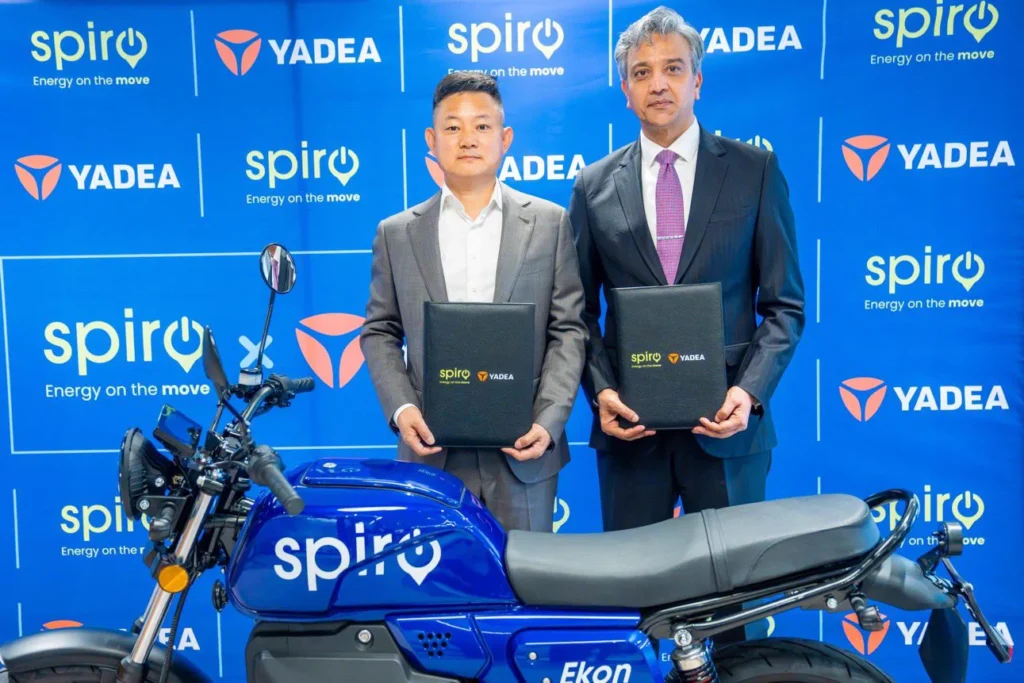
Africa’s electric mobility market is entering a new phase as African electric mobility company Spiro partners with Chinese electric two-wheeler giant Yadea to expand affordable electric transport across the continent. The partnership brings together Yadea’s manufacturing and research capabilities with Spiro’s battery-swapping infrastructure and operating network across seven African countries, creating one of the continent’s more ambitious efforts to move commercial transport away from petrol-powered motorcycles.
The agreement comes as demand for electric motorcycles grows across Africa, particularly in markets where motorcycles are essential for transportation, delivery services, logistics and informal commerce. For millions of riders, the transition to electric mobility will ultimately depend not only on the price of the vehicle but also on access to reliable charging, affordable financing, replacement batteries and infrastructure that fits African roads and business models.
A Partnership Built Around African Mobility Needs.
Under the agreement, Yadea will supply electric two-wheelers and related electric-vehicle products adapted to Spiro’s regional markets, while Spiro will integrate those vehicles into its battery-swapping and energy infrastructure. The companies also plan to co-develop customised two-wheeler platforms designed specifically for local road conditions and commercial applications.
That approach is important because Africa’s electric mobility market cannot simply copy models developed for wealthier markets. Commercial motorcycles in cities such as Nairobi, Kampala, Lagos and other rapidly growing urban centres often travel long distances every day, carrying passengers, delivering goods or supporting small businesses.

For those riders, charging downtime can directly affect income. Battery swapping offers a different model, allowing riders to exchange depleted batteries for charged ones rather than waiting for a vehicle to recharge.
Battery Swapping Could Be the Real Game Changer.
Spiro has built much of its African strategy around battery swapping. The company says its network currently spans seven countries and has more than 2,500 battery-swapping stations, while its electric motorcycle fleet has surpassed 130,000 vehicles. It also reports more than 50 million battery swaps and more than two billion kilometres of low-carbon travel.
The partnership with Yadea gives that infrastructure a potentially much larger vehicle pipeline.
Instead of building a mobility ecosystem around one manufacturer’s products, Spiro can combine its existing energy and battery network with Yadea’s enormous manufacturing capacity. The result could accelerate the availability of electric motorcycles while reducing some of the infrastructure barriers that have slowed EV adoption in African markets.
Anant Badjatya, CEO of Spiro, said the partnership is designed to help the company respond to accelerating demand while bringing more riders into affordable electric transport.
Yadea Brings Massive Manufacturing Scale.
Yadea gives Spiro access to one of the world’s biggest electric two-wheeler manufacturing platforms. The Chinese company has sold more than 100 million electric vehicles globally across more than 100 countries and operates 10 production facilities, according to the companies. It also holds more than 2,000 patents related to electric-vehicle technology.
That scale could prove critical in Africa, where affordability remains one of the biggest barriers to electric mobility.
Electric motorcycles have the potential to reduce fuel and maintenance costs over time, but the initial purchase price can still be difficult for commercial riders. Increasing production volumes and adapting products specifically to African markets could help narrow that gap.
Wang Jiazhong, Senior Vice President of Yadea Technology Group, described Africa as a major frontier for zero-emission transport and said the partnership would combine global technology with local infrastructure.
Africa’s Motorcycle Economy Is Already Moving Electric.
The timing of the partnership reflects a broader shift. Imports of electric motorcycles and three-wheelers from China into Africa rose by 60 percent during the first half of 2026 to $114.6 million, according to reporting based on trade data. North African markets such as Morocco, Egypt and Algeria have been particularly important for consumer electric scooters, while East and West Africa have seen growing investment in commercial electric motorcycle ecosystems.
The difference matters. In many sub-Saharan African markets, motorcycles are not simply personal vehicles. They are income-generating assets.
A motorcycle can be used as a taxi, a delivery vehicle, a courier service or a small logistics business. That makes commercial riders one of the most important potential drivers of electric mobility adoption.
If electric motorcycles can deliver lower operating costs without reducing earning capacity, the transition could happen much faster than many traditional car-focused EV forecasts suggest.
Spiro Is Expanding Beyond a Motorcycle Business.
The partnership also reflects a broader ambition from Spiro. The company is attempting to build an integrated electric mobility ecosystem that combines vehicles, energy infrastructure and battery technology rather than simply selling motorcycles.
That strategy received additional financial backing through a $270 million funding round involving NewTrails Capital, a Chinese investment fund. Spiro has also established assembly operations in countries including Uganda, Kenya, Nigeria and Rwanda.
The combination of financing, local assembly, battery swapping and international manufacturing partnerships gives the company a platform from which it can potentially expand much faster.
For Africa, local assembly is particularly important because it could gradually move the continent beyond simply importing finished electric vehicles.
The China-Africa Mobility Relationship Is Deepening.
The Spiro-Yadea partnership also highlights the changing nature of China-Africa economic cooperation.
Much of the China-Africa relationship has historically centred on infrastructure, mining, construction and manufactured goods. Electric mobility adds another dimension, bringing Chinese technology and manufacturing expertise together with African companies that understand local markets and operating conditions.
In this case, the partnership is not simply about importing motorcycles. The companies intend to develop products specifically for African conditions and integrate them into infrastructure already being built on the continent.
That distinction could become increasingly important as African governments seek greater local participation in emerging industries.
The Bigger Question Is Whether Africa Can Build Its Own EV Ecosystem.
Electric mobility has the potential to reduce fuel imports, lower transport costs and improve air quality in African cities. But the transition will not happen automatically.
Governments will need to support charging and battery infrastructure, establish clear regulations for electric motorcycles, create financing opportunities for commercial riders and encourage local manufacturing and assembly. Businesses, meanwhile, will need to demonstrate that electric vehicles are economically viable rather than simply environmentally attractive.
The rapid expansion of electric motorcycles also creates new questions around battery standards, recycling, electricity supply and long-term infrastructure investment.
The Spiro-Yadea partnership does not solve all of those challenges, but it addresses one of the most important: scale.
A New Race for Africa’s Electric Mobility Market.
For Spiro, the partnership provides access to Yadea’s global manufacturing strength. For Yadea, it provides a stronger route into Africa through a company that already understands the continent’s commercial mobility environment.
For African consumers and businesses, the potential prize is much larger: cheaper-to-operate transport, new mobility services and an expanding ecosystem of electric vehicles built around African realities.
Africa’s electric mobility transition is still at an early stage, but the direction is becoming clearer. Motorcycles are likely to be among the continent’s most important entry points into electric transport, particularly because they already play such a central role in urban and commercial life.
The partnership between Spiro and Yadea could therefore become more than another corporate agreement. It could mark the beginning of a new phase in Africa’s electric mobility race — one in which manufacturing scale, local infrastructure and African market knowledge come together to bring electric transport to millions of riders.

Comments (0)
No comments yet — be the first to share your thoughts.