

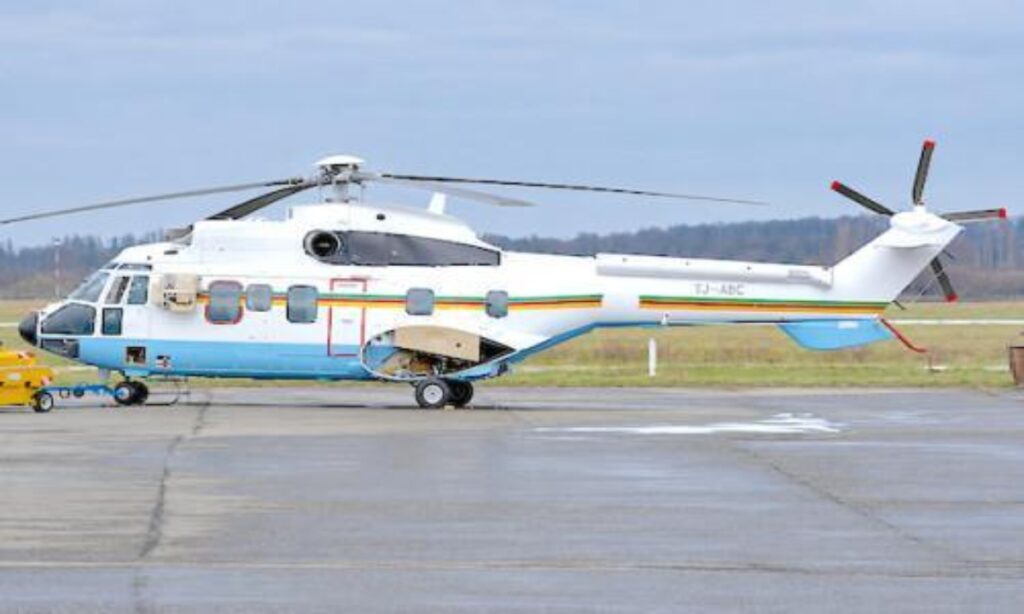
Cameroon has suffered a setback in its attempt to recover about 355 million FCFA linked to the repair of a presidential helicopter after a Qatari court blocked the country’s effort to reclaim the money. The amount, equivalent to roughly US$660,000, was reportedly paid in 2018 to help complete repair work on a helicopter, but Cameroon has since sought to recover the funds through legal proceedings in Qatar.
The case is drawing attention because it involves public money, a presidential aircraft and an international legal dispute stretching back several years. The decision also raises broader questions about how governments manage payments for major public assets and how effectively they can recover funds when contractual or technical disputes emerge across borders.
A 355 Million FCFA Dispute.
The money at the centre of the case was reportedly transferred in 2018 in connection with repairs to a helicopter used by Cameroon’s presidency. According to the current reporting, Cameroon is seeking to recover approximately US$660,000, or about 355 million FCFA, that it says was paid toward completing the repair process.
The legal battle illustrates how relatively modest amounts by the standards of state budgets can become complicated when they involve specialised equipment, international contractors and foreign jurisdictions. A helicopter is a highly technical asset, requiring specialised maintenance, certified parts and qualified engineering teams, meaning disputes over repairs can quickly become contractual and financial disputes.

For Cameroon, however, the issue is not simply about the value of one payment. It also concerns the government’s ability to protect public funds and enforce its interests when transactions involve companies or institutions outside the country.
Why the Qatari Court Matters.
Cameroon’s decision to pursue the matter through the Qatari judicial system reflects the international nature of the underlying transaction. Once a payment, repair arrangement or contractual relationship involves a foreign jurisdiction, recovering disputed funds can require a government to navigate another country’s legal procedures.
That can make the process considerably more difficult than a domestic recovery claim. Cameroon must operate within the legal framework governing the parties and transactions in Qatar, while also establishing its own contractual and financial claims before the relevant court.
The reported decision therefore represents an important setback for the government’s recovery effort, even if it does not necessarily end every possible avenue available to Cameroon under applicable law.
The Presidential Helicopter Connection.
The involvement of a presidential helicopter gives the dispute additional political and public interest. Aircraft used by heads of state are not ordinary commercial assets. Their maintenance is connected to government operations, official travel and the security requirements surrounding senior state officials.
That makes the financial management of such assets particularly sensitive. Payments for repairs, spare parts, maintenance contracts and technical services can involve substantial public resources, while failures to resolve contractual disagreements can leave governments facing additional costs.
The Cameroon case therefore highlights the importance of clear contractual arrangements and strong oversight when public institutions enter into international maintenance agreements.
A Wider Question About Public Money.
The 355 million FCFA at stake may appear relatively small compared with Cameroon’s overall public expenditure, but disputes of this nature raise a broader issue: how effectively can African governments recover public funds when money has already crossed international borders?
The answer often depends on the quality of the original contract, the documentation supporting the payment, the obligations of each party and the jurisdiction governing the agreement. When those elements are disputed, governments can face lengthy legal battles before any money is recovered.
For Cameroon, the latest ruling demonstrates the difficulty of pursuing such claims after the fact. It also reinforces the importance of preventing disputes before public funds are transferred, particularly when the transaction involves complex technical equipment.
Cameroon Faces a Difficult Recovery Path.
The court’s decision means Cameroon’s effort to recover the reported 355 million FCFA has encountered a significant obstacle. The government must now assess its legal options and determine whether additional proceedings or other mechanisms remain available.
Such decisions can be particularly frustrating for governments because litigation itself can create additional costs. Legal representation, technical expertise, documentation and proceedings across borders can all require resources, even when the original dispute involves a comparatively limited amount.
The case consequently illustrates one of the less visible costs of international public procurement disputes: the money at stake can become only one part of the overall financial burden.
The Bigger Issue Is Accountability.
Beyond the courtroom, the helicopter dispute raises an important question about public accountability in Cameroon. Citizens ultimately have an interest in knowing how public funds are committed, why payments are made, what contractual obligations accompany those payments and what happens when expected services are not delivered.
International procurement can be unavoidable for specialised equipment, particularly in aviation and defence-related fields. But the complexity of those contracts makes transparency and oversight even more important.
The current dispute shows why governments need strong mechanisms for monitoring international contracts from the moment an agreement is signed through to the completion of the work. Recovering money years later through foreign courts can be significantly more difficult than preventing a contractual dispute from escalating in the first place.
A Setback, but Not the End of the Question.
For now, Cameroon has not achieved its objective of recovering the approximately 355 million FCFA at the centre of the dispute. The Qatari court ruling represents a legal setback in a case that has remained unresolved since the original payment in 2018.
But the significance of the case extends beyond the amount involved. It touches on public procurement, international contracts, government accountability and the ability of African states to protect public resources when transactions cross borders.
For Cameroon, the immediate challenge is to determine what legal options remain. The longer-term lesson is equally important: when public money is committed to highly specialised international contracts, the strength of the agreement and the oversight surrounding it can be just as important as the money itself.

Comments (0)
No comments yet — be the first to share your thoughts.