
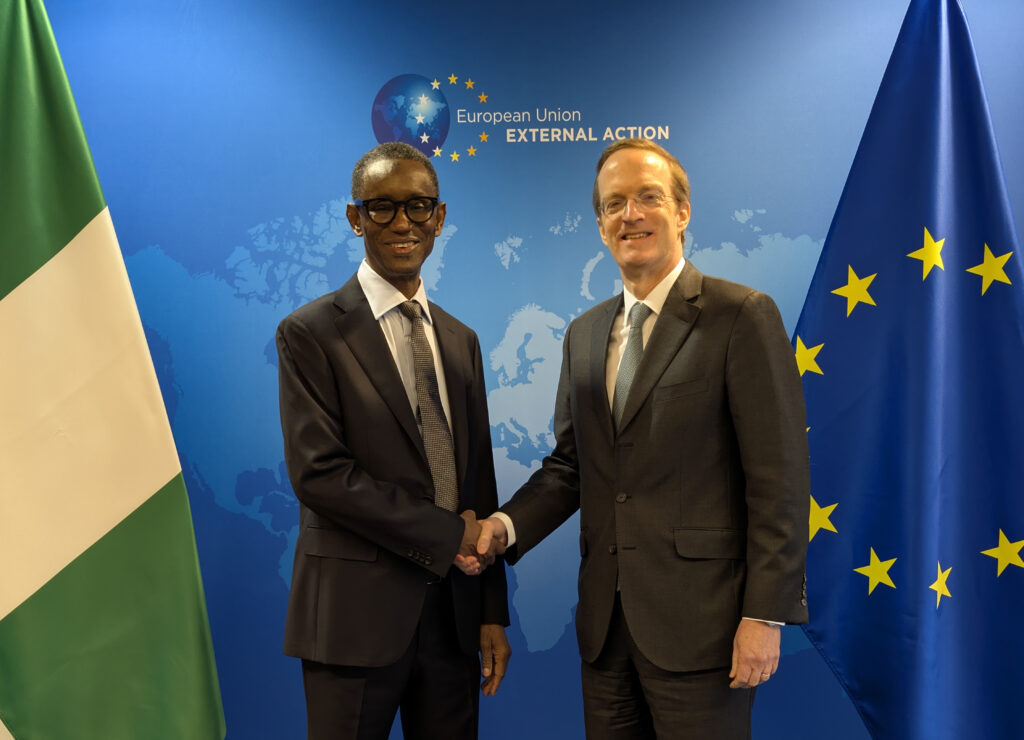
Nigeria and the European Union have renewed discussions on a long-pending agreement that would establish a clearer framework for the readmission and return of migrants, while also expanding cooperation on legal migration, border management and the protection of migrants.
The renewed talks took place on the sidelines of the 81st United Nations General Assembly in New York, where Nigeria’s Foreign Minister Yusuf Tuggar met with EU officials to discuss migration cooperation between Abuja and Brussels. The discussions included efforts to advance the EU-Nigeria Readmission Agreement, which has been under negotiation for several years.
Nigeria and EU Seek Progress on Readmission Agreement.
The proposed agreement would provide procedures for the identification and return of Nigerian nationals who are found to have no legal right to remain in an EU member state.
Readmission agreements are intended to establish rules governing how countries cooperate when a person is ordered to leave another country. They can cover issues such as confirming nationality, issuing travel documents and organising transfers.

Nigeria and the EU have previously held several rounds of negotiations, but a final agreement has not been concluded.
The latest discussions indicate that both sides want to move the process forward while also broadening migration cooperation beyond returns.
Legal Migration Also on the Agenda.
Nigeria has emphasised that cooperation with Europe should not focus exclusively on deportations and irregular migration.
The two sides are also discussing legal migration pathways, skills mobility, labour opportunities and cooperation on border management. These areas are particularly important to Nigeria as the country seeks greater opportunities for its citizens to study, work and acquire skills legally in European countries.
For the EU, establishing effective return arrangements remains an important component of its broader migration policy.
Nigeria Wants Cooperation Beyond Returns.
Nigeria’s position has consistently been that migration should be addressed through a comprehensive partnership.
That includes tackling the factors that encourage irregular migration while expanding legitimate routes for Nigerians seeking opportunities abroad.
The government has also highlighted the importance of protecting Nigerian citizens who migrate and ensuring that returns are carried out in an orderly and dignified manner.
This approach puts the proposed readmission agreement within a much wider framework covering migration, development, employment and mobility.
A Long-Running Negotiation.
The EU-Nigeria readmission discussions are not new. Negotiations have been underway for years as Brussels has sought stronger cooperation with major countries of origin and transit for migrants.
Nigeria is one of Africa’s largest countries of origin for migrants travelling to Europe, making cooperation between Abuja and Brussels particularly significant for the EU’s wider migration strategy.
However, finalising an agreement requires both sides to resolve practical and political questions surrounding identification, documentation, returns and reintegration.
What Happens Next.
The renewed engagement does not itself mean that a final readmission agreement has been signed. Instead, Nigerian and European officials are seeking to advance negotiations toward a framework that both sides can accept.
The discussions also reflect an effort to balance two priorities: the EU’s interest in effective migration management and Nigeria’s demand for broader cooperation that includes legal migration opportunities and development.
If negotiations progress, the eventual agreement could provide a formal framework for handling the return of Nigerians without legal status in EU countries while establishing additional channels for cooperation between Nigeria and the European Union.

Comments (0)
No comments yet — be the first to share your thoughts.