

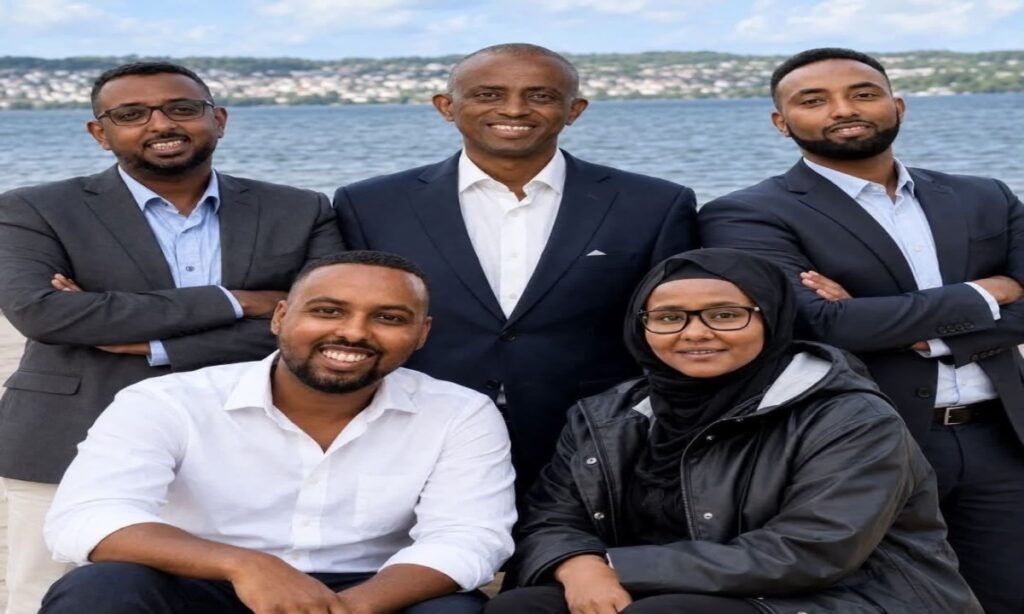
Five Swedish politicians of Somali origin have been elected to Sweden’s 349-seat Riksdag following the country’s September 13, 2026 parliamentary election, marking a notable presence for the Somali-Swedish community in the new parliament. Sweden’s parliament published the official list of elected members on September 21.
The five lawmakers are Leila Ali Elmi, Mursal Isa, Mohamed Abdukani, Ilyas Hassan and Mohamed Abdukardir Ali. They were elected under two parties — the Green Party (Miljöpartiet) and the Left Party (Vänsterpartiet) — and represent constituencies including Gothenburg, Stockholm, Södermanland and Dalarna.
Leila Ali Elmi Makes Another Parliamentary Return.
Leila Ali Elmi, a Green Party politician representing Gothenburg Municipality, is the most established of the five. She first entered the Riksdag in 2018, becoming Sweden’s first parliamentarian of Somali origin, and has now secured another term.
Her political career has made her one of the most recognisable Somali-Swedish figures in Swedish national politics. Her latest election means she will continue serving as a member of parliament when the new Riksdag begins its work on September 28.

Four Newcomers Join the Riksdag.
The other four elected politicians are entering the parliament in the new 2026–2030 term.
Ilyas Hassan, representing the Left Party, won a seat in Stockholm Municipality. Mursal Isa was elected for the Green Party in Dalarna County, while Mohamed Abdukani won a Green Party seat in Södermanland County.
Mohamed Abdukardir Ali, representing the Left Party in Dalarna County, also secured a parliamentary seat. According to reporting on the election, Ali received enough personal votes to move from ninth position on his party’s regional list to the position that secured him a seat.
Election Investigation Puts One Seat Under Scrutiny.
The election has also generated an important development involving Mohamed Abdukardir Ali. Swedish prosecutors opened a preliminary investigation into alleged electoral fraud in Borlänge, where unusually strong preference voting helped Ali secure his seat. Reuters reported that investigators are examining allegations involving pre-marked ballots.
Ali has taken leave and will not assume the parliamentary seat while the investigation proceeds. Reuters stressed that no suspects have been identified at this stage. Sweden’s Election Review Board could potentially order a re-run in Dalarna if it determines that the allegations affected the result.
The investigation therefore does not establish that Ali or any other individual committed electoral fraud. It remains a preliminary inquiry into the circumstances surrounding the voting.
A New Chapter for Somali-Swedish Representation.
The election of five politicians of Somali origin comes as Sweden undergoes a significant political transition. The centre-left opposition won 176 of the Riksdag’s 349 seats, compared with 173 for the outgoing right-leaning bloc.
The new parliament will officially begin its work with the roll-call on September 28. Until then, the outgoing Riksdag remains in office.
For Sweden’s Somali community, the five elected politicians represent a broader development in the country’s political landscape: candidates of Somali origin are now present across two political parties and several constituencies, rather than being concentrated within a single political movement. Their individual political positions, however, differ according to their respective parties and constituencies.
The development also comes at a politically sensitive moment, with the election result itself under scrutiny in Dalarna and Sweden preparing for the formation of a new government.

Comments (0)
No comments yet — be the first to share your thoughts.