
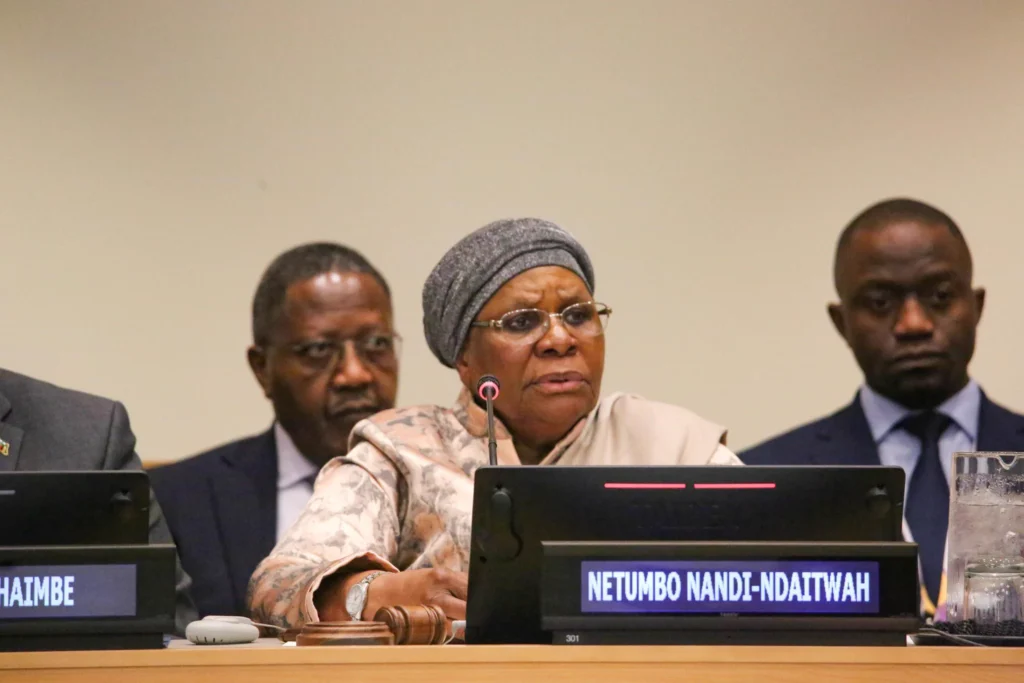
Namibian President Netumbo Nandi-Ndaitwah has used the 81st United Nations General Assembly to press for changes to the global economic system, arguing that Africa needs greater control over the resources and financial opportunities that shape its development.
Her intervention in New York comes as African leaders use the UN General Assembly to push for reforms to international institutions, greater representation for the continent and a financial system that they say better reflects Africa’s economic realities.
Nandi-Ndaitwah has placed particular emphasis on illicit financial flows, taxation and the need for international cooperation to ensure that African economies retain more of the wealth generated within their borders.
Namibia Pushes Back Against Illicit Financial Flows.
The Namibian president’s message comes against a broader African concern over money leaving the continent through illicit channels. African governments and institutions have increasingly focused on tax avoidance, corruption, trade misinvoicing and other mechanisms that can deprive governments of revenues needed for infrastructure and public services.

Nandi-Ndaitwah has called for stronger international measures to address these flows and for reforms that can give developing countries a greater role in decisions affecting the global financial system.
The issue is particularly significant for resource-rich African countries, where large revenues can be generated from minerals, oil, gas and other commodities while governments continue to face pressure to finance development.
Africa Wants More Value From Its Natural Resources.
Namibia is itself undergoing a major transformation in its resource sector. The country has attracted international interest in uranium, lithium, green hydrogen and other strategic resources, making questions about ownership, investment and local economic benefits increasingly important.
The debate reflects a wider shift across Africa. Governments are seeking to move beyond the traditional model of exporting raw materials and are increasingly calling for processing, manufacturing and other value-added activities to take place domestically.
That approach could allow African countries to capture a larger share of the economic value generated by their natural resources while creating jobs and developing industrial capacity.
The Global Financial System Remains a Major African Concern.
Nandi-Ndaitwah’s intervention also fits into a broader African campaign for reform of international financial institutions.
African governments have repeatedly argued that developing economies face financing conditions that can restrict their ability to invest in infrastructure, climate adaptation, healthcare and industrial development.
The debate has become more prominent as many African countries deal with elevated debt-service costs and limited access to affordable long-term financing.
For Namibia, the question is also connected to the country’s ambition to attract investment into emerging sectors while ensuring that investment contributes to domestic development.
Namibia’s Resource Debate Is Part of a Continental Conversation.
The president’s comments come at a time when Africa’s natural resources have become increasingly important to the global economy. Demand for critical minerals used in batteries, renewable-energy technologies and advanced manufacturing has intensified competition for access to African deposits.
The central question for African governments is increasingly not simply whether foreign companies will invest, but how much economic value remains in Africa after those investments take place.
That conversation is particularly relevant for countries such as Namibia, the Democratic Republic of Congo, Zambia, Ghana and South Africa, where mineral and other natural-resource sectors play important roles in national economies.
Nandi-Ndaitwah’s UN intervention therefore places Namibia within a much larger African debate over resource ownership, economic sovereignty, illicit financial flows and global financial reform.
As African leaders continue their engagement at the UN, the push is increasingly focused on ensuring that the continent’s resources translate into greater domestic investment, employment and long-term economic development rather than primarily serving external markets.

Comments (0)
No comments yet — be the first to share your thoughts.