
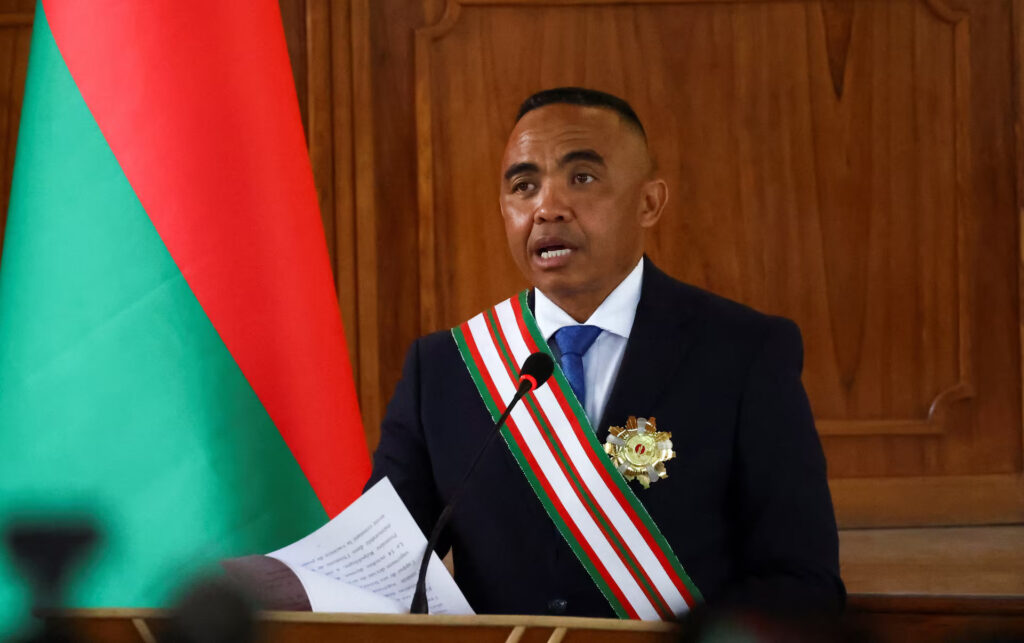
Madagascar’s military-backed government is moving to take greater control of the country’s fuel supply chain, with a state-chartered tanker carrying petrol now at the centre of President Michaël Randrianirina’s effort to reshape how the island imports and distributes petroleum products.
The development marks a significant change in a sector that has traditionally relied heavily on private companies. The tanker, chartered through Nigerian trader Sahara Energy and ordered through the state procurement company State Procurement of Madagascar, is part of the government’s new approach to fuel imports and is currently positioned off Toamasina, Madagascar’s principal eastern port.
The move is politically important because Randrianirina’s transitional government is attempting to establish greater state control over strategic sectors while presenting its broader programme as a national “refoundation” of Madagascar.
The State Is Moving Into the Fuel Market.
The government’s intervention follows a new legal framework that allows a state-authorised entity to take a central role in importing petroleum products. Madagascar’s High Constitutional Court upheld the legislation in August, finding that the system could be justified by the need to guarantee reliable and continuous national fuel supplies.

Under the new system, the government can organise petroleum imports through an entity specifically authorised by the state while maintaining a regulated role for other licensed operators. The legislation also provides mechanisms intended to prevent disruption if the authorised importer fails to meet national supply requirements.
For the junta, this represents more than an administrative adjustment. Fuel is one of the most politically sensitive commodities in Madagascar because shortages and high energy costs can quickly affect transport, electricity generation, businesses and household expenses.
A Challenge to the Old Private System.
For decades, Madagascar’s fuel-import system was dominated by private distributors. The new arrangement significantly changes that model by giving the state a much larger role in procurement and infrastructure.
The shift has already affected established players in the sector. Earlier government action included the requisitioning of storage capacity at the Toamasina petroleum terminal, while the new procurement system has reduced the role of long-standing private suppliers.
The restructuring has also disrupted a long-running fuel-import arrangement associated with Jovena, part of the business interests linked to Malagasy billionaire Hassanein Hiridjee. Reports indicate that the new system effectively ended a 27-year arrangement involving the private sector.
That makes the fuel reform one of the clearest examples of the junta using its transitional authority to alter the country’s economic structure.
The Nigerian Connection.
Sahara Energy, a Nigerian energy company, has emerged as an important partner in Madagascar’s new supply strategy.
A previous shipment, the Sunda 1, delivered roughly 67 million litres of diesel to Madagascar in August after being procured through Sahara Group. The fuel was intended primarily for JIRAMA, the state-owned electricity and water utility, and was reported to provide several months of supply.
The latest tanker, the Meissa, is carrying petrol and represents another stage of the government’s effort to build a direct state-led procurement system.
The involvement of a Nigerian energy trader also gives the policy a broader African dimension. Rather than relying exclusively on the country’s traditional commercial suppliers, Madagascar is using a regional African company to help restructure its fuel procurement.
The Government Says Supply Security Comes First.
Madagascar’s authorities have defended the reform on the grounds that fuel security is a matter of national interest.
The legislation approved by the High Constitutional Court explicitly frames the new system around creating a resilient, sustainable, adequate, reliable and economically efficient petroleum supply chain. The court also noted the instability of international petroleum markets and Madagascar’s inadequate territorial coverage as reasons supporting the intervention.
The government therefore argues that greater state involvement can protect consumers and reduce the risk of shortages.
That argument carries particular weight for JIRAMA, which has faced persistent financial and operational problems. Reliable fuel supplies are essential for the utility’s thermal generation capacity, meaning disruptions in petroleum imports can quickly translate into electricity problems for households and businesses.
But Private Operators Are Watching Closely.
The government’s intervention has also generated concern among established industry players.
The Groupement Pétrolier de Madagascar has previously warned about the practical consequences of changing the import and storage system, particularly when multiple tankers arrive around the same period and existing terminal capacity is being reorganised by the state.
The central question is whether the new system can deliver cheaper and more reliable fuel without creating new bottlenecks.
The High Constitutional Court sought to address concerns about private investment by stressing that the new system does not completely exclude private operators. Licensed companies can continue to participate in importing, processing, transporting, storing and selling petroleum products, while access to essential infrastructure is subject to regulated and transparent conditions.
That distinction will be important as the reform develops.
Randrianirina’s Broader Refoundation Agenda.
The fuel policy comes as Randrianirina’s transitional administration attempts to reshape Madagascar following the country’s political upheaval.
The government has launched a broader national consultation process, with the FFKM, Madagascar’s council of Christian churches, recently identifying 12 major themes for a national dialogue. Governance and public administration are among the central issues being examined.
Against that backdrop, the fuel sector provides an early test of what the junta means by political and economic refoundation.
Taking control of a strategic commodity can strengthen the state, but it also creates new responsibilities. If government procurement produces reliable supplies and improves access to fuel, the policy could become an important argument in favour of the junta’s interventionist approach.
If shortages, inefficiencies or higher costs persist, however, the same policy could become a source of political criticism.
A Bigger Battle Over Economic Control.
Madagascar’s fuel restructuring ultimately reflects a larger question facing the transitional government: how far should the state go in reclaiming control over strategic sectors of the economy?
The arrival of the latest tanker suggests that the government is not simply discussing reform. It is actively building an alternative procurement system.
For Randrianirina, the immediate objective is straightforward: ensure that petrol and diesel reach Madagascar reliably while reducing dependence on the traditional private import structure. But the political stakes are considerably higher.
The junta is attempting to demonstrate that the state can take control of essential economic functions and deliver better results for citizens. Fuel will be one of the first places where Malagasy consumers can judge whether that promise is being fulfilled.
The tanker now waiting at Toamasina therefore carries more than petrol. It is becoming a symbol of Madagascar’s wider political transition and the government’s determination to put strategic economic decisions more firmly in state hands.

Comments (0)
No comments yet — be the first to share your thoughts.