

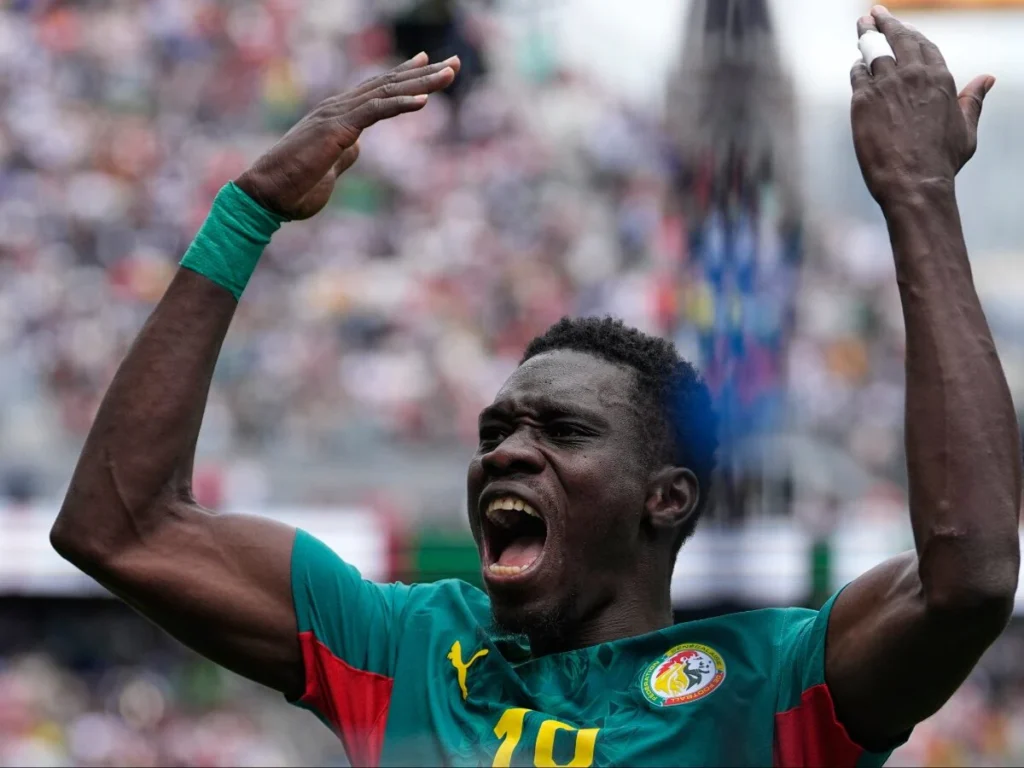
Four World Cup Goals Have Put Sarr Alone at the Top.
Ismaïla Sarr has written his name into Senegalese football history. After scoring against Iraq during Senegal’s 5–0 victory at the 2026 FIFA World Cup, the Crystal Palace forward moved to four World Cup goals, becoming the first Senegalese player to reach that figure across two editions of the tournament.
The achievement is significant because Senegal has produced some outstanding World Cup performers since its debut in 2002. Papa Bouba Diop, Sadio Mané, Henri Camara and El Hadji Diouf have all played important roles in the country’s World Cup story, but Sarr now stands alone as Senegal’s leading scorer in the competition.
From Qatar to Canada, Mexico and the United States.
Sarr’s World Cup journey began at Qatar 2022, where he scored once as Senegal reached the round of 16. Four years later, he returned with a much bigger role and immediately demonstrated his importance to the attack.
At the 2026 tournament, Sarr scored twice against Norway before finding the net again against Iraq. His goal in the 5–0 victory helped Senegal produce the biggest World Cup win ever recorded by an African team at the time.

That consistency is what separates Sarr’s World Cup record from a single memorable tournament. He has now scored at two different editions and has repeatedly provided Senegal with a threat in the final third.
But Is He Really Senegal’s Most Lethal?
The statistics give Sarr a strong argument, but “most lethal” is a bigger claim than simply being the country’s leading World Cup scorer. Papa Bouba Diop remains Senegal’s leading scorer in the country’s overall World Cup history according to some pre-tournament records, while Sadio Mané remains one of the most influential players Senegal has produced on the international stage.
Sarr’s advantage is that he has combined longevity with goals. He has featured at multiple World Cups and has continued to produce despite playing in different attacking roles. His pace, ability to attack space and willingness to make direct runs have made him particularly dangerous against teams that leave room behind their defence.
His 2026 numbers reinforce that impact. Opta’s current international data credits Sarr with four World Cup goals, while he has also become one of Senegal’s most productive attacking players during the 2026 international calendar.
The Legacy Debate Has Changed.
For years, discussions about Senegal’s greatest World Cup players centred on the heroes of 2002 and the generation that reached the last 16 in Qatar. Sarr’s latest achievement changes that conversation.
He may not yet have the overall legacy of Mané, Diouf or Diop, particularly when considering their contributions outside the World Cup. But when the question is specifically about goals and consistency on football’s biggest stage, Sarr now has a compelling case.
Senegal Has Another World Cup Record to Celebrate.
Sarr’s achievement is ultimately another indication of how far Senegalese football has come. From the historic quarter-final run of 2002 to consecutive World Cup appearances and a growing pool of elite players, the Lions of Teranga have established themselves as one of Africa’s most consistent international teams.
So, is Ismaïla Sarr Senegal’s most lethal World Cup player ever? On goals alone, the answer is now yes. Whether that makes him the country’s greatest World Cup performer is a much harder debate. For now, however, four goals across two tournaments have given Sarr a record that belongs entirely to him.

Comments (0)
No comments yet — be the first to share your thoughts.