
Guinea’s landmark Simandou iron ore project is entering a new phase under Kox Gomba, who has been appointed Managing Director of SimFer, the company responsible for Rio Tinto’s interest in Simandou Blocks 3 and 4. SimFer announced the leadership change on September 2, 2026, confirming that Chris Aitchison, who had led the company since 2022, will leave Guinea to take up a new position as Rio Tinto’s Head of Projects. The transition comes at a critical moment as Simandou moves from years of construction into a period of increasing production and exports.
The appointment is significant because Simandou is no longer simply a future mining development. Iron ore is already being produced and exported, while construction of the mine, railway and port infrastructure continues. The project is gradually becoming one of the most important sources of new high-grade iron ore supply globally and one of the largest industrial investments ever undertaken in Guinea. Gomba will therefore inherit a project that has moved beyond planning and construction milestones and into the more demanding stage of operational ramp-up.
Kox Gomba Takes Over at a Critical Moment.
Gomba joined SimFer in May 2026 as Chief Operating Officer after more than 20 years of experience across mining, mineral processing, engineering and asset management. Before joining SimFer, he spent almost eight years with Rio Tinto and served as Chief Operating Officer of Richards Bay Minerals in South Africa, where he was involved in operational improvement, safety, local-content development and business transformation.
His appointment therefore represents continuity rather than a complete change of direction. Gomba has already been working within SimFer and preparing the organisation for the transition from construction to operations. His familiarity with the project should allow him to take over without the disruption that might accompany the arrival of an external executive unfamiliar with Simandou’s complex infrastructure and stakeholder environment.

For Guinea, the timing is particularly important. Simandou’s next stage will require not only mining expertise but also the ability to manage rail transportation, port operations, international customers, government relations, local suppliers and communities around the project. Gomba’s operational background will be tested against all of those demands.
Chris Aitchison Leaves After Four Years at the Helm.
Aitchison has led SimFer since 2022, overseeing a period of extraordinary development for Simandou. During his tenure, the project moved from large-scale construction into initial production and international exports.
SimFer said Aitchison led the project from the early construction of the mine and associated infrastructure through initial production and exports. He will now take responsibility for Rio Tinto’s projects globally, meaning his departure from Guinea represents a move within the same corporate group rather than an exit from Rio Tinto.
The transition also provides a clear indication of how Rio Tinto views the maturity of Simandou. The company is moving one of its senior executives into a global projects role while handing SimFer to an executive whose background is strongly focused on operations and the transition from construction to production.
Aitchison described his four years in Guinea as an enriching experience and thanked the Guinean government, project partners, employees and communities for their support. Gomba, meanwhile, described Simandou as a project of extraordinary importance to Guinea and said his priority would be building a safe and successful business while maximising its positive impact on the Guinean people.
Simandou Is Already Exporting Iron Ore.
The leadership transition comes as Simandou’s operational performance accelerates. During the first half of 2026, SimFer shipped 2.2 million tonnes of iron ore to international customers, including 1.6 million tonnes during the second quarter alone. The company reported that the increased volumes reflected growing rail logistics capacity and the gradual ramp-up of mining operations.
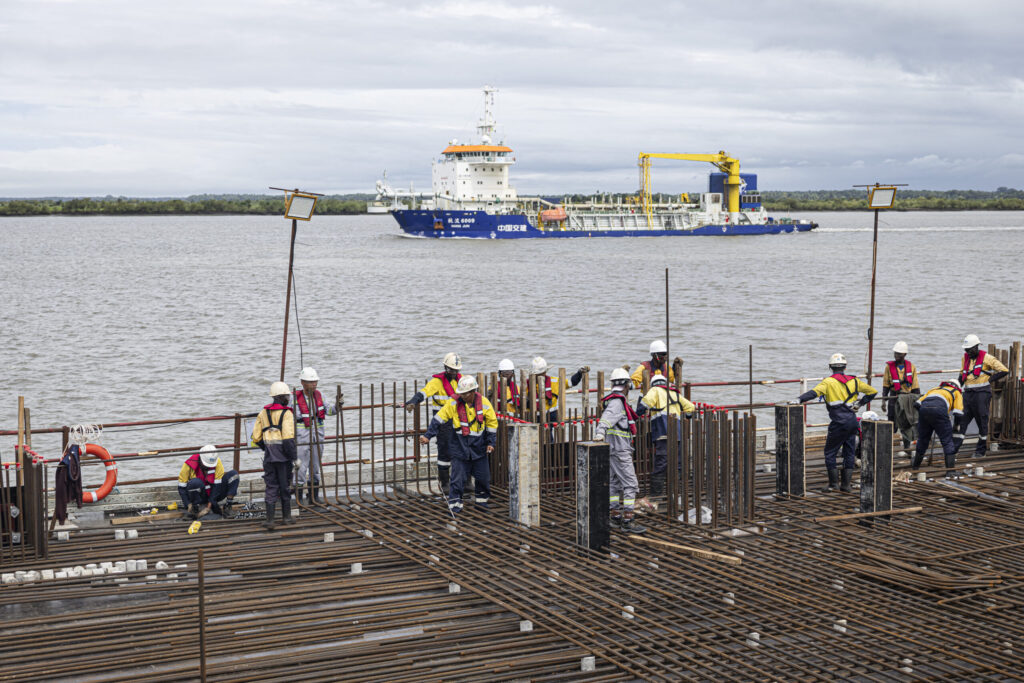
SimFer reported in August that mine construction had reached approximately 77 percent completion, while port infrastructure was about 85 percent complete. Full commissioning of the railway network had already been achieved during the first quarter of 2026, providing a crucial transportation link between the mining operations and Guinea’s export infrastructure.
The figures illustrate the extraordinary scale of the project. Simandou is not simply a mine. It involves an integrated system of mining, railways, ports and logistics infrastructure designed to move millions of tonnes of iron ore from Guinea’s remote southeast to international markets.
The 60 Million-Tonne Target Remains the Big Prize.
SimFer is ultimately targeting annual production capacity of around 60 million tonnes from its Simandou operations. The company has said full production is expected during the second half of 2028, meaning the next two years will be dominated by construction, commissioning and the gradual increase of production volumes.
The scale of that target helps explain why the leadership transition matters. Moving from several million tonnes of early production to tens of millions of tonnes annually requires a dramatic increase in mining, processing, rail and port capacity.
It will also require the project to maintain operational reliability while expanding. Any major interruption to rail infrastructure, mining operations or export facilities could have consequences for production volumes, revenues and the project’s contribution to Guinea’s economy.
Gomba’s immediate challenge will therefore be to maintain momentum while ensuring that the expansion does not compromise safety, operational standards or the quality of the infrastructure being commissioned.
Guinea Expects Simandou to Transform Its Economy.
The economic significance of Simandou extends well beyond iron ore exports. Guinea has some of the world’s largest untapped or underdeveloped mineral resources, but inadequate transport infrastructure has historically limited the country’s ability to turn those resources into sustained economic growth.
Simandou is changing that equation by creating a large-scale transport corridor connecting the country’s interior with the Atlantic coast. The project includes a roughly 600-kilometre TransGuinean railway and major port infrastructure on the country’s coast.
The government hopes the infrastructure will have effects beyond the mine itself. Improved rail and port connectivity could potentially support other economic activities, including agriculture, manufacturing and future mineral developments. Whether those broader benefits materialise will depend heavily on how the infrastructure is managed and whether Guinea can build complementary industries around it.
That makes local participation another important test for the new leadership.
Local Content Is Becoming a Major Measure of Success.
SimFer reported that it spent US$210.5 million with Guinean suppliers and businesses during the first half of 2026, highlighting the growing role of local companies in the project. The company has also reported significant employment and skills-development initiatives aimed at increasing Guinean participation.
The challenge now is to convert this spending into a durable local industrial ecosystem. Large mining projects can generate substantial economic activity without necessarily creating enough domestic businesses capable of supplying goods and services at international standards.
For Guinea, the long-term value of Simandou will therefore be measured not only in tonnes of iron ore exported but also in the number of Guinean companies that become competitive suppliers, the skills transferred to Guinean workers and the infrastructure that remains useful to the wider economy.
Gomba will inherit expectations on all of these fronts. Rio Tinto has repeatedly emphasised local content and stakeholder engagement, while the Guinean government has made national participation a central component of its mining policy.
Simandou Could Reshape Global Iron Ore Supply.
The project is also attracting international attention because of the quality and scale of its iron ore resources. Simandou is expected to become one of the world’s largest sources of high-grade iron ore, a product increasingly valued by steelmakers seeking to reduce emissions from steel production.
High-grade ore can require less energy and produce fewer emissions during certain steelmaking processes compared with lower-grade ores. This gives Simandou strategic importance at a time when the global steel industry is under pressure to decarbonise.
Rio Tinto has described Simandou as an important opportunity to meet growing demand for high-grade iron ore while contributing to the transition toward lower-carbon steelmaking.
The project is therefore positioned at the intersection of three major trends: Guinea’s economic ambitions, China’s and other markets’ demand for iron ore, and the global search for materials that can support lower-carbon industrial production.
The Infrastructure Challenge Is Not Over.
Despite the progress, Simandou remains one of the most technically complex mining projects in Africa. The mine is located deep inside Guinea, far from the coast, requiring an extensive railway system and sophisticated port infrastructure to move the ore to international customers.
The railway has already reached full commissioning, but the port remains under construction. SimFer reported in August that commissioning of its port infrastructure remained scheduled for the first quarter of 2027.
Until the entire logistics system reaches full capacity, SimFer will continue operating through a phased export model. That means the coming period will involve managing production growth alongside the completion of infrastructure capable of supporting the project’s ultimate scale.
This is where the difference between construction leadership and operational leadership becomes important. The next phase requires the organisation to build while simultaneously producing, transporting and selling iron ore.
Guinea Will Be Watching the New Leadership Closely.
For President Mamadi Doumbouya’s government, Simandou represents one of the most important opportunities to transform Guinea’s economic structure. The government has sought to increase national participation in mining while demanding greater economic benefits from international investors.
The new SimFer leadership will therefore operate under considerable public expectations. Guinea wants jobs, infrastructure, supplier opportunities, tax revenues and wider economic development, while Rio Tinto and its partners must deliver a commercially viable mining operation capable of competing in global markets.
Those objectives are not necessarily contradictory, but they require careful management. The success of Simandou will depend on whether the project can simultaneously achieve high production volumes, strong safety standards, meaningful local participation and sustainable relationships with communities and government.
A New Chapter Begins for Simandou.
Kox Gomba’s appointment marks a natural transition for a project that is itself changing character. Under Aitchison, SimFer moved through years of construction and reached the point where Guinea began exporting Simandou iron ore to international markets. Under Gomba, the focus will increasingly shift toward operational excellence, production growth and delivering the project’s long-term economic potential.
The stakes are enormous. Simandou could transform Guinea’s position in the global mining industry, generate major export revenues and create infrastructure that changes the country’s economic geography. But the scale of the opportunity also means that mistakes will be costly.
With the mine and port progressing, railway infrastructure operational and exports already underway, the project has crossed an important threshold. The question for the next two years is no longer whether Simandou can become an operating mine. It is whether Guinea and its partners can successfully turn one of Africa’s largest mineral developments into a sustainable engine of national economic transformation.

Comments (0)
No comments yet — be the first to share your thoughts.