

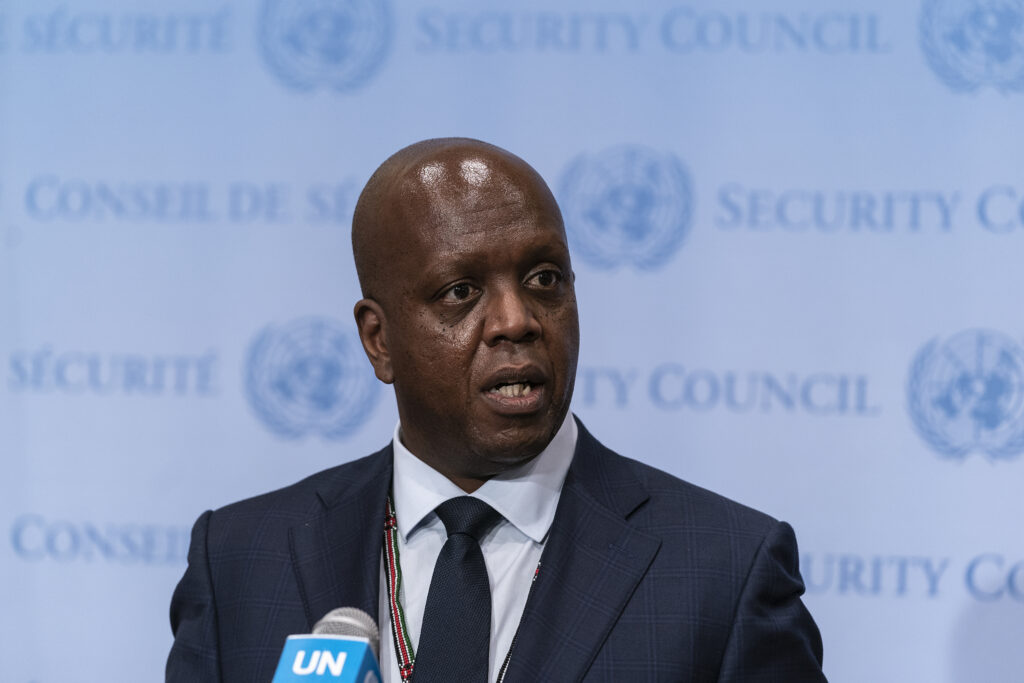
Kenya has secured another influential position at the United Nations after Secretary-General António Guterres appointed veteran Kenyan diplomat Martin Kimani as the organisation’s new Assistant Secretary-General for Africa. Kimani takes over from Ghanaian diplomat Martha Ama Akyaa Pobee, bringing more than two decades of experience in international relations, conflict prevention and multilateral diplomacy to one of the UN’s most important positions dealing with the continent.
The appointment, announced on September 14, places Kimani at the centre of the UN’s political and peacebuilding engagement across Africa. He will work within the Departments of Political and Peacebuilding Affairs and Peace Operations, where his responsibilities will include supporting conflict prevention, mediation, peace processes and political transitions across the continent.
For Kenya, the appointment represents another major diplomatic gain at a time when Nairobi is seeking a stronger voice in international affairs. For Ghana, it marks the end of Pobee’s tenure in a senior UN role that placed her at the heart of some of Africa’s most difficult political and security challenges.
Kimani Takes Over a High-Stakes African Portfolio.
The position inherited by Martin Kimani is far more than a ceremonial diplomatic appointment. The Assistant Secretary-General for Africa plays an important role in advising the UN Secretary-General on political developments across the continent while supporting efforts to prevent conflicts from escalating into full-scale crises.

The office also works closely with regional organisations, particularly the African Union and the Intergovernmental Authority on Development, on peacebuilding, mediation and political transitions. That makes Kimani’s experience particularly relevant at a time when Africa is dealing with conflicts, military takeovers, fragile political settlements and growing competition among external powers.
His appointment comes as the UN continues to face pressure to adapt its approach to African crises. Across the continent, governments and regional organisations have increasingly demanded greater African ownership of peace and security initiatives, making the relationship between the UN and institutions such as the AU increasingly important.
A Diplomat Who Knows the UN System.
Kimani is returning to a system he knows exceptionally well. He served as Kenya’s Permanent Representative to the United Nations in New York from 2020 to 2024, representing Kenya during its term as a non-permanent member of the UN Security Council.
During that period, he served as President of the Security Council in October 2021 and chaired important discussions dealing with conflict prevention and resolution in Africa. He also co-chaired the council’s informal expert group on climate and security.
His diplomatic profile became particularly prominent during Kenya’s tenure on the Security Council. Kimani was widely recognised for his interventions on international peace and security, including a notable 2022 speech on Russia’s invasion of Ukraine in which he connected the conflict to Africa’s own history of colonial borders and foreign domination.
That combination of diplomatic experience and knowledge of African political affairs could prove valuable in his new position.
From Counterterrorism to Peacebuilding.
Before becoming Kenya’s UN ambassador, Kimani held several positions directly connected to security and conflict prevention. He served as Director of Kenya’s National Counter Terrorism Centre and as the President’s Special Envoy for Countering Violent Extremism between 2015 and 2020.
He also served as Director of the Intergovernmental Authority on Development’s Conflict Early Warning and Response Mechanism from 2011 to 2012. That role exposed him to some of the Horn of Africa’s most difficult political and security challenges and gave him experience in identifying potential conflicts before they escalate.
His career has also included senior positions outside government. He has led The Africa Center in New York and served as Executive Director of New York University’s Centre on International Cooperation. His academic background includes a master’s degree and PhD in War Studies from King’s College London.
Pobee Leaves Behind a Significant Record.
While Kimani begins his new assignment, Martha Ama Akyaa Pobee leaves the position after several years at the centre of UN diplomacy on African affairs.
The Ghanaian diplomat was appointed Assistant Secretary-General for Africa in 2021 after a distinguished diplomatic career that included serving as Ghana’s Permanent Representative to the United Nations. During her time at the UN, she addressed the Security Council on conflicts and political developments across Africa and regularly engaged with questions surrounding peace, security, development and governance.
Guterres specifically thanked Pobee for her dedicated service when announcing Kimani’s appointment. Her departure therefore represents a change in leadership rather than simply a routine personnel move, as the UN prepares for a new phase of engagement with African governments and regional organisations.
Kenya’s Diplomatic Influence Continues to Grow.
Kimani’s appointment adds to Kenya’s growing presence in senior international positions. The country has increasingly positioned itself as an important diplomatic and security actor in Africa, particularly through its engagement with the UN, regional organisations and peace processes.
His appointment follows the selection of Kenyan diplomat Monica Juma as Executive Director of the UN Office on Drugs and Crime earlier this year, further strengthening Kenya’s representation within the UN system.
That growing presence gives Nairobi additional diplomatic visibility, but it also creates expectations. Kenya will increasingly be judged not only by the number of senior positions its diplomats occupy but by the influence those officials can exercise on major African issues.
Africa’s Conflicts Will Test Kimani.
The new assignment comes at a particularly challenging time for African diplomacy. Conflicts and political instability continue to affect several regions, while peace processes often struggle to gain traction because of disagreements between governments, armed groups, regional organisations and external powers.
Kimani will therefore inherit a demanding portfolio. His experience in conflict prevention, counterterrorism and multilateral diplomacy gives him a strong foundation, but the scale and complexity of Africa’s current political crises will require careful coordination between the UN, African Union and regional organisations.
The biggest test will be whether the UN can support African-led solutions while responding effectively when national and regional institutions struggle to contain conflicts.
A Change of Leadership at a Critical Moment.
The transition from Martha Pobee to Martin Kimani represents more than a change from one African diplomat to another. It comes at a time when the UN is being challenged to rethink how it approaches African conflicts, political transitions and peacebuilding.
Pobee leaves with a record shaped by years of engagement with Africa’s complex political and security environment. Kimani now inherits that responsibility with a background spanning government, the UN, regional organisations and international policy institutions.
His appointment gives Kenya another powerful voice inside the UN while placing a seasoned African diplomat at the centre of the organisation’s efforts to address the continent’s political and security challenges.
For Martin Kimani, the task is now to turn that experience into influence. For the United Nations, the expectation will be that Africa’s new Assistant Secretary-General can help bridge the gap between international diplomacy and African-led solutions at a moment when the continent needs both more urgently than ever.

Comments (0)
No comments yet — be the first to share your thoughts.