

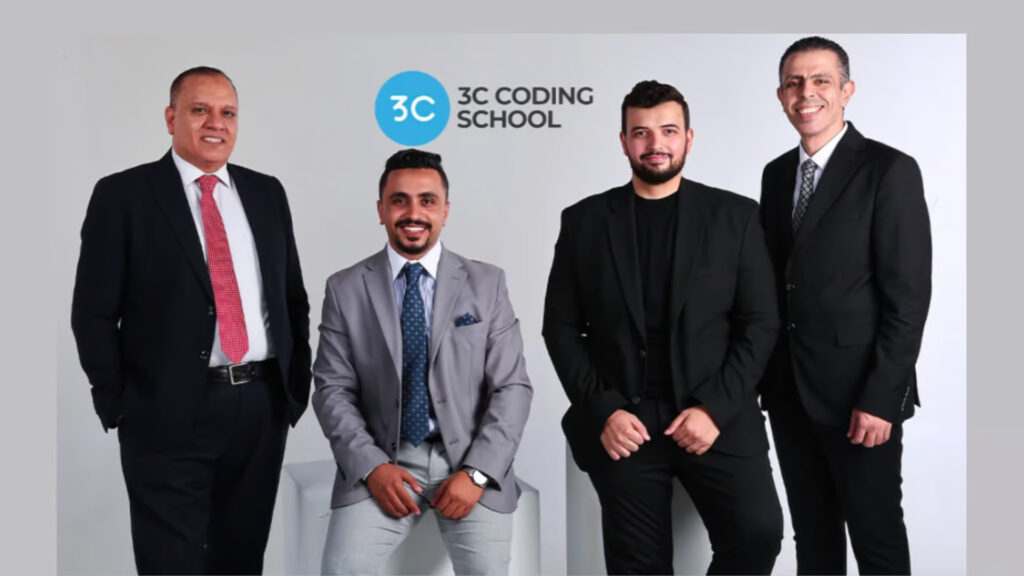
Egyptian EdTech startup 3C Coding School has raised US$3 million in a seed funding round as it prepares to expand into Saudi Arabia and accelerate the development of an artificial intelligence powered learning platform. The funding round, announced on September 2, 2026, was led by MRG Economic Group, headed by Egyptian businessman Mahmoud Ramadan, with participation from investor Amr Saad and a group of strategic angel investors. The deal represents one of the latest signs of growing investor interest in technology education and AI across Africa and the wider Middle East.
Founded in 2015 by engineers Hossam Hosny and Ahmed Khallaf, 3C Coding School has spent more than a decade building a technology education business focused primarily on children and young people. Its programmes cover software development, data science, artificial intelligence, machine learning, web and mobile development, game development and cybersecurity. The company says its platform has now reached more than 120,000 students, while revenue has increased by 230 percent, giving the startup a substantially larger base from which to pursue regional expansion.
Saudi Arabia Becomes 3C’s Next Major Market.
The largest immediate priority for the new capital is Saudi Arabia. 3C plans to establish a presence in the Saudi market, develop locally relevant educational programmes, build strategic partnerships and expand its student base in the Kingdom. The decision places 3C at the intersection of two rapidly developing markets: the growing demand for digital skills and Saudi Arabia’s broader effort to build a diversified, technology-driven economy.
For an Egyptian EdTech company, Saudi Arabia offers both scale and purchasing power. The Kingdom has invested heavily in digital transformation and education technology as part of its wider economic diversification programme. Demand for coding, artificial intelligence and other technology skills is also increasing as businesses and government institutions prepare for an economy in which digital capabilities are becoming increasingly important.

3C’s expansion therefore represents more than a geographic move. It is an attempt to take an Egyptian-developed education model into a market where technology education is becoming strategically important to national economic development.
AI Is Becoming Central to the Company’s Strategy.
A significant portion of the new investment will go toward developing an AI-powered personalised learning platform. The system is designed to analyse students’ learning patterns and progress and use that information to adapt course content to the pace and abilities of individual learners. It will also provide tools to support instructors as they monitor student performance and manage different learning needs.
The move reflects a broader transformation taking place across education technology. Traditional online learning platforms generally deliver the same material to large numbers of students, leaving teachers or parents to determine whether a particular learner is struggling or progressing faster than expected. AI can potentially make that process more dynamic by identifying patterns in student behaviour and adjusting the learning experience accordingly.
For 3C, artificial intelligence is consequently becoming more than another course subject. The company wants to make AI part of the underlying technology that powers its educational platform.
From Coding School to Regional Technology Platform.
The evolution of 3C Coding School is particularly significant because the company is attempting to move beyond the traditional model of a coding academy. Its original proposition centred on teaching young people programming and technology skills. Its new strategy is focused on building a scalable technology platform that combines educational content, AI and personalised learning.
That transition could allow the company to serve substantially larger numbers of students without relying entirely on classroom-based instruction. If the AI platform can successfully personalise courses while supporting teachers, 3C could potentially expand into multiple markets without having to replicate its entire physical infrastructure in each country.
The company’s founders have described the next phase as an opportunity to rethink how young people learn technology rather than simply expanding the existing business geographically. Hossam Hosny has said the objective is to make technology education more accessible while helping young people move from being consumers of technology to becoming creators and innovators.
More Than 120,000 Students Give the Startup Momentum.
3C enters its expansion phase with a relatively strong operating base for an African EdTech company. The startup reports that more than 120,000 students have used its educational programmes, while revenue has grown by 230 percent. These figures suggest that the company has already demonstrated significant demand for its products in its existing market.
The challenge now is converting that domestic success into a sustainable regional model. Education markets are heavily influenced by language, curriculum, household income, parental expectations and national education systems. A product that works well in Egypt cannot necessarily be transferred unchanged into Saudi Arabia or other markets.
3C will therefore need to localise its content while maintaining the technology infrastructure that allows the platform to operate efficiently at scale.
Egypt’s EdTech Sector Is Attracting Larger Investments.
The $3 million funding round also highlights the growing visibility of Egypt’s startup ecosystem. Egypt has one of Africa’s largest technology markets and has produced companies across fintech, logistics, healthtech, e-commerce and education technology.
The 3C transaction comes at a time when investors are increasingly looking for startups capable of serving customers beyond their domestic markets. Regional expansion has become particularly important for African startups because many companies face relatively fragmented national markets and limited access to late-stage capital.
For Egyptian founders, Saudi Arabia and the wider Gulf therefore represent important destinations for expansion. The geographical proximity, large consumer market and growing technology investment environment make the Kingdom a natural target for companies seeking to build regional businesses.
Technology Education Is Becoming an Economic Priority.
The growth of 3C also reflects a much larger shift in the skills required by young Africans and Arabs entering the workforce. Artificial intelligence, software development, cybersecurity and data science are increasingly influencing industries ranging from banking and healthcare to manufacturing, entertainment and government.
Governments and companies are therefore placing greater emphasis on developing technology skills at an earlier age. Coding education for children is no longer viewed solely as an extracurricular activity. Increasingly, it is being positioned as a foundation for future participation in the digital economy.
3C’s emphasis on young learners places it directly within that transformation. Its educational programmes are designed not only to teach programming languages but also to develop problem-solving, logical thinking, creativity and practical technology skills.
AI Personalisation Could Become the Company’s Competitive Advantage.
The development of an AI-powered learning platform could ultimately determine whether 3C can differentiate itself in an increasingly crowded EdTech market. Many companies can provide coding lessons, recorded classes and online exercises. Fewer can build systems capable of understanding how individual students learn and adapting content accordingly.
The potential advantage is scale. An AI-driven platform could allow one educational system to serve thousands or even millions of learners while providing each student with a more individualised experience. Teachers could also use the technology to identify students who need additional support and monitor progress more efficiently.
However, the technology also introduces new challenges. AI-powered education systems need reliable data, strong privacy protections and effective human oversight. An algorithm that incorrectly assesses a student’s ability could send that learner down an inappropriate educational path. 3C will therefore need to ensure that its AI system complements teachers rather than attempting to replace them.
Saudi Expansion Will Test the Business Model.
The Saudi market will provide 3C with its first major test of whether its business can operate successfully beyond Egypt. The company plans to use partnerships and localised programmes to establish its presence rather than simply exporting its Egyptian operation unchanged.
Success in Saudi Arabia could open the door to additional markets across the Gulf and wider Arab world. It could also strengthen 3C’s position as an Egyptian technology company capable of exporting intellectual property and education services.
Failure to adapt, however, could make expansion expensive. Regional EdTech is becoming increasingly competitive, and parents have a growing number of options for technology education. 3C will therefore have to demonstrate not only that its courses work but that its combination of coding education and AI personalisation provides measurable value to students and families.
A New Generation of African Tech Education Companies Is Emerging.
The significance of the 3C funding round ultimately goes beyond the $3 million investment. It illustrates how African technology companies are increasingly developing products around the continent’s future workforce rather than simply solving today’s consumer problems.
Coding, artificial intelligence, cybersecurity and data science are becoming foundational skills. Companies that can make those subjects accessible to children and young people could play an important role in determining whether the next generation participates actively in the digital economy.
For 3C Coding School, the immediate goal is clear: establish a successful Saudi operation, strengthen its technology infrastructure and build an AI-powered platform capable of personalising education at scale.
If the strategy succeeds, the Egyptian startup could evolve from a coding school into a regional EdTech technology company serving millions of young learners across Africa and the Middle East. The $3 million seed investment is therefore not simply financing expansion. It is funding an attempt to redefine how technology education is delivered to the next generation.

Comments (0)
No comments yet — be the first to share your thoughts.