

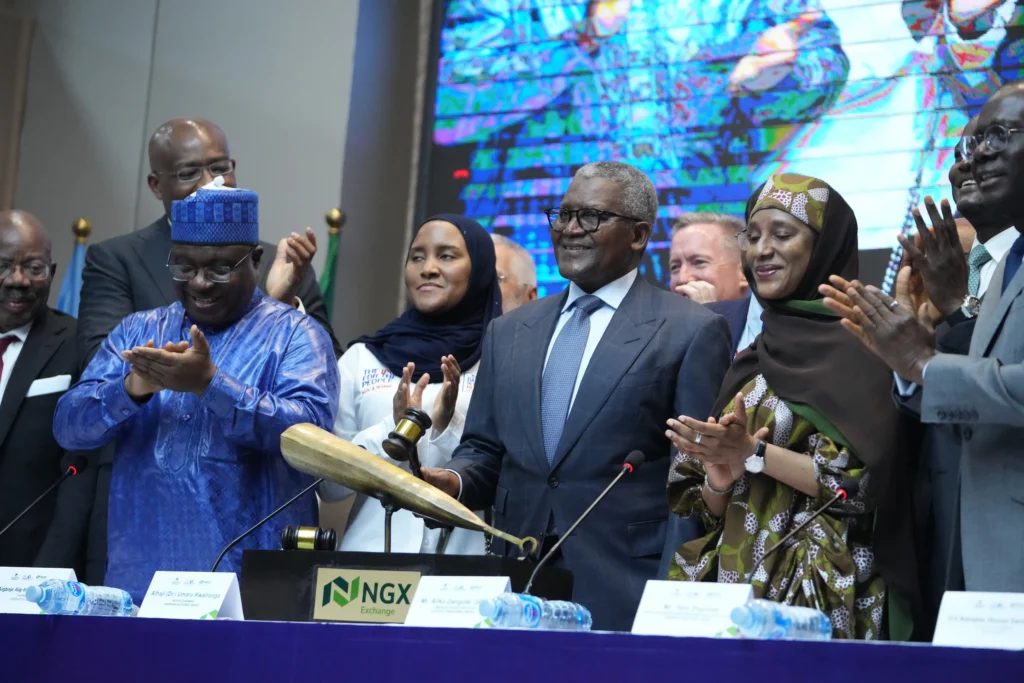
Africa’s largest oil refinery has entered a new phase of its story, and this time ordinary Nigerians are being invited to become shareholders. The Dangote Petroleum Refinery and Petrochemicals opened its initial public offering on September 14, launching what is being described as Africa’s largest-ever IPO and putting 4.1 billion shares on offer at ₦525 each. If fully subscribed, the offer could raise about ₦2.15 trillion, or roughly $1.6 billion.
For billionaire industrialist Aliko Dangote, the public offering represents much more than another fundraising exercise. It is the latest stage in a project that took roughly a decade to build and around $20 billion to establish, transforming Nigeria from a major importer of refined petroleum products into an increasingly important exporter of refined fuel.
The IPO also represents a significant moment for Nigeria’s capital market. By opening ownership of one of the country’s most strategically important industrial assets to retail investors, the refinery is attempting to bring millions of Nigerians closer to the formal investment economy.
The “People’s IPO” Opens.
The offer has been marketed as a way for ordinary Nigerians to participate in the ownership of the refinery. Dangote has repeatedly described the exercise as an opportunity to broaden ownership, saying that workers and ordinary citizens should have a chance to hold stakes in the industrial asset.

The scale of the offering is unprecedented for Africa. The refinery is seeking to sell 4.1 billion ordinary shares, with the public offer running from September 14 to October 13, according to Reuters. The shares are priced at ₦525 each, while the minimum subscription is low enough to allow relatively small investors to participate.
That accessibility is deliberate. Rather than relying exclusively on large institutional investors, Dangote is seeking to draw retail investors into what could become one of Nigeria’s most closely watched public offerings.
A Refinery That Has Already Changed Nigeria’s Oil Industry.
The IPO comes as the Dangote refinery reaches an important point in its development. The facility, located in Lagos, has a current processing capacity of around 700,000 barrels per day and is operating at full capacity, according to Reuters. Its emergence has helped Nigeria reduce its dependence on imported refined petroleum products while creating the possibility of becoming a major regional fuel supplier.
The transformation is particularly important for a country that produces large quantities of crude oil but historically depended heavily on imported petrol and other refined products. The refinery changes that equation by keeping more of the value chain inside Nigeria.
The impact also extends beyond Nigeria. The facility is already supplying petroleum products to international markets, while its growing output gives West and Central African countries another potential source of refined fuel.
Dangote Plans an Even Bigger Refinery.
The IPO is not simply about the refinery as it exists today. The capital raising is closely connected to an ambitious expansion programme that could make the facility one of the world’s largest.
Dangote plans to increase processing capacity from approximately 700,000 barrels per day to 1.4 million barrels per day. Reuters reported that the company has outlined a $14.3 billion expansion programme, with completion targeted around 2029.
That expansion would effectively double the refinery’s capacity and strengthen its position as a major supplier of refined petroleum products.
The company is also looking beyond Nigeria. Dangote has indicated plans to expand its energy interests elsewhere in Africa, including a proposed refinery project in Kenya. The broader strategy is to build an integrated African industrial business capable of producing and distributing energy products across multiple markets.
Global Fuel Disruptions Have Changed the Timing.
The IPO arrives at an unusual moment for the global energy market. Conflicts and disruptions affecting refining capacity in the Middle East and other regions have tightened supplies of refined petroleum products, increasing the strategic importance of refineries capable of producing large volumes.
The Dangote refinery has benefited from that environment. Reuters reported that the company recorded a $1.82 billion profit in the first half of 2026, compared with a loss of $476 million in the same period a year earlier.
That financial turnaround strengthens the investment story behind the IPO, although potential investors still have to consider the risks associated with oil prices, currency movements, regulation and the enormous capital requirements of the planned expansion.
Can Retail Investors Really Change Nigeria’s Capital Market?
One of the most interesting aspects of the Dangote IPO is the attempt to bring ordinary Nigerians into an investment opportunity normally dominated by institutional investors and wealthy individuals.
The offer’s relatively low entry point could introduce new investors to the Nigerian Exchange and potentially deepen the country’s equity market. It also gives Nigerians an opportunity to participate financially in an industrial project that has already become central to the country’s energy strategy.
But the excitement surrounding the IPO also needs to be balanced with caution. Nigeria’s Securities and Exchange Commission has warned investors to use only officially approved channels and to verify the identity and regulatory status of platforms handling subscriptions. The SEC has specifically warned against unsolicited messages, social media offers and unauthorised payment channels.
The warning is important because the popularity of the offering creates opportunities for fraudsters to exploit public interest.
The Valuation Is Already Creating Debate.
The refinery is being valued at roughly $47 billion in connection with the offering, making it one of the most valuable industrial assets on the continent. That valuation has generated excitement but also questions among analysts and investors about how the market will ultimately judge the business.
The central issue is whether the refinery can maintain strong profitability while financing its enormous expansion plans and operating in an energy market exposed to volatile crude prices, geopolitical shocks and changing global demand.
The answer will become clearer as the refinery builds a longer track record as a publicly owned business.
Dangote’s Bigger Bet Is on African Industrialisation.
The significance of the IPO goes beyond the Dangote Group. At its core, the public offering represents a bet on whether Africa can increasingly finance its own large industrial projects through domestic capital markets.
For years, many African economies have depended heavily on foreign investment, development finance and international lenders to fund major infrastructure. The Dangote IPO presents a different model: build a major industrial asset, establish it as a profitable business and then invite domestic investors to participate in its future.
If successful, that model could encourage other African companies to consider similar approaches.
It could also deepen the relationship between African citizens and the continent’s largest businesses, transforming large companies from institutions controlled by a handful of shareholders into assets with broader public participation.
A New Chapter for Dangote and Nigeria.
For Aliko Dangote, the refinery IPO represents the latest chapter in a business journey that began decades ago with trading and gradually expanded into cement, sugar, manufacturing and energy. His refinery project has become the most ambitious expression yet of his vision for African industrialisation.
For Nigeria, the stakes are even wider. A successful refinery could reduce fuel import dependence, support exports, strengthen the country’s energy security and create a new source of industrial investment.
And for the Nigerian public, the IPO offers something that was previously unavailable: a chance to own a small part of one of Africa’s biggest industrial projects.
Whether the offering ultimately becomes a landmark in African capital markets will depend not only on how much money it raises, but on what the company does with that capital.
For now, however, one thing is clear. Africa’s biggest IPO has opened, and the Dangote refinery is no longer simply a symbol of Nigerian industrial ambition. It is becoming a publicly owned investment story that could reshape how Africa finances its next generation of major businesses.

Comments (0)
No comments yet — be the first to share your thoughts.