

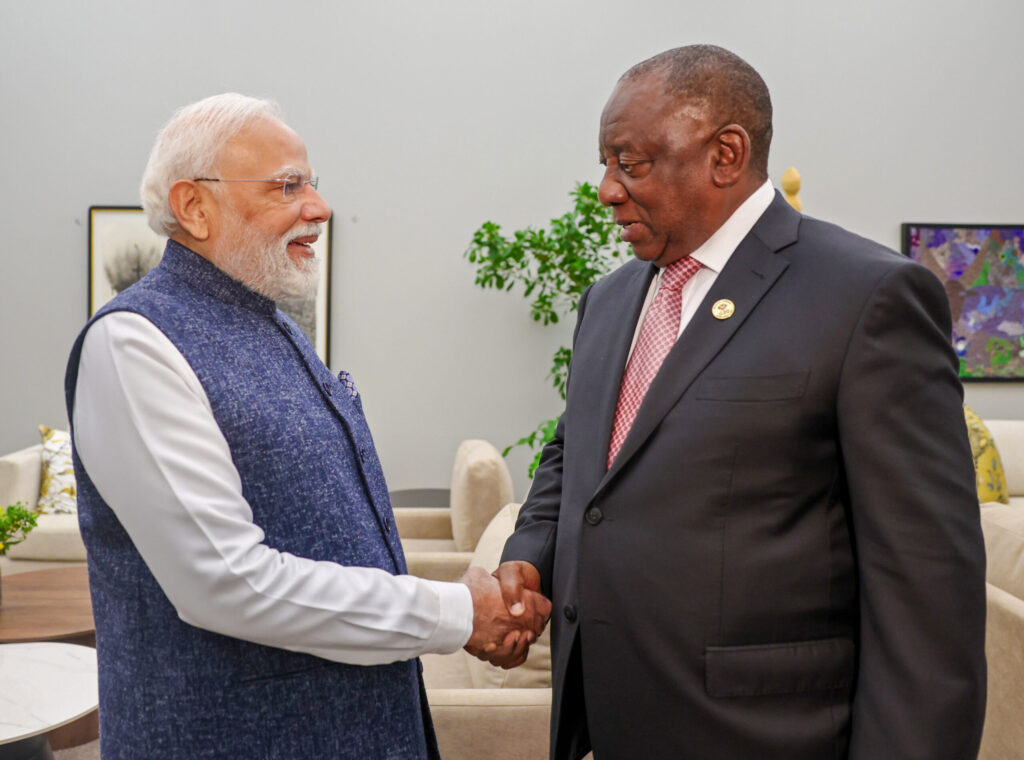
South Africa is looking increasingly toward BRICS to help solve one of its biggest economic problems: the shortage of investment needed to lift growth and create jobs. President Cyril Ramaphosa has returned from the BRICS summit in India with renewed emphasis on expanding trade and investment links with fellow members, particularly India, as his government tries to move the economy beyond its prolonged low-growth cycle.
The strategy comes at a difficult moment for South Africa. The economy contracted by 0.2% in the second quarter of 2026, while gross fixed capital formation stood at only 13.6% of GDP. Business leaders and economists are warning that although reforms in electricity, logistics and other sectors are beginning to produce improvements, investment remains far below what is needed to generate sustained economic expansion.
For Ramaphosa, BRICS therefore represents more than a diplomatic alliance. It is increasingly being presented as a source of new markets, new investors and new industrial partnerships that could help South Africa diversify its economic relationships at a time when global trade is becoming more fragmented.
India Becomes a Major Part of the Strategy.
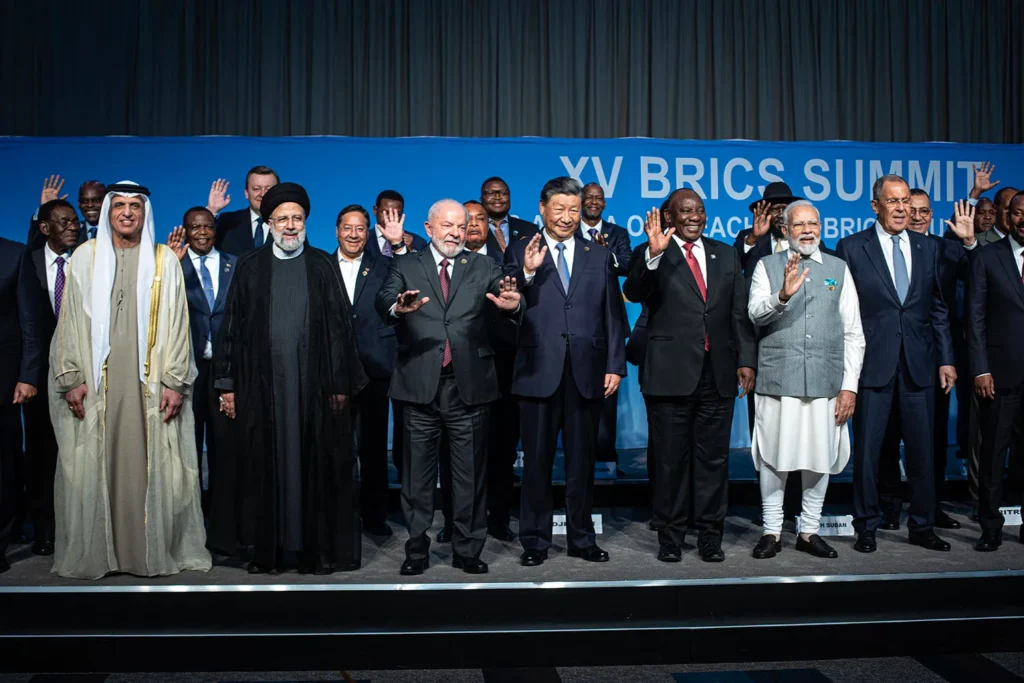
South Africa’s relationship with India is emerging as one of the clearest examples of what Ramaphosa wants BRICS to deliver. The president says more than 150 Indian companies have invested over $10 billion in South Africa and created more than 18,000 jobs. South African companies including Naspers, FirstRand, Sanlam and Momentum have also established significant interests in India.

The next opportunity is to move beyond the existing investment base. Ramaphosa has identified green industrialisation, critical minerals, beneficiation, infrastructure, agriculture and the digital economy as sectors where South Africa and India can deepen cooperation.
This approach is significant because South Africa has enormous mineral resources but has long faced criticism for exporting too many commodities without capturing enough value through domestic processing. Partnerships that bring investment, technology and manufacturing capacity into the country could help change that model.
BRICS Offers Markets, but South Africa Needs More Than Markets.
The broader BRICS bloc gives South Africa access to some of the world’s largest emerging economies. The expanded group now includes countries such as China, India, Brazil, Russia, Egypt, Ethiopia, Indonesia, Iran and the United Arab Emirates, creating a substantial network of potential markets and investment partners.
At the recent BRICS summit in New Delhi, members also pushed for stronger economic cooperation, including greater use of local currencies, improved cross-border payment systems and reforms to global financial institutions. Those initiatives could eventually make trade between emerging economies cheaper and less dependent on established Western financial channels.
For South Africa, this creates opportunities to expand exports and attract investment from countries with growing demand for energy, minerals, food, technology and manufactured goods. But access to a larger market does not automatically create a competitive economy.
Economists Warn Against Expecting BRICS to Do Everything.
That is where the optimism surrounding South Africa’s BRICS strategy meets a harder domestic reality. Economist Raymond Parsons of North-West University has argued that BRICS can help diversify South Africa’s sources of trade and investment, but cannot substitute for domestic capital mobilisation.
His warning goes to the heart of South Africa’s economic challenge. Foreign investors can provide capital, technology and market access, but they are unlikely to commit large amounts of money if domestic infrastructure, electricity, logistics, municipalities and regulatory systems remain unreliable.
In other words, South Africa cannot simply invite BRICS investors and expect investment to solve problems that are still discouraging businesses inside the country. The government must create the conditions that make investment attractive in the first place.
Infrastructure Remains the Critical Test.
South Africa’s infrastructure constraints remain particularly important. Problems affecting ports, railways, electricity and municipalities have increased the cost of doing business and weakened the country’s ability to compete for investment.
There are signs of improvement. Transnet, for example, recently returned to profit after years of losses, while private-sector participation at the Durban Gateway Terminal has generated significant revenue for the state-owned logistics company.
But these improvements must become part of a much wider transformation. The Development Bank of Southern Africa has also warned that a shortage of infrastructure projects sufficiently prepared to receive funding is limiting investment, illustrating that having ambitious infrastructure plans is not the same as having projects that investors can actually finance.
That gap between ambition and implementation could determine whether South Africa’s BRICS strategy succeeds.
The Country Wants Value Addition, Not Just More Raw Exports.
One of the most important arguments emerging from the BRICS discussion is the need for South Africa to move higher up global value chains.
Raymond Parsons has called for South Africa to use BRICS relationships to develop “value-add partnerships” involving processing and industrialisation rather than simply exporting raw materials.
That could be particularly important in critical minerals. South Africa has resources that are increasingly important to the global energy transition, but the real economic opportunity lies in developing industries around those resources.
Instead of exporting minerals and importing finished products, the country wants investment that creates processing facilities, manufacturing capacity, skilled employment and new export industries. This is where BRICS could become strategically valuable.
The $22 Billion Omnia Deal Shows What Is Possible.
A major example arrived almost immediately after the BRICS summit. Indian conglomerate Solar Industries has offered around R22 billion to acquire South African fertiliser and explosives group Omnia, a transaction that Omnia CEO Seelan Gobalsamy described as a vote of confidence in South Africa’s industrial capabilities.
The deal illustrates the type of investment relationship that Ramaphosa wants to encourage. Rather than focusing exclusively on financial flows, South Africa is looking for partnerships that connect foreign capital with domestic industrial capacity.
It also demonstrates why India is becoming particularly important to Pretoria’s economic strategy.
If more deals of this nature emerge across manufacturing, mining, energy, agriculture and technology, BRICS could become a meaningful contributor to South Africa’s investment drive.
But Western Markets Still Matter.
There is another important dimension to the strategy. South Africa cannot afford to treat BRICS as a replacement for its existing economic relationships with Europe, North America and other markets.
Parsons has described BRICS as a mechanism for diversification rather than a substitute for South Africa’s traditional economic partners.
That distinction matters. South Africa’s economy is deeply integrated into global trade and investment networks, and restricting itself to one geopolitical or economic bloc would create new vulnerabilities rather than eliminate existing ones.
The smarter strategy may therefore be to expand the country’s options rather than choose sides.
Can Ramaphosa Convert Diplomacy Into Growth?
That is ultimately the question facing Cyril Ramaphosa.
BRICS gives South Africa access to major economies, new investors and emerging markets. It provides opportunities in critical minerals, green energy, infrastructure, agriculture, manufacturing and technology. The recent expansion of the bloc makes that opportunity even larger. But investment follows confidence.
South Africa must therefore continue fixing electricity supply, modernising logistics, improving municipalities, strengthening infrastructure delivery and creating greater policy certainty. The government’s own target of moving toward 3% economic growth by 2030 will be difficult to achieve without a significant increase in investment.
BRICS can help provide the capital and markets. It cannot provide the domestic reforms. For Ramaphosa, the challenge now is to turn South Africa’s BRICS relationships into factories, mines that produce more processed goods, stronger infrastructure, technology partnerships and sustainable jobs.
If that happens, BRICS could become an important part of South Africa’s economic revival. If it does not, the country may discover that having access to more investors means little when the domestic conditions are still preventing those investors from committing at scale.

Comments (0)
No comments yet — be the first to share your thoughts.