

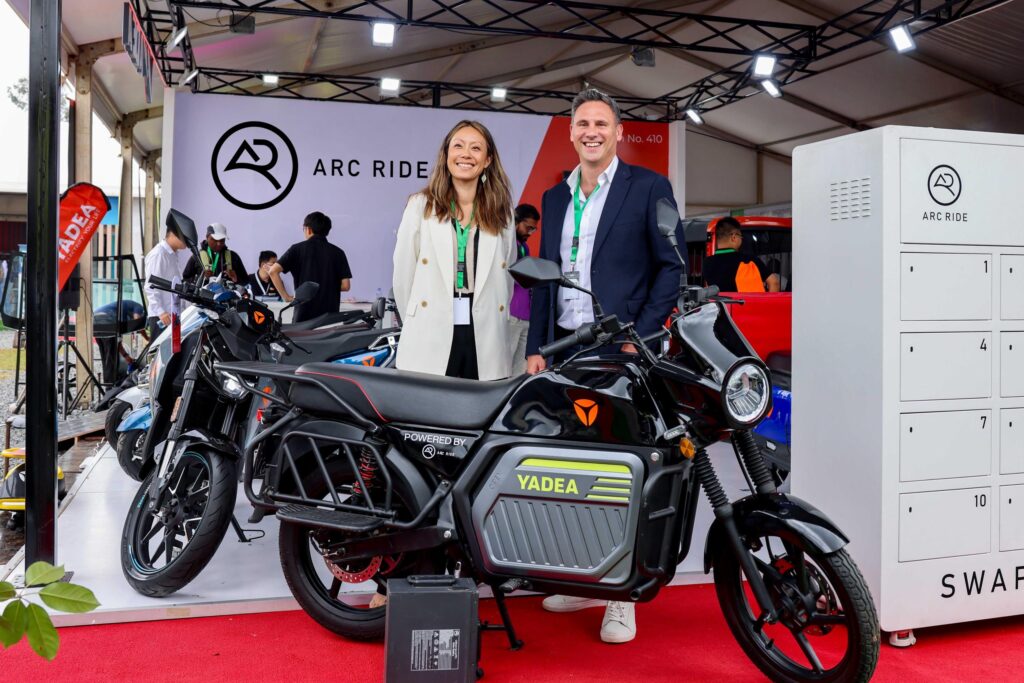
Kenyan electric mobility company ARC Ride has raised $33.3 million in a new financing round as it moves to expand battery swapping infrastructure and accelerate the adoption of electric motorcycles across African markets. The funding, announced on September 8, 2026, represents another significant investment in Africa’s emerging electric mobility sector.
The round was led by Novastar Ventures and Norrsken22, with participation from the International Finance Corporation (IFC), British International Investment (BII) and Proparco. Existing investors Musashi Seimitsu and Talanton also participated, while the financing included a debt facility from BII’s Kinetic programme and Mirova.
Battery swapping at the centre of the strategy.
ARC Ride, headquartered in Nairobi, operates a Battery-as-a-Service model designed to address one of the biggest barriers to electric motorcycle adoption: the cost and charging time associated with batteries.
Rather than requiring riders to purchase expensive batteries or wait for vehicles to charge, the company allows users to exchange depleted batteries for fully charged ones at dedicated swapping stations. The model is particularly suited to commercial motorcycle operators, for whom vehicle downtime can directly affect daily income.

The company’s strategy is built around making electric motorcycles more practical for Africa’s large two and three-wheeler transport sector. Motorcycles are widely used for passenger transport and deliveries across African cities, making the sector an important potential market for electrification.
New capital will expand the network.
ARC Ride plans to use the new financing to add thousands of electric motorcycles to its operations while increasing the number and reach of battery-swapping stations.
The company is expected to add around 5,000 motorcycles and strengthen its infrastructure in Kenya, including expansion beyond its established Nairobi operations. It also plans to invest in battery lifecycle management, station reliability, automated swapping technology and smart charging systems linked to renewable energy.
The expansion is also expected to take ARC Ride into additional African markets, including Ghana, South Africa, Tanzania and Uganda. Entering these markets would give the company a significantly larger geographic footprint and expose its battery-swapping model to different regulatory environments, energy systems and urban transport markets.
Investors see infrastructure as the bigger opportunity.
The composition of the financing is significant because it combines venture capital with funding from major development finance institutions.
IFC, BII and Proparco have increasingly supported projects aimed at expanding sustainable infrastructure and private-sector development in Africa. Their participation suggests that investors increasingly view electric mobility not simply as a vehicle business, but as an infrastructure opportunity involving energy, transportation, technology and climate investment.
For ARC Ride, building a reliable network of swapping stations could prove just as important as increasing the number of electric motorcycles on the road. A larger network can make electric transport more practical for riders while creating infrastructure that could eventually support wider adoption of electric two-wheelers.
Kenya remains the company’s testing ground.
Kenya has emerged as one of Africa’s most active markets for electric mobility, supported by the popularity of motorcycles and growing interest in reducing fuel costs and urban emissions.
ARC Ride has already attracted substantial financing for its Kenyan operations. Earlier investments supported the deployment of electric motorcycles and expansion of its battery-swapping infrastructure, while Mirova previously provided debt financing for additional swapping capacity.
The latest $33.3 million financing therefore marks a significant escalation rather than a completely new direction for the company.
Africa’s electric mobility market enters a new phase.
The ARC Ride deal comes as African cities face rising transportation costs, congestion and pressure to reduce emissions. Electric motorcycles offer a potential solution, particularly for commercial riders who depend heavily on fuel-powered vehicles.
However, the transition requires more than simply importing electric motorcycles. Reliable charging or battery-swapping infrastructure, affordable financing, suitable regulations and dependable electricity supplies will determine whether electric mobility can move beyond early adopters and reach mass-market users.
ARC Ride’s approach attempts to address several of those challenges simultaneously by combining electric motorcycles with the infrastructure required to keep them operating throughout the day.
The company’s expansion across several African markets will now provide an important test of whether battery swapping can become a scalable model for the continent’s rapidly growing urban transport sector.
With $33.3 million in fresh capital and backing from major international investors, ARC Ride is positioning itself not merely as an electric motorcycle company, but as a potential infrastructure player in Africa’s transition toward cleaner urban transportation.

Comments (0)
No comments yet — be the first to share your thoughts.