

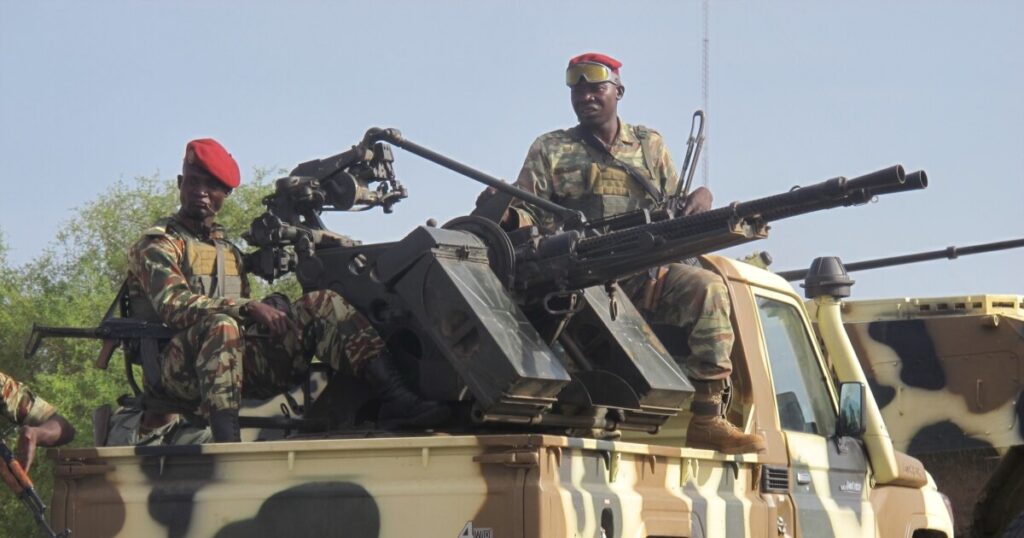
Cameroon is sending its 13th contingent of peacekeepers to the Central African Republic, continuing a military commitment that has now lasted for more than a decade under the United Nations peacekeeping mission known as MINUSCA. The latest deployment comes at an important moment for the mission, as the United Nations is simultaneously trying to consolidate security gains in the Central African Republic and gradually transfer some responsibilities back to national authorities.
The new contingent received its flag and operational standard from Cameroon’s Minister Delegate at the Presidency in charge of Defence, Joseph Beti Assomo, during a ceremony at the Peacekeeping Operations Training School in Motcheboum, in the East Region, on September 14. Lieutenant-Colonel Ewang Mesape Young has been designated to command the contingent.
This is a continuation, not a sudden military expansion.
The phrase “sending more troops” can be misleading. Cameroon is continuing its established rotation of peacekeepers rather than announcing a new unilateral military intervention in the Central African Republic.
The previous, 12th Cameroonian contingent was deployed in September 2025 and consisted of 750 military personnel, including 82 women. By February 2026, those peacekeepers had received UN medals for their contribution to security and civilian protection in Ouham prefecture.

The 13th contingent therefore represents another rotation of Cameroonian forces serving under the United Nations framework.
That distinction matters because the mission is not a Cameroon-only operation. The soldiers operate under the MINUSCA mandate established by the UN Security Council.
So why does Cameroon keep returning to CAR?
Cameroon shares a border with the Central African Republic, making instability in CAR a direct regional security concern. The two countries are also connected through trade, population movements and cross-border communities.
MINUSCA was established in 2014 to support the stabilisation of the Central African Republic after years of political and armed conflict. Its mandate includes protecting civilians, supporting the peace process, helping extend state authority and facilitating humanitarian assistance.
For Cameroon, contributing troops allows its armed forces to participate in a wider regional peacekeeping operation while also supporting security in a neighbouring country.
The latest contingent is therefore part of a much longer Cameroonian presence rather than an entirely new policy.
What will the new contingent actually do?
The mission’s responsibilities go considerably beyond fighting armed groups.
MINUSCA’s current mandate places the protection of civilians at the centre of its operations. Peacekeepers are expected to maintain patrols in high-risk areas, respond to credible threats against civilians and work with local communities to improve early warning and prevent violence.
The mission also supports the Central African authorities in extending state authority across the country’s territory, including assistance related to the deployment of national security forces.
Other responsibilities include supporting the peace process, facilitating humanitarian assistance, protecting UN personnel and supporting justice and the rule of law.
The Cameroonian soldiers are therefore entering a mission that combines security, civilian protection and support for broader stabilisation efforts.
The environment will not be easy.
At the handover ceremony in Motcheboum, Minister Beti Assomo warned the new contingent that its year-long mission would take place in a difficult environment.
According to Cameroon Tribune, he instructed the troops to remain disciplined, respect the rules of engagement and international humanitarian law, and avoid behaviour that could damage the mission’s credibility. He also warned them to remain vigilant and resistant to provocation.
The emphasis on discipline is significant because peacekeeping operations depend heavily on the conduct of individual soldiers.
The soldiers are not only representing the United Nations while deployed in CAR. They are also representing Cameroon.
CAR is entering a different phase.
The deployment comes as MINUSCA itself is changing.
The United Nations says the mission has entered a phase focused increasingly on consolidating gains rather than maintaining the same stabilisation structure indefinitely. In June, MINUSCA transferred seven operational bases to the Central African government as part of a planned reconfiguration of the mission.
The UN has stressed that those transfers do not mean an immediate withdrawal.
Instead, some responsibilities are gradually being handed back to Central African institutions in areas where the security situation allows it, while MINUSCA continues to maintain peacekeepers and conduct mobile patrols in other locations.
That makes the arrival of a new Cameroonian contingent particularly interesting.
Cameroon is reinforcing its contribution at a time when the overall UN mission is simultaneously reorganising how it operates.
Security remains a concern.
Although the Central African Republic has recorded progress in some areas, the UN continues to describe the security and peacebuilding gains as fragile in certain regions.
MINUSCA’s current mandate specifically requires the mission to protect civilians under threat and maintain a mobile presence in areas where risks remain significant. The mission is also supporting the extension of state authority and the implementation of the country’s peace agreement.
The changing security environment means that the new Cameroonian contingent will have to adapt to different areas and circumstances rather than simply repeat the work of the previous rotation.
Cameroon’s role goes beyond the battlefield.
Cameroon’s contribution to MINUSCA is also part of its wider role in regional peacekeeping.
The country has repeatedly supplied military personnel to the UN mission since its creation, making Cameroon one of the countries with a sustained operational presence in CAR.
The previous contingent’s work included security operations and civilian-protection missions in Ouham, including heightened security for major public events.
The 13th contingent now inherits that responsibility while operating under the UN’s evolving mandate.
Why the deployment matters now.
The timing gives the deployment a significance beyond another routine troop rotation.
The Central African Republic is moving through a period in which the UN is trying to preserve security gains while gradually strengthening the capacity of national institutions to assume greater responsibility. At the same time, MINUSCA’s mandate remains centred on civilian protection and support for the country’s peace process.
For Cameroon, the task is therefore twofold: maintain its contribution to the UN mission while ensuring that its soldiers operate effectively in a changing security environment.
The 13th contingent has now been formally entrusted with that mission.
For the soldiers heading to CAR, the next year will be less about simply maintaining a Cameroonian presence and more about carrying out a UN mandate in a country where the international peacekeeping operation itself is entering a new phase.

Comments (0)
No comments yet — be the first to share your thoughts.