

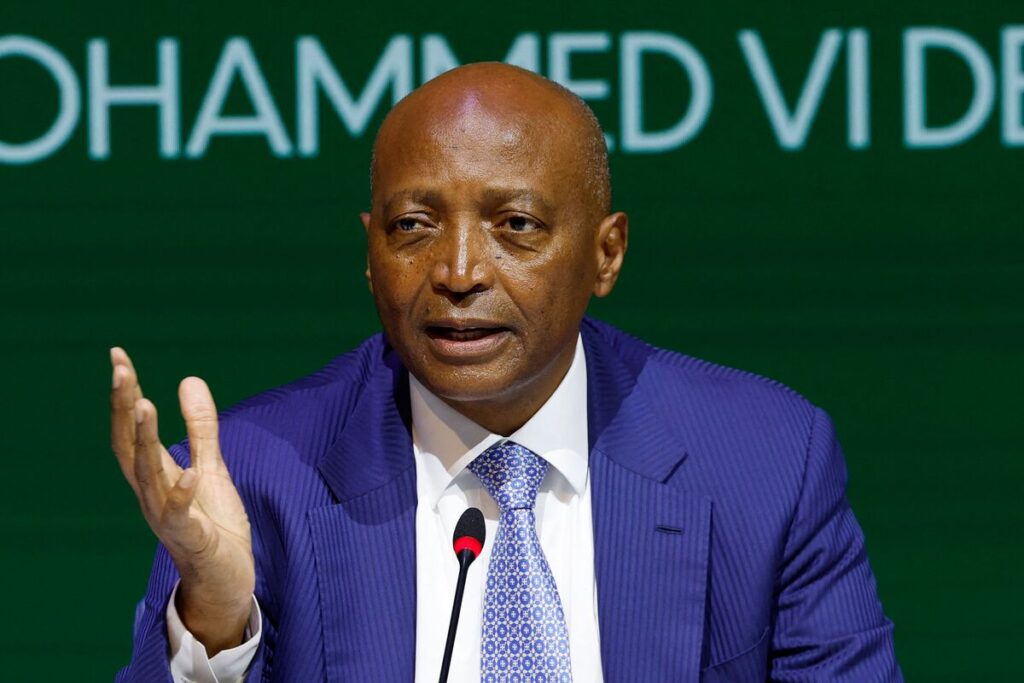
When Patrice Motsepe arrives in Tanzania, the focus will be less about football on the pitch and more about what happens away from it.
The CAF president is in Dar es Salaam on Thursday, September 17, as part of a two-day inspection mission covering Tanzania and Kenya. His visit comes as preparations accelerate for the 2027 Africa Cup of Nations, which Tanzania, Kenya and Uganda will jointly host.
For Tanzania, the timing is significant. The country is no longer simply preparing to host AFCON in theory. It is now entering the stage where CAF needs to see whether stadiums, training grounds, transport systems and other supporting facilities can actually operate at the level required for a continental tournament.
The stadium is only the beginning.
One of Motsepe’s first stops will be the Benjamin Mkapa Stadium in Dar es Salaam, where he will meet Tanzanian government officials to review the country’s preparations.

CAF says the visit is intended to assess progress and discuss the key areas that still require attention before the tournament. A press conference is also scheduled at the stadium on Thursday.
But the inspection goes beyond the condition of one stadium.
CAF’s broader assessment programme covers infrastructure, training facilities, accommodation, airports, transportation, safety and security, media operations and other services required to stage AFCON.
That means Tanzania is effectively being tested on whether it can make the entire tournament ecosystem work together, rather than simply present a stadium that looks ready on television.
Tanzania has made progress, but the pressure is rising.
A CAF inspection earlier this month examined key facilities in Tanzania, alongside infrastructure in Kenya and Uganda.
The inspection covered stadiums, training sites, hotels, airports and supporting facilities. In Tanzania, the Benjamin Mkapa Stadium was among the venues assessed.
Local reporting has also highlighted the increasing attention being placed on training grounds.
Several facilities in Dar es Salaam have been identified for participating teams, including Dar es Salaam Gymkhana-2, Major General Isamuhyo, the Law School of Tanzania, Leaders Club and Farasi. Some had already been completed, while others were still undergoing work.
This matters because a successful AFCON cannot depend entirely on the main match venues. Teams need suitable training centres, hotels and transportation arrangements throughout the tournament.
The real test is what happens outside the stadium.
The most complicated part of hosting a major football tournament can sometimes be the infrastructure that spectators barely notice.
CAF has already identified transportation, accommodation, airports, safety and security, media operations and fan movement as important areas in the preparations for the three-nation tournament.
For Tanzania, that means roads and transport networks will have to cope with increased movement between hotels, training grounds and stadiums. Airports will also form part of the wider tournament logistics.
The government has been upgrading roads around some of the venues, while work continues on facilities intended to support the tournament.
The challenge is therefore moving from construction to coordination: making sure the infrastructure works together when thousands of supporters, players, officials and journalists arrive.
Motsepe is also checking the timetable.
CAF has already established a joint oversight structure with Kenya, Tanzania and Uganda to monitor preparations for the tournament.
The three host countries committed to an accelerated preparation roadmap covering stadium development, operational planning, cross-border mobility, security, medical preparedness and core tournament infrastructure.
CAF needs to know not only what has been completed, but what remains unfinished and whether the remaining work can be delivered within the required timelines. With AFCON 2027 scheduled for next year, there is increasingly little room for delays.
Tanzania is preparing for more than football.
There is also a broader national development dimension to the tournament.
Tanzania has been using the AFCON preparations to improve sports facilities and supporting infrastructure, while discussions have also expanded into football development and international partnerships.
Earlier this week, Tanzania’s Information, Culture, Arts and Sports Minister Paul Makonda travelled to Barcelona for discussions with FC Barcelona officials about possible cooperation in areas including talent development, coaching and national-team management.
That suggests the country’s AFCON preparations are being connected to a wider attempt to strengthen Tanzania’s football system. But CAF’s immediate concern remains tournament readiness.
What Motsepe will be looking for.
The message from CAF is clear: the inspection is about identifying what still needs attention.
Motsepe will therefore be looking at the condition of the facilities, the pace of preparations and whether Tanzania’s plans remain aligned with CAF’s operational, infrastructure and competition requirements.
His visit will be followed by a trip to Kenya on Friday, where he will meet government officials and inspect facilities being prepared for the tournament.
The sequence is important. CAF is now moving into a phase of continuous oversight rather than waiting until the final months before AFCON.

Comments (0)
No comments yet — be the first to share your thoughts.