

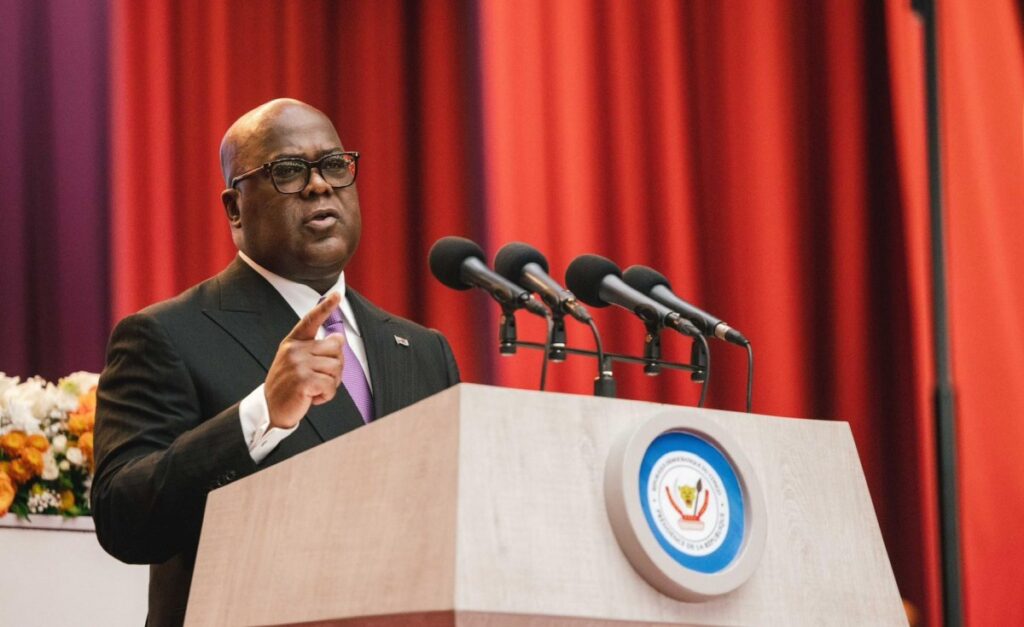
Democratic Republic of Congo President Félix Tshisekedi has taken the first formal step toward organising a national dialogue, creating a committee responsible for preparing the framework for talks that could become an important test of the country’s political stability. The move comes at a sensitive moment for the DRC, where questions over governance, constitutional politics and the country’s security situation continue to shape the national debate.
Tshisekedi signed an ordinance on Sunday, September 13, establishing the committee that will begin laying the groundwork for the proposed dialogue. The committee is expected to examine the political, financial, technical, logistical and security requirements for the process before making recommendations to the president.
The announcement does not yet formally convene the national dialogue. Instead, it creates the institutional machinery that could eventually lead to a broader political meeting involving different actors in Congolese society.
Tshisekedi Begins Building the Framework.
The newly established committee will have a wide-ranging mandate. Among its responsibilities will be defining the basic parameters of the dialogue and identifying the resources required to organise it.

It will also make recommendations regarding the creation of a preparatory commission, meaning the process is likely to unfold in several stages before political talks can formally begin.
That approach gives the presidency time to establish the structure of the proposed dialogue, but it also creates an immediate political question: who will ultimately decide who participates and what issues will be placed on the table?
For a national dialogue to carry political weight, opposition parties and other stakeholders will need to believe that the process is not simply an extension of the presidential agenda.
Opposition Concerns Could Become the Biggest Challenge.
Several opposition groups have already criticised the initiative, raising concerns about what they see as excessive presidential control over the process. Their objections are significant because the credibility of any national dialogue will depend heavily on whether participants believe the discussions can take place on relatively equal political ground.
The disagreement reflects a broader problem that has affected political dialogue across Africa. Governments frequently call for national consultations during periods of political tension, but opposition parties often question whether they are being invited to negotiate or simply being asked to endorse decisions that have already been made.
That distinction could become particularly important in the DRC. If opposition groups conclude that the dialogue is controlled entirely from the presidency, participation could become more difficult and the process could deepen political divisions rather than reduce them.
Constitutional Questions Add More Pressure.
The proposed dialogue is also emerging alongside a growing political debate over the country’s constitutional order. Opposition coalition C64 has announced plans for demonstrations in Kinshasa and Lubumbashi against what it describes as threats to constitutional principles.
In Lubumbashi, authorities have prohibited a planned September 15 opposition march, while C64 leaders have said they intend to proceed. The coalition argues that the Constitution guarantees the right to peaceful demonstrations and has accused authorities of violating that principle.
The situation illustrates the difficult political environment in which Tshisekedi’s proposed dialogue will operate. While the government is preparing a mechanism for political discussion, opposition groups are simultaneously challenging restrictions on public mobilisation.
That contradiction could become a defining issue for the dialogue itself.
The DRC Needs More Than Another Political Meeting.
The idea of national dialogue carries particular importance in the DRC because the country has repeatedly faced political disputes that cannot easily be resolved through elections or parliamentary negotiations alone.
A credible dialogue could potentially create space for discussions around constitutional governance, political freedoms, electoral institutions and national cohesion. It could also provide an opportunity for political actors to address disagreements before they develop into deeper confrontations.
But dialogue by itself is not enough. Its success will depend on whether participants believe that the process is independent enough to produce meaningful commitments and whether those commitments are subsequently implemented.
The history of political consultations across the continent shows that agreements can lose credibility when they produce declarations without practical reforms.
A Test of Tshisekedi’s Political Strategy.
For Tshisekedi, the national dialogue could become an important opportunity to demonstrate political leadership. Bringing competing political forces into a structured conversation could help reduce tensions and provide a mechanism for addressing disagreements before they become more serious.
But the opposite is also possible. If major opposition groups refuse to participate or argue that the process has been designed to strengthen the presidency, the initiative could become another source of political confrontation.
The president therefore faces a delicate balancing act. His administration must establish enough structure to make the dialogue workable while giving political opponents sufficient space to influence the agenda and the composition of the process.
That will be critical to whether the dialogue is seen as a genuine national initiative or simply a government-led political exercise.
What Happens Next Will Matter.
The committee created by Tshisekedi now has to translate the broad idea of national dialogue into a concrete process. Its recommendations will determine the next stage, including how the preparatory commission is formed, what issues are prioritised and which political and social actors are invited.
The opposition, meanwhile, is likely to continue demanding greater guarantees over participation and political freedoms.
For the DRC, the stakes extend beyond the immediate disagreement between the presidency and its opponents. The country is attempting to manage political competition while also dealing with wider security and governance challenges.
If Tshisekedi can create a dialogue that opposition groups and other stakeholders consider credible, it could become a platform for reducing political tensions and strengthening national institutions. If the process is perceived as controlled from the top, however, it risks reinforcing exactly the divisions it is supposed to address.
The coming weeks will therefore determine whether the DRC’s proposed national dialogue becomes a genuine attempt at political reconciliation — or another chapter in the country’s long struggle over who gets to define its political future.

Comments (0)
No comments yet — be the first to share your thoughts.