
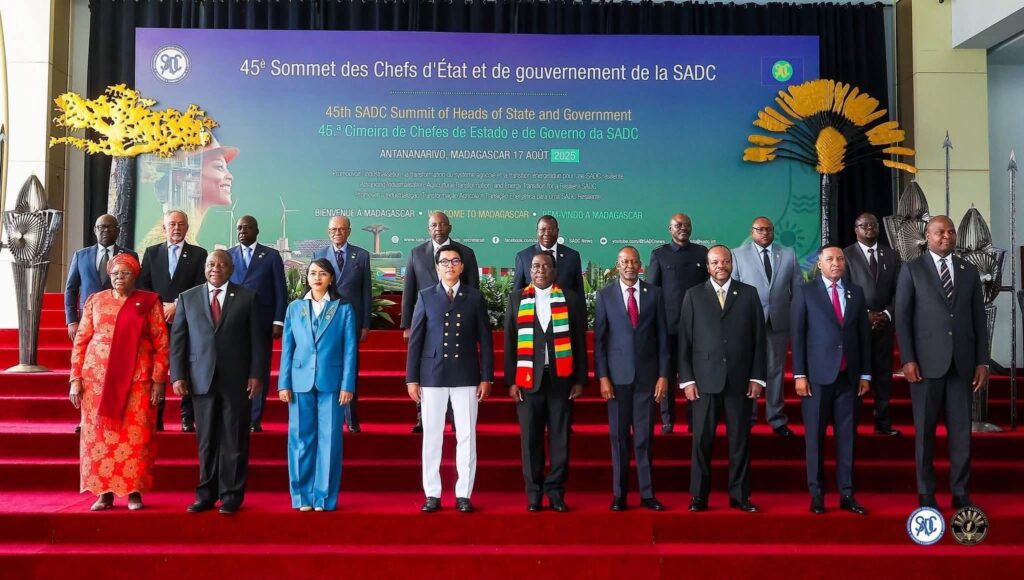
Regional Leaders Gather as South Africa Takes the Chair.
Southern African leaders are meeting in Durban on Monday, 17 August 2026, for the 46th Ordinary Summit of the Southern African Development Community (SADC), with regional integration, migration, economic transformation, youth unemployment and security dominating the political agenda. South African President Cyril Ramaphosa is chairing the summit as South Africa assumes leadership of the 16-member regional bloc for the coming year. The summit is being held at the Inkosi Albert Luthuli International Convention Centre in Durban.
The meeting comes at a critical moment for Southern Africa, where governments are facing the combined pressures of slow economic growth, unemployment, food insecurity, migration and persistent security challenges. For Ramaphosa, the summit is an opportunity to position regional cooperation as a practical economic strategy rather than simply a diplomatic ambition. He has called for SADC countries to make better use of their natural resources, industrial capacity and youthful population to create jobs and strengthen economic growth.
Migration and Xenophobia Take Centre Stage.
One of the most politically sensitive issues surrounding the summit is migration. South Africa has faced growing tensions over undocumented migrants from neighbouring countries, with anti-immigration groups increasingly demanding tighter controls. Ramaphosa has argued, however, that migration cannot be addressed through enforcement alone and that regional governments must tackle the economic and political conditions that drive people to leave their countries.
The South African president has also expressed concern about the treatment of foreign nationals inside South Africa. In a significant diplomatic gesture, Ramaphosa apologised to Mozambican President Daniel Chapo over recent violence against Mozambican nationals. He has described the treatment of foreigners as a source of shame for South Africa and warned that xenophobia threatens the very regional integration that SADC is trying to build.

The issue is particularly important because South Africa’s economy is deeply connected to the rest of the region. Millions of people move across Southern African borders for employment, trade, education and family reasons. Restricting that movement may respond to domestic political pressure, but it can also undermine the cross-border economic relationships that SADC has spent decades trying to strengthen.
Ramaphosa Pushes Economic Integration.
Economic transformation is expected to be another central theme of the summit. Ramaphosa has argued that Southern Africa must move beyond exporting raw materials and instead develop industries capable of processing the region’s resources locally. The approach is particularly relevant as global demand for critical minerals increases and countries compete to secure supplies of copper, lithium, cobalt and other strategic resources.
The summit’s theme reflects this ambition: “Resilient, sustainable and inclusive industrialisation through Infrastructure Development, Agricultural and Critical Minerals Transformation in Pursuit of a Just World.” The agenda places infrastructure, agriculture, critical minerals and industrialisation at the centre of South Africa’s SADC chairmanship.
For Southern Africa, the question is whether regional governments can translate these ambitions into concrete projects. The region has substantial mineral wealth, agricultural potential and renewable-energy resources, but infrastructure gaps, unreliable energy supplies, regulatory differences and limited intra-African trade continue to restrict economic integration.
Youth Unemployment Adds Pressure.
Youth unemployment is another major political concern. Southern Africa has one of Africa’s largest young populations, yet many countries continue to struggle to create sufficient formal employment opportunities. South African International Relations and Cooperation Minister Ronald Lamola has called for greater attention to youth unemployment and hunger, warning that regional development strategies must deliver tangible improvements in people’s lives.
The issue extends beyond employment statistics. Persistent youth unemployment can contribute to migration, political dissatisfaction and social instability. For SADC governments, creating jobs therefore represents not only an economic objective but also a political and security priority.
The challenge is particularly visible in South Africa, where unemployment and migration have become politically intertwined. Ramaphosa’s argument that migration pressures must be addressed through economic development reflects an understanding that stronger regional economies could reduce some of the forces pushing people to cross borders in search of opportunities.
Security Remains a Major Regional Concern.
While economic development dominates much of the summit’s public messaging, security remains a major part of SADC’s agenda. The bloc’s Organ Troika on Politics, Defence and Security Cooperation met in Durban ahead of the main summit, with regional political and security developments under discussion. SADC Executive Secretary Elias Magosi has described the security mechanism as central to maintaining the stability required for economic development.
The emphasis on security reflects a broader reality: economic integration cannot succeed in an environment of political instability and insecurity. SADC has increasingly had to balance its economic ambitions with its role in responding to regional crises, particularly where instability threatens cross-border trade, investment and population movement.
Security concerns have also been evident around the summit itself. South African authorities have increased security arrangements in Durban, while three people were reportedly arrested on Sunday following an alleged attempt to gain unauthorised access to the summit venue.
A Test of South Africa’s Regional Leadership.
The Durban summit gives Ramaphosa an opportunity to define South Africa’s regional leadership at a time when Pretoria is facing its own domestic political pressures. His call for deeper integration, an end to xenophobia and stronger economic cooperation represents an attempt to reconcile South Africa’s position as the region’s largest economy with the concerns of neighbouring countries that often depend heavily on access to the South African market.
But the success of South Africa’s SADC chairmanship will ultimately depend on implementation. Regional declarations about integration have been made repeatedly over the years. What businesses, workers and ordinary citizens need is better infrastructure, more reliable energy, easier cross-border trade, stronger agricultural production and greater access to employment.
The 46th SADC Summit therefore arrives with a clear political challenge. Southern Africa has the resources, population and economic potential to become a more integrated regional market, but political disagreements, economic inequalities and social tensions continue to stand in the way.
For Ramaphosa and the other leaders gathered in Durban, the task is no longer simply to reaffirm the importance of regional unity. It is to demonstrate that cooperation can produce measurable improvements in the daily lives of the region’s people.

Comments (0)
No comments yet — be the first to share your thoughts.