

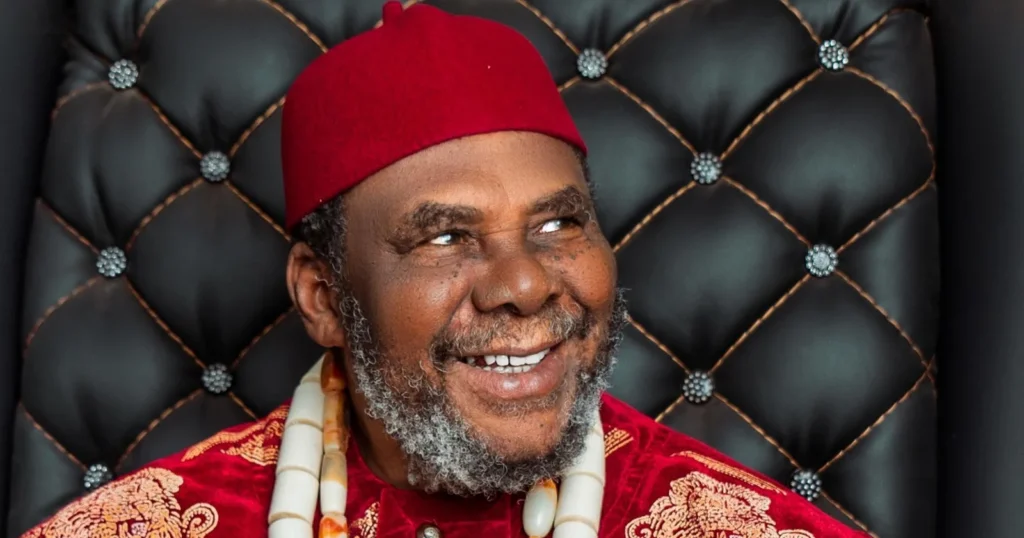
For generations of African audiences, the name Pete Edochie has represented more than acting. His deep voice, commanding presence, measured delivery and frequent portrayal of powerful fathers, kings, elders and traditional authorities have made him one of the most recognisable faces in African cinema. Yet behind the familiar image of the proverbial father of Nollywood is a career that began long before the Nigerian film industry acquired the name by which the world knows it today.
As the veteran actor turns the spotlight back on his own journey in 2026, Edochie is once again at the centre of conversations about seniority, influence and the history of Nigerian acting. Appearing on comedian Isbae U’s Curiosity Made Me Ask, he challenged claims from some colleagues that they were professionally senior to him, arguing that his involvement in acting goes back decades before the emergence of Nollywood. He said he performed Shakespeare’s The Merchant of Venice on stage in 1962, when he was only 15 years old, at a time when acting in Nigeria was largely rooted in theatre and broadcasting rather than the commercial film industry that exists today.
Before Nollywood, There Was Pete Edochie.
Born on March 7, 1947, Pete Edochie grew up at a time when Nigeria’s entertainment industry was still developing and opportunities in broadcasting and theatre were among the major avenues through which performers could reach national audiences. His professional journey did not begin with Nollywood. In fact, broadcasting played an important role in preparing him for the acting career that would eventually make him internationally famous.
Edochie worked in broadcasting and rose through the ranks to become a Director of Programmes. His experience in radio and television gave him an understanding of performance, storytelling, voice projection, production and the power of communication long before he became a household name on screen. He also undertook journalism and television training in England, adding an international dimension to his professional background. His transition into acting therefore did not represent the beginning of his career in entertainment, but rather the expansion of an already established life in broadcasting and performance.

That history explains why Edochie has consistently rejected the idea that his place in Nigerian entertainment can be measured simply by the year he entered mainstream film. In his recent interview, he pointed to his stage work in 1962 and his subsequent broadcasting career as evidence that his professional journey predates what is now called Nollywood by several decades. His argument is particularly significant because Nollywood itself is generally associated with the rise of the home-video industry in the early 1990s, with Living in Bondage widely regarded as one of the defining productions of that era.
The Role That Changed Everything.
The defining turning point in Edochie’s acting career came with Things Fall Apart, the screen adaptation of Chinua Achebe’s celebrated novel. Edochie portrayed Okonkwo, one of African literature’s most recognisable characters, in the television production that brought Achebe’s story to a massive audience.
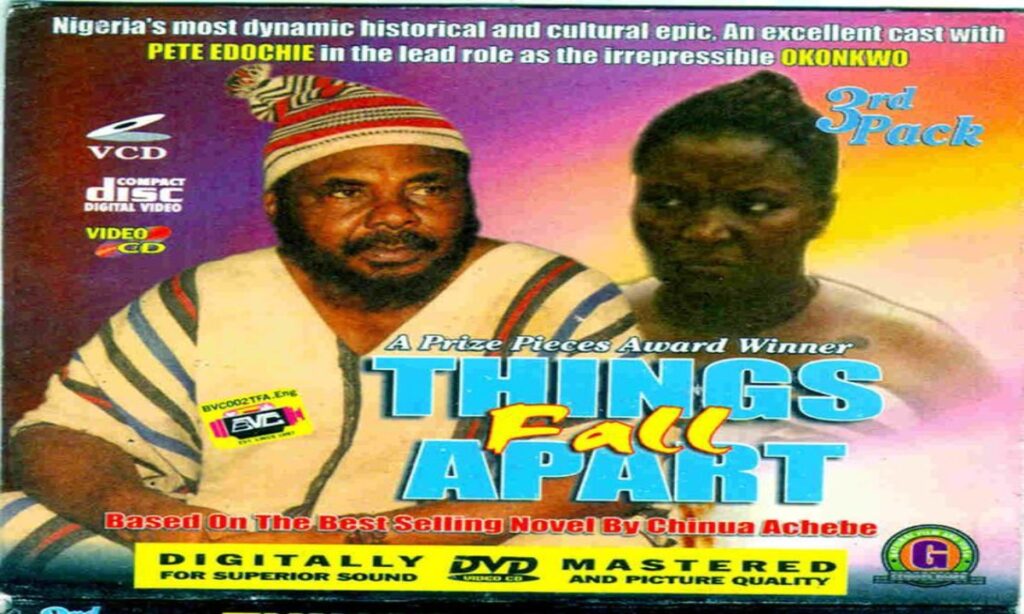
The role demanded much more than memorising lines. Okonkwo is a complicated character whose strength is inseparable from fear, pride, insecurity and an intense determination to preserve his idea of masculinity and tradition. Edochie’s interpretation gave the character an extraordinary physical and vocal authority, helping transform Okonkwo from a literary figure into one of the most memorable characters in African television history.
Edochie has repeatedly stressed that Things Fall Apart came before Nollywood as an industry. In an earlier interview, he explained that when he made the production in 1985, Nollywood had not yet emerged, adding that the film’s international reach exposed him to audiences beyond Nigeria. He has also recalled that the production had already gained international significance because Achebe’s novel had been translated into numerous languages.
The impact was substantial enough to attract international attention. Edochie has recalled that foreign journalists came to Nigeria to interview him following his performance, a point he again referenced during his recent 2026 appearance. His emergence as Okonkwo therefore positioned him as one of the early Nigerian performers capable of carrying an African story to audiences beyond the continent.
From Broadcaster to Nollywood Institution.
Although audiences often associate Edochie almost exclusively with acting, his broadcasting career remains an important part of understanding his influence. His years behind the microphone and in television administration meant that he understood the entertainment industry from several perspectives before becoming one of its most famous performers.
His career in broadcasting eventually saw him rise to the position of Director of Programmes, and he has explained that he retired from that professional path before entering the film industry on a full-time basis. This distinction matters because it challenges the perception that Edochie simply emerged as an actor during the rise of Nollywood. By the time he became a major screen presence, he had already accumulated decades of experience in communication, theatre and broadcasting.
That background also helped shape the qualities that became central to his acting style. Edochie’s performances are often built around voice, timing and authority rather than excessive movement. He can command a scene simply by speaking slowly and deliberately, a quality that has made his voice one of the most recognisable in Nigerian entertainment.
The Father Figure of African Cinema.
As Nollywood expanded throughout the 1990s and 2000s, Edochie’s image became increasingly associated with fathers, kings, chiefs, community leaders and powerful elders. Rather than seeing this as a limitation, he has explained that his age and established position naturally influenced the kinds of roles available to him when he entered the industry.
In an interview with TheWill Downtown, Edochie explained that by the time he entered Nollywood he was already in his late 50s or early 60s. He therefore did not enter the industry as a young actor competing for romantic lead roles. Instead, filmmakers saw in him the credibility and authority required to portray fathers and patriarchs, and he eventually became one of the actors most strongly associated with those characters.
The result was a screen persona that became bigger than individual films. Whether playing a wise elder, an intimidating father, a traditional ruler or a morally complicated patriarch, Edochie’s presence often gave a production a sense of gravity. His voice became so recognisable that his name and image eventually became part of Nigerian popular culture beyond cinema.
His Influence Reached Beyond Acting.
Edochie’s contribution to Nollywood cannot be measured only by the number of films in which he appeared. His importance also lies in the generation of actors and filmmakers who entered the industry after him and inherited an entertainment environment that pioneers like him helped establish.
Former President Muhammadu Buhari recognised this contribution when he celebrated Edochie’s 75th birthday in 2022. Buhari described Edochie as an important figure whose performance in Things Fall Apart brought attention to Nigeria and Africa, while also praising his pioneering and motivating role in the growth of the entertainment industry. The statement specifically recognised Edochie’s role in nurturing younger professionals and talents, including his son, actor Yul Edochie.
That acknowledgement is important because Edochie’s legacy is not simply about individual fame. His career belongs to a transitional period in African entertainment when television, theatre and traditional broadcasting gradually evolved into the modern film and digital entertainment industries.
A Legacy That Includes Lionheart.
Edochie’s relevance did not end with the first generation of Nollywood. He continued to appear in major productions as the Nigerian film industry became increasingly sophisticated and internationally visible.
One notable example is Lionheart, the 2018 film directed by and starring Genevieve Nnaji. Edochie played Chief Ernest Obiagu, bringing the same sense of authority and traditional masculinity that had defined many of his earlier roles into a contemporary story about family, business and generational change.
The film became historically significant after Netflix acquired it, making it the first Netflix Original film produced in Nigeria. Edochie’s involvement therefore connected one of the earliest generations of Nigerian screen actors with a new era in which Nigerian films could reach global audiences through international streaming platforms.
What Others Have Said About Him.
The respect surrounding Edochie has extended well beyond ordinary audience admiration. In 2022, Buhari described his performance in Things Fall Apart as having brought the spotlight to Nigeria and Africa. The former president also highlighted Edochie’s contribution to the development of Nollywood and his influence on younger professionals.
Industry publications have similarly described Edochie as one of the defining figures of Nigerian cinema. His numerous honours include Nigeria’s Member of the Order of the Niger, an AMVCA Industry Merit Award and a lifetime achievement recognition from the Africa Movie Academy Awards. These honours reflect the fact that his career has been recognised not simply for popularity, but for its contribution to the development of African screen culture.
His influence has also extended into popular internet culture. Even younger audiences who may not have watched his earliest productions often recognise his face, voice and famous proverbial style through memes, short videos and references across social media. That unusual ability to remain culturally relevant across generations is one of the strongest indications that his influence has moved beyond traditional Nollywood.
Edochie and the Debate About Seniority.
The veteran actor’s recent comments have nevertheless introduced another dimension to the conversation about his legacy. During his appearance on Curiosity Made Me Ask, Edochie rejected suggestions that other actors could claim greater seniority than him, pointing instead to his early stage work, broadcasting career and international recognition.
He also said he does not consider himself to be in the same league as other actors, a statement that has generated discussion because of its confidence and the long-running debates surrounding seniority within Nollywood. The comments followed earlier claims by actor Yemi Solade that he began acting before Edochie, although Edochie did not mention Solade by name when responding to the issue.
Yet Edochie’s comments can also be understood within the context of a career that genuinely belongs to several different eras of Nigerian entertainment. He was performing Shakespeare on stage before Nollywood existed, worked in broadcasting before becoming a major film star, achieved international recognition through Things Fall Apart, became one of the defining faces of the home-video era and later appeared in productions distributed to global audiences through streaming platforms.
The Man Behind the Voice.
There is also a personal dimension to Edochie’s longevity. He has spoken about his family, his marriage and his experience as a father, while his children have also become part of the Nigerian entertainment conversation. His son Yul Edochie followed him into acting, creating one of Nollywood’s most visible father-and-son connections.
This generational link is particularly significant because it demonstrates how entertainment careers can become cultural legacies. Pete Edochie’s influence did not stop with the characters he played. His professional example became part of the environment in which another generation of Nigerian performers developed their own careers.
More Than Okonkwo.
It would be easy to reduce Pete Edochie’s legacy to Okonkwo, because the character remains his most internationally recognised performance. But doing so would overlook the decades of work that came before and after it.
His story begins with a teenager performing Shakespeare on stage in 1962. It continues through broadcasting, journalism, television production and administration before reaching the screen in the 1980s. It then moves through the rise of Nollywood, the expansion of Nigerian cinema across Africa, the emergence of new generations of actors and the arrival of Nigerian films on global streaming platforms.
That is why Pete Edochie’s place in African entertainment history is larger than any individual character. He represents a bridge between the old Nigerian theatre and broadcasting tradition and the modern film industry that eventually became Nollywood. His career demonstrates how one performer could move through several generations of African storytelling without becoming irrelevant.
At 79, Edochie remains a figure whose words can still generate national conversation, whose performances remain familiar to audiences who discovered him decades after his breakthrough, and whose career continues to provide a reference point for discussions about Nigerian acting. Whether one agrees with his assessment of his own place in the industry or not, the historical record makes one point difficult to dispute: Pete Edochie was already an established performer long before Nollywood became the global cultural force it is today.
His greatest legacy may therefore not be that he became one of Nollywood’s most famous actors. It may be that he helped create the tradition against which generations of African actors would later be measured.

Comments (0)
No comments yet — be the first to share your thoughts.