

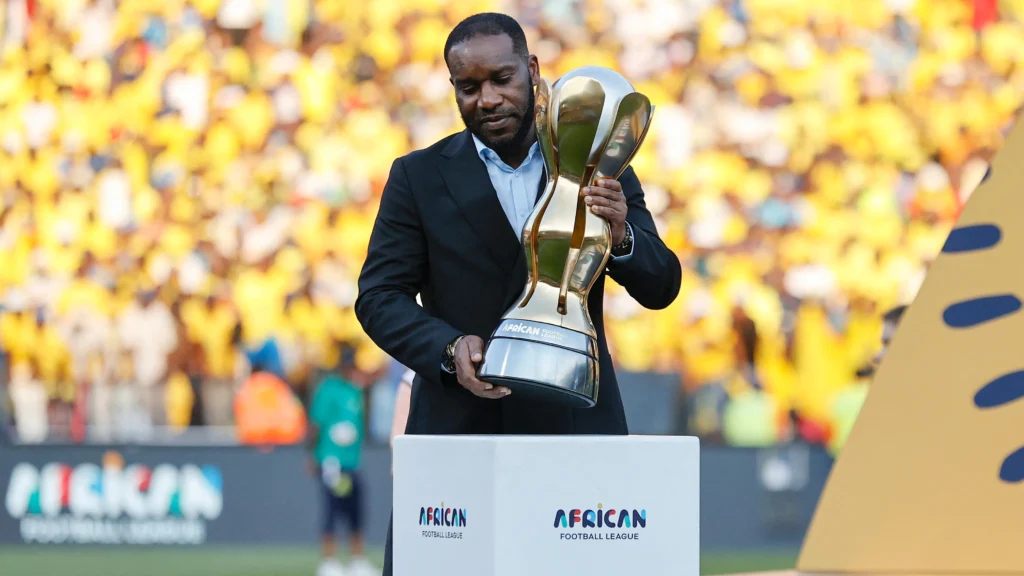
Nigerians Question the Timing of Super Eagles Legends’ Public Football Debates.
A debate over Lionel Messi and Cristiano Ronaldo has opened a wider conversation about the state of Nigerian football after former Super Eagles captain Austin “Jay-Jay” Okocha shared his preference between the two global icons. Okocha made the comments during an appearance on The Obi One Podcast, hosted by former Nigeria international John Obi Mikel, where he explained why he would choose Messi over Ronaldo. While the discussion was fundamentally about one of football’s oldest debates, the timing has generated reactions among Nigerian supporters who believe the country’s football legends should be paying greater attention to the problems confronting the national game.
Okocha’s preference for Messi was based largely on the Argentine’s creativity, intelligence and overall influence on matches. The former Paris Saint-Germain and Bolton Wanderers star highlighted qualities that go beyond simply scoring goals, arguing that Messi’s ability to create, assist and control different aspects of a game makes him his preferred player. The comments themselves are hardly controversial in the wider football world, where players and former internationals have repeatedly offered different opinions on the Messi-Ronaldo debate. However, in Nigeria, the discussion has taken on a different dimension because of growing frustration over the performance and management of the country’s national teams.
The Debate Is About More Than Messi and Ronaldo.
For Nigerian supporters, the issue is not necessarily that Okocha chose Messi. It is that conversations involving some of the country’s most respected former footballers often attract attention at a time when Nigerian football is dealing with much more immediate challenges. The Super Eagles have struggled to maintain consistency, while questions surrounding coaching, administration, player development and long-term planning continue to dominate discussions about the future of the sport.
Those concerns have become even more pronounced following recent disappointments involving Nigeria’s national teams. The country’s football supporters expect far more from a nation with such a deep pool of talent and such a powerful football culture. Nigeria consistently produces players capable of competing at the highest levels of European football, yet the national teams have struggled to turn that individual quality into sustained international success.

That contradiction has created an uncomfortable question: why does a country with Nigeria’s football resources continue to struggle with consistency?
Okocha Remains One of Nigeria’s Most Influential Football Figures.
Jay-Jay Okocha occupies a unique position in Nigerian football. His career at clubs including Eintracht Frankfurt, Fenerbahçe, Paris Saint-Germain and Bolton Wanderers established him as one of Africa’s most technically gifted midfielders, while his performances for the Super Eagles made him a national icon. His influence extends beyond the generation that watched him play, with younger Nigerian football supporters continuing to regard him as one of the country’s greatest footballers.
That reputation means his opinions naturally attract considerable attention. When Okocha discusses football, supporters, journalists and younger players listen, and that influence also creates expectations about the issues he chooses to address publicly. Some Nigerians believe former internationals such as Okocha have an important responsibility to speak more forcefully about the structural problems affecting the national game, particularly because their experience gives them credibility that many outsiders do not possess.
Others argue that retired footballers should not be expected to turn every public appearance into an intervention on Nigerian football administration. Okocha was answering a question about Messi and Ronaldo, not presenting a strategy for reforming the Nigeria Football Federation. There is therefore a legitimate argument that he should be allowed to discuss football without every comment being interpreted through the country’s wider football crisis.
Nigeria’s Problems Go Far Beyond Its Footballers.
The biggest mistake would be to treat the reaction to Okocha’s comments as evidence that former players are responsible for Nigeria’s football problems. They are not. The country’s challenges are much deeper and involve institutions, infrastructure, coaching, youth development, administration and long-term planning.
Nigeria has no shortage of football talent. Victor Osimhen, Ademola Lookman, Samuel Chukwueze, Alex Iwobi and numerous other Nigerian players have established themselves at major European clubs, demonstrating the extraordinary quality available to the country. The issue is how that talent is identified, developed, integrated and managed at international level.
A successful national team cannot depend entirely on the brilliance of individual players. It needs a clear tactical identity, strong preparation, continuity in the technical department and an administration capable of creating an environment in which players can perform at their best.
Nigeria has repeatedly struggled to maintain those elements.
Former Legends Could Still Play a Bigger Role.
While former players cannot be expected to fix Nigerian football on their own, there is a strong argument that they could play a more active role in shaping its future. Former Super Eagles stars possess experience that is difficult to replicate through formal administration. They understand the demands of international football, the transition from African football to Europe and the pressures that come with representing Nigeria.
Okocha, Nwankwo Kanu, Daniel Amokachi, Sunday Oliseh and Joseph Yobo are among the former internationals whose experiences could be valuable to younger generations. Their contribution does not necessarily have to involve taking administrative positions. Mentorship, grassroots development, player education and advocacy for better football structures could all provide meaningful ways for former stars to contribute.
Their greatest value may ultimately be their ability to speak directly to the football community. When respected former players raise concerns about the national game, their voices can generate conversations that administrators and politicians cannot easily ignore.
Nigeria Has the Talent to Demand More.
The frustration among Nigerian supporters is understandable because the country possesses almost every ingredient required to become one of Africa’s most consistently successful football nations. It has a huge population, an enormous football culture, a strong diaspora and a steady production line of players competing in some of the world’s best leagues.
Yet those advantages have not always translated into sustained success.
Nigeria’s football development system needs to produce more than individual stars. It needs to create a pathway through which talented young players can receive quality coaching, compete in properly organised competitions and eventually transition into professional and international football. That process requires investment and planning rather than short-term reactions whenever a major tournament approaches.
The same principle applies to the national teams. Constant changes in coaching and strategy can make it difficult to develop a consistent playing philosophy, while administrative disagreements can create distractions that ultimately affect performances on the pitch.
The Messi-Ronaldo Argument Is Not the Real Problem.
Ultimately, whether Messi is better than Ronaldo is a matter of football preference. Okocha is entitled to his opinion, just as Nigerians are entitled to disagree with it. The debate has existed for more than a decade and will probably continue long after both players have retired.
What the reaction reveals, however, is the level of frustration among Nigerian football supporters. They are increasingly demanding conversations about the future of their own football rather than simply celebrating the achievements of previous generations or debating international stars.
That frustration should not necessarily be directed at Okocha personally. Instead, it should encourage a much larger discussion about what Nigeria wants its football system to look like over the next decade.
The Legends Can Help Shape the Next Generation.
Nigeria’s former football stars still have an important role to play. They can mentor young players, support grassroots initiatives, advocate for improved facilities and use their public platforms to demand greater accountability from football administrators. Their experience can also help younger Nigerian players understand the professional standards required to succeed internationally.
Okocha’s legacy gives him a particularly powerful platform in that regard. The same applies to other former Super Eagles players who experienced the highs and lows of representing Nigeria at the highest level.
Their voices should not replace coaches, administrators or football development professionals, but they can complement those institutions and help keep the national conversation focused on improvement.
Nigeria’s Football Future Matters More Than the GOAT Debate.
The controversy surrounding Okocha’s comments ultimately points towards a much bigger issue. Nigeria has spent decades producing exceptional footballers, but it has not always built the systems required to maximise that talent. The country cannot continue relying on individual brilliance while hoping that success will eventually follow.
The next generation of Nigerian footballers deserves better infrastructure, stronger development programmes, better coaching and more consistent leadership. The Super Eagles also need a clear long-term vision that goes beyond qualifying for the next tournament or reacting to the latest disappointment.
That is where Nigeria’s football legends can make a meaningful difference.
The Messi-Ronaldo debate will eventually fade, but Nigeria’s football challenges will remain. Okocha should be free to choose Messi, Ronaldo or anyone else as his greatest player. At the same time, Nigerian supporters are justified in asking their football legends to use their influence to help address the problems affecting the national game. The question is no longer simply who is the greatest footballer of the generation. For Nigeria, the more important question is whether the country can finally build a football system capable of turning its extraordinary talent into sustained success.

Comments (0)
No comments yet — be the first to share your thoughts.