

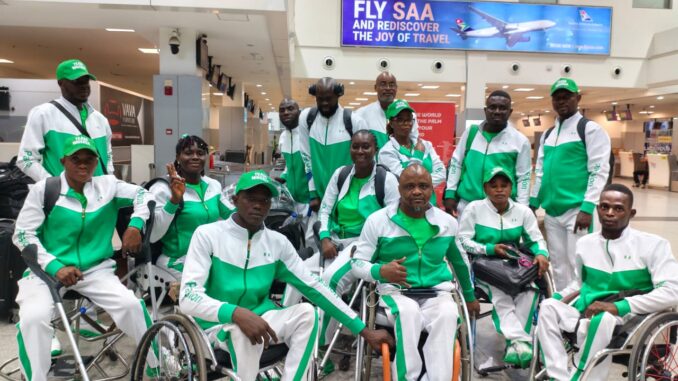
Nigeria’s women’s wheelchair basketball team has opened a new chapter in the country’s para-sport history, and captain Ijigbamigbe Gbemisola Olubisi is already looking beyond the achievement that put the team on the international stage. After helping Nigeria secure its first-ever place in wheelchair basketball at the Commonwealth Games, Ijigbamigbe says the next ambition is even bigger: taking the country to the Paralympic Games.
The breakthrough did not happen by accident. Nigeria defeated South Africa 8–3 in the final of the African qualifying tournament in Angola to secure its historic Commonwealth Games place. The result represented a major moment for a sport that has often struggled for funding, equipment, sponsorship and public attention in Nigeria.
For Ijigbamigbe, the achievement has therefore become about more than one tournament. It has demonstrated what Nigerian wheelchair basketball can accomplish when players are given the opportunity to compete, prepare and believe in themselves.
A Historic Commonwealth Breakthrough.
Nigeria’s qualification for the 2026 Commonwealth Games was the first time the country’s women’s wheelchair basketball team had secured a place in the competition. The victory over South Africa in Angola provided the decisive moment, but the significance extended far beyond the scoreline.

The team had to overcome the traditional difficulties facing many African para-sports programmes, including limited resources and inadequate access to specialised sporting equipment. Ijigbamigbe has said that confidence, teamwork and determination were crucial in helping the players overcome those obstacles.
The captain acknowledged that competing on such a stage initially came with fear and uncertainty. But as the tournament progressed, the team’s confidence grew, supported by the belief that they belonged among the best teams competing for qualification.
That psychological shift could prove just as important as the qualification itself.
Ijigbamigbe Wants More Than a Historic Appearance.
Rather than treating the Commonwealth breakthrough as the end of a journey, Ijigbamigbe sees it as the beginning of something much larger. Her ambition is now to help Nigeria qualify for the Paralympic Games, an objective that would take the country’s women’s wheelchair basketball programme into another level of international competition.
That goal will require sustained investment. Paralympic qualification is considerably more demanding than simply establishing a presence at one major multi-sport event, and Nigeria will need regular international competition, specialist coaching, appropriate facilities and modern sporting wheelchairs.
The team will also need a stronger domestic structure capable of identifying and developing players before they reach the national team.
For Ijigbamigbe, however, the recent breakthrough has provided evidence that the foundation exists.
Equipment Has Been One of the Biggest Challenges.
One of the most important issues raised by the Nigerian captain is the shortage of appropriate sporting wheelchairs. Unlike ordinary wheelchairs, equipment used in wheelchair basketball is specifically designed for speed, manoeuvrability, stability and physical contact during competition.
Ijigbamigbe recently praised the intervention of Bukola Olopade, Director-General of Nigeria’s National Sports Commission, after efforts were made to provide sporting wheelchairs for the team ahead of the Commonwealth Games. She described the development as an important improvement after years of equipment and funding difficulties.
That support could have a significant effect on performance. Athletes cannot be expected to compete consistently against international opposition when they lack equipment comparable to what their opponents use.
The challenge now is ensuring that support does not disappear after a major tournament.
From One Player’s Journey to a National Story.
Ijigbamigbe’s own sporting journey also reflects the wider potential of para-sport in Nigeria. She has explained that she was introduced to sport in 2018 almost casually, without initially imagining that the decision would eventually lead to an international career and the responsibility of captaining the national team.
Her progression demonstrates how much talent can remain hidden when people with disabilities do not have access to structured sporting opportunities.
Nigeria has already produced world-class para-athletes in disciplines such as powerlifting and athletics. At the 2026 Commonwealth Games, Goodness Nwachukwu retained her women’s discus title with a world-record performance, while Nigerian athletes also produced strong results in para-powerlifting.
Wheelchair basketball now has an opportunity to become another part of that story.
The Next Challenge Is Building Continuity.
The greatest danger after a historic breakthrough is that attention disappears once the competition ends. Nigeria’s wheelchair basketball programme cannot afford that cycle.
The team needs regular training camps, international matches, qualified coaches, medical and technical support and a clear development pathway for younger players. Without those structures, a historic qualification can remain an isolated achievement rather than becoming the foundation of a sustainable programme.
There is also a need for greater public awareness. Para-sport in Nigeria often receives significantly less media attention and commercial investment than mainstream sports, despite athletes competing at the highest international levels.
The success of Ijigbamigbe and her teammates gives sponsors and sports administrators an opportunity to change that.
A Bigger Dream for Nigerian Para-Sport.
The timing is also important because wheelchair basketball remains one of the world’s major Paralympic team sports. The 2026 IWBF World Championships are currently taking place in Ottawa, Canada, from September 9 to 19, bringing together 28 teams from around the world.
Nigeria’s absence from that competition highlights the distance the team still has to travel. But it also makes the captain’s ambition more significant. The objective is not simply to qualify for another tournament; it is to build a programme capable of competing consistently at the highest level.
For a team that only recently secured its first Commonwealth Games appearance, that may seem ambitious. But the players have already demonstrated that they can overcome expectations.
Nigeria Has Started Something Bigger.
The rise of Nigeria’s women’s wheelchair basketball team is ultimately a story about opportunity. The players have shown that when they receive a platform, they can compete. The responsibility now falls on administrators, sponsors and sports authorities to ensure that the opportunity becomes sustainable.
Ijigbamigbe Gbemisola Olubisi has already helped lead Nigeria into a new chapter. Her next target — the Paralympic Games — may be difficult, but the team’s Commonwealth breakthrough has changed the conversation.
Nigeria no longer has to ask whether its women wheelchair basketball players can compete internationally. The question now is how far they can go when the right support is finally in place.

Comments (0)
No comments yet — be the first to share your thoughts.