

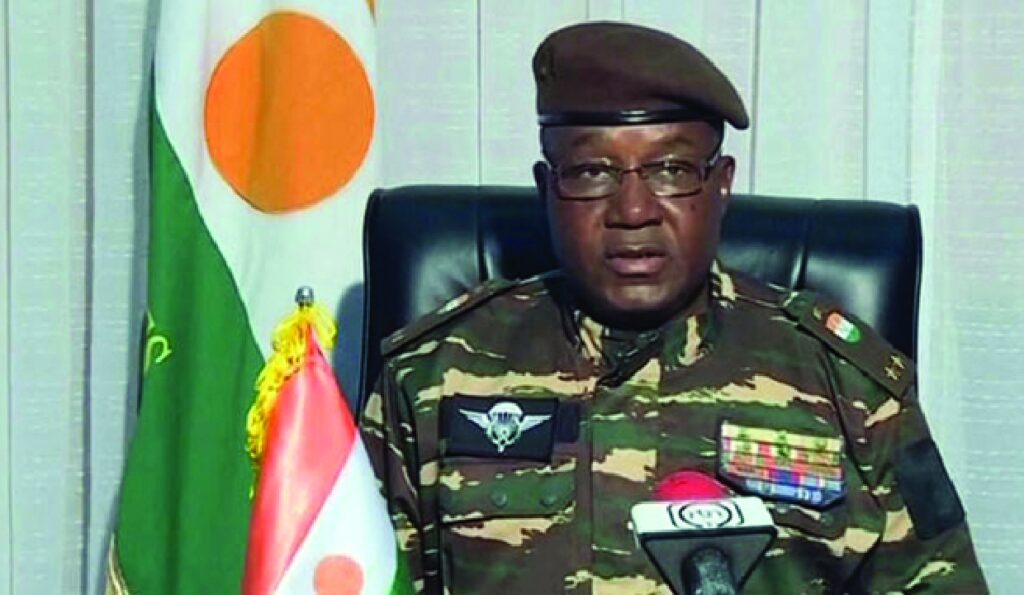
Niger’s military government has reshuffled the country’s top military command less than two weeks after a mutiny in the capital exposed growing tensions within the armed forces and raised fresh questions about the junta’s ability to maintain control.
General Abdourahamane Tchiani, Niger’s military ruler, appointed Brigadier General Mamane Sani Kiaou as the new chief of staff of the armed forces, replacing Major General Moussa Salaou Barmou, who had held the position since the 2023 coup that removed elected President Mohamed Bazoum. The change was announced in a decree signed on September 11 and read on state television.
No official explanation was given for Barmou’s removal. But the timing of the reshuffle has attracted considerable attention because it follows a nearly 24-hour mutiny in Niamey on August 28 and 29, when mostly young soldiers seized fellow servicemen and attacked sensitive locations in the capital.
A Mutiny Exposed Tensions Inside the Military.
The uprising centred on Base 101, a military installation near Diori Hamani International Airport. The mutineers also exchanged fire around the airport and presidential palace, creating one of the most serious internal challenges to Tchiani’s government since it seized power in July 2023.

According to reporting by the Associated Press, the soldiers appeared to be motivated partly by frustration over worsening militant violence and poor conditions within the military. Some of the soldiers reportedly came from regions in western and southern Niger that have been particularly affected by armed-group attacks.
The mutiny was eventually suppressed with assistance from Russia’s Africa Corps, which provided ground and air support to government forces. The fighting resulted in deaths and arrests among the mutineers, while three members of the presidential guard were also killed.
The episode was politically damaging because Tchiani’s junta originally justified its 2023 takeover by accusing the civilian government of failing to protect Niger from extremist violence.
The New Army Chief Brings Battlefield Experience.
Kiaou is not an outsider to Niger’s security establishment. Before his appointment, he served as chief of staff of the army and was involved in military operations against armed groups in the Tillaberi region in western Niger and Diffa in the southeast.
His promotion therefore places an experienced field commander at the top of the armed forces at a time when the government is under pressure to demonstrate that its security strategy is working.
General Abdourahmane Abou Zataka has been appointed to replace Kiaou as army chief of staff. General Ismael K Sidi Omar has also been named deputy chief of the general staff. Sidi Omar previously commanded Base 101, the facility at the centre of the recent mutiny, and remained loyal to Tchiani during the confrontation.
The appointments appear designed not only to refresh the military leadership but also to reinforce loyalty within the command structure.
Russia’s Role Remains Significant.
The reshuffle also comes against the backdrop of Niger’s rapidly changing international security partnerships.
Since taking power, Tchiani’s government has broken with France and reduced its security relationship with the United States, instead moving closer to Russia. The August mutiny highlighted how important that new relationship has become when Russian Africa Corps personnel intervened to help Nigerien government forces regain control of strategic positions in Niamey.
That dependence carries its own political implications. Niger’s military government has presented its shift away from Western security partners as part of a broader assertion of national sovereignty. But the reliance on Russian forces during an internal military crisis demonstrates that the junta still faces significant security vulnerabilities.
The Bigger Challenge Is Still the Insurgency.
Changing military commanders will not by itself resolve the security problems facing Niger.
The country remains exposed to attacks by armed groups linked to al-Qaeda and Islamic State networks, particularly in areas close to its borders with Mali, Burkina Faso and Nigeria. Reuters reported after the August mutiny that frustration was growing within Niger’s armed forces over their difficulties in containing jihadist violence.
That creates a difficult test for Kiaou. The new commander must improve battlefield performance while also maintaining discipline and confidence within an armed forces structure that has now experienced an open internal revolt.
The pressure is particularly important because the junta’s political legitimacy is closely tied to its promise to restore security.
The Reshuffle Could Shape Niger’s Next Phase.
Tchiani’s decision to reorganise the military leadership sends a clear message that the government is unwilling to allow the mutiny to undermine its authority.
But it also exposes the contradiction at the centre of Niger’s military rule. The junta came to power promising stronger security, yet some of the strongest pressure it has faced has emerged from within the military itself.
For the new leadership, success will ultimately be measured not by how many generals are replaced, but by whether Niger’s armed forces become more capable of protecting territory, defeating insurgent groups and maintaining internal cohesion.
The coming months will therefore be closely watched. If Kiaou can improve military performance while restoring confidence among soldiers, the reshuffle could strengthen Tchiani’s government. If insecurity and dissatisfaction continue, however, the leadership changes may prove to be only a temporary response to a much deeper crisis inside Niger’s security system.

Comments (0)
No comments yet — be the first to share your thoughts.