

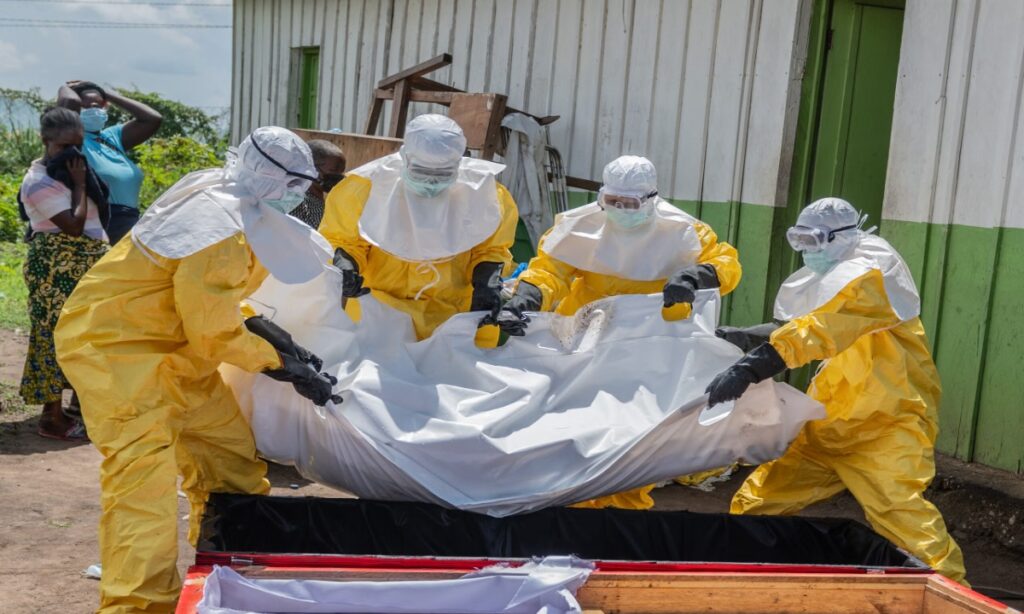
There is finally some encouraging news from the Democratic Republic of Congo’s Ebola outbreak, but health officials are warning against treating the latest improvements as the end of the crisis.
The World Health Organization says the response is beginning to gain ground, particularly in Ituri province, where transmission has declined in some of the areas hit hardest by the outbreak. More than 1,700 people have recovered, while South Kivu has reported no new cases since May.
But those gains are being accompanied by another reality: the virus has continued to spread geographically, and the number of cases has now passed 7,000.
The good news is coming from Ituri.
Ituri has been the centre of the outbreak since the Bundibugyo virus was first detected in the DRC earlier this year.

According to WHO Director-General Tedros Adhanom Ghebreyesus, transmission is now declining in the most affected parts of the province. He attributed the improvement to the work of the Congolese government, WHO, Africa CDC, health workers and other response partners.
Several health zones have also gone for extended periods without reporting new cases, suggesting that containment measures are having an impact.
That is significant because Ituri accounts for a large share of the infections recorded since the outbreak began.
But the virus has moved beyond the original epicentre.
The encouraging picture in Ituri does not describe the entire country.
By September 11, official Congolese data showed more than 7,000 confirmed cases, while the outbreak had expanded into a seventh province, South Ubangi, in the northwest of the country.
That geographical expansion is one reason health authorities remain cautious.
An outbreak can appear to be slowing in one region while new transmission chains are developing somewhere else. In the DRC, population movement between communities and provinces makes that risk particularly difficult to eliminate.
North Kivu is becoming a major concern.
While parts of Ituri are showing improvement, the situation in North Kivu remains much more worrying.
United Nations and WHO reporting indicates that transmission is still active there, with security problems and population mobility making it harder for response teams to identify cases, trace contacts and maintain continuous surveillance.
That creates a difficult situation for health authorities.
The response cannot simply be scaled back because the numbers are improving in the original epicentre. Teams must continue looking for infections in areas where transmission remains active and in locations that are newly affected.
More cases could still be discovered.
Another reason officials are refusing to declare victory is that improved surveillance can actually produce more reported cases.
As testing, contact tracing and community surveillance become stronger, infections that previously went undetected can be identified.
WHO has therefore warned that the current numbers should be interpreted alongside the response capacity and the geographical spread of the outbreak rather than treated as a simple measure of whether Ebola has been defeated.
This is particularly important in communities where people may reach healthcare facilities late or where insecurity makes access difficult.
The vaccine question is complicated.
Vaccination is also part of the response, but the current outbreak presents a scientific complication.
The virus responsible for this outbreak is Bundibugyo virus, rather than the Zaire ebolavirus targeted by the licensed Ervebo vaccine.
WHO’s Strategic Advisory Group of Experts on Immunization has said there is currently insufficient evidence to support routine use of Ervebo for preventing Bundibugyo virus disease. WHO therefore recommends its use for this outbreak within research protocols.
At the same time, vaccination of healthcare and frontline workers has begun in affected areas as part of research and response activities.
Clinical research into treatments is also underway, with the PARTNERS trial enrolling confirmed patients in treatment facilities in Ituri.
The next battle is keeping the gains.
The DRC has already demonstrated that an Ebola outbreak can be brought under control when surveillance, treatment, contact tracing and community cooperation work together.
But the current outbreak is unusually large.
With thousands of confirmed cases, more than 3,000 deaths and transmission extending across multiple provinces, the response still faces a considerable task. Recent UN reporting put the total at more than 7,200 confirmed cases and 3,510 deaths across seven provinces.
The difference now is that health authorities are seeing evidence that some of their measures are working.
The challenge is preventing those gains from being reversed.
Why the fight is not over.
The latest Ebola figures tell two stories at the same time.
One is encouraging: transmission is declining in parts of Ituri, recoveries are increasing and some affected areas are beginning to report no new cases.
The other remains worrying: the outbreak has expanded to another province, North Kivu continues to experience serious transmission and population movement could allow the virus to reach new communities.
That is why WHO is describing the situation as progress rather than victory.
For the DRC, the immediate objective is no longer simply to respond to an explosive outbreak. It is to maintain surveillance, find remaining cases quickly, protect health workers, support patients and stop transmission chains before they restart elsewhere.
The signs are better than they were several weeks ago.
But Ebola has not been defeated yet.

Comments (0)
No comments yet — be the first to share your thoughts.