

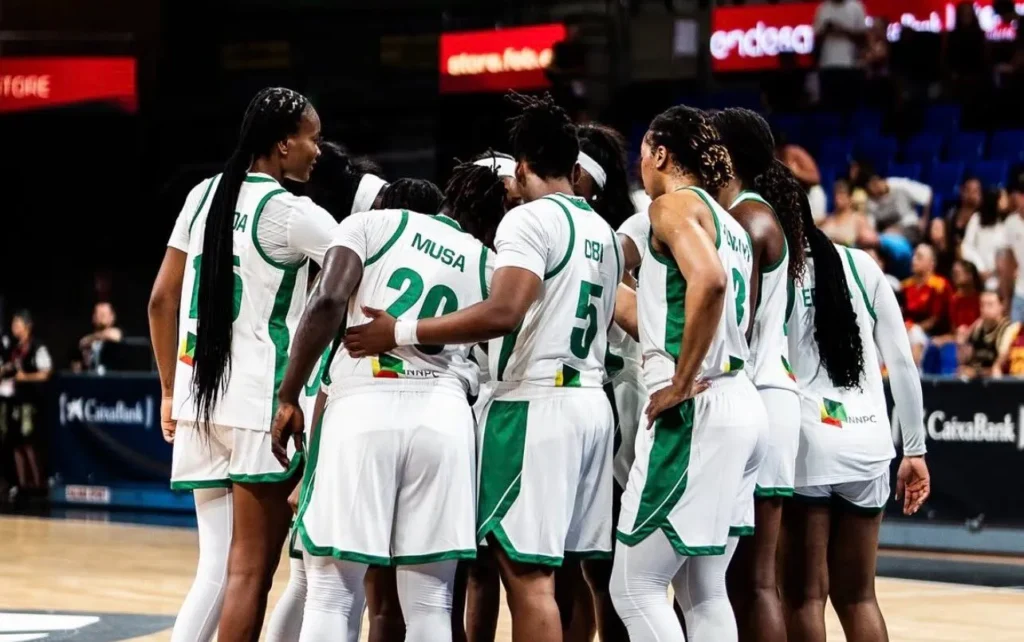
African champions leave Berlin without a victory.
Nigeria’s D’Tigress have returned from the 2026 FIBA Women’s Basketball World Cup with difficult questions to answer after a winless campaign that ended with a heavy 111–56 defeat to France in Berlin.
The result completed three defeats from three Group B matches for the reigning African champions. Nigeria had previously lost 99–81 to South Korea and suffered a narrower 71–67 defeat against Hungary, leaving them at the bottom of their group and outside the knockout stages.
The scale of the defeat to France has intensified the scrutiny. France raced into a 31–13 lead after the opening quarter and extended the advantage to 65–26 by halftime. Nigeria struggled to generate consistent offence while France continued to increase the pressure, eventually winning by 55 points.
Oyedeji warns Nigeria can no longer rely on continental dominance.
Former D’Tigers captain and Nigeria Basketball Federation board member Olumide Oyedeji has described the campaign as a major warning for Nigerian basketball.

Oyedeji argued that Nigeria must urgently examine the structures supporting the women’s national team rather than treating the World Cup performance as an isolated disappointment. He warned that the rest of Africa is improving and that Nigeria can no longer assume that its position at the top of the continent is guaranteed.
His intervention comes at a particularly important moment because D’Tigress have enjoyed remarkable success in recent years.
The team won a fifth consecutive AfroBasket title in 2025 and reached the quarter-finals at the Paris 2024 Olympic Games, becoming the first African team to reach that stage of the women’s Olympic basketball tournament. The contrast between those achievements and the events in Berlin has made the World Cup collapse particularly difficult to explain.
The France defeat exposed a widening gap.
The final score against France was not simply another loss. It exposed the difference between Nigeria and one of the world’s strongest basketball programmes.
France scored 31 points in the opening quarter, followed by 34 in the second and another 30 in the third. Nigeria managed only 13 points in each of the first three periods before producing a stronger fourth quarter. France also made 22 three-point shots, demonstrating the shooting depth and offensive efficiency that Nigeria struggled to match.
Grace Efosa-Aguebor led Nigeria with 15 points, while France were led by Gabby Williams with 25. The individual performances, however, could not compensate for the collective problems exposed throughout the tournament.
Preparation and consistency will come under scrutiny.
Nigeria’s difficult tournament has inevitably raised questions about preparation, coaching continuity and the development of the national programme.
D’Tigress entered the World Cup with significant international experience, but the team struggled to maintain competitiveness against opponents capable of punishing defensive mistakes and slow starts.
The pattern appeared in more than one match. Against South Korea, Nigeria remained within reach for significant portions of the contest before the Koreans pulled away in the final quarter. Against Hungary, Nigeria again found itself chasing the game after falling behind early.
By the time France arrived, Nigeria had little margin for error.
The campaign therefore raises a broader question: how can Nigeria convert its strong African record into consistent competitiveness against the world’s leading basketball nations?
Africa is becoming more competitive.
Oyedeji’s warning about the rest of Africa catching up is significant.
Nigeria remains the continent’s reigning women’s basketball champion, but other African programmes are investing in development, improving player pathways and gaining international experience.
The rise of competitive African teams means Nigeria’s historic dominance cannot be treated as a permanent advantage. Maintaining leadership will require continuous investment in coaching, youth development, player development and international preparation.
For Nigerian basketball, the danger is not simply losing one World Cup campaign. It is allowing the gap between its domestic structures and those of competing nations to widen.
The next challenge is rebuilding.
The immediate temptation after a tournament like this is to focus on blame. But the more important question is what Nigeria does next.
D’Tigress still have an established winning culture, experienced players and a strong record at continental level. Those assets provide a foundation from which the programme can rebuild.
The priority should now be identifying the weaknesses exposed in Berlin and addressing them before the next major international competition. That means examining preparation schedules, coaching support, player development, tactical planning and the transition between emerging talent and the senior national team.
Nigeria’s basketball authorities also face the challenge of ensuring that success at AfroBasket translates into genuine global competitiveness.
A setback that could become a turning point.
The D’Tigress World Cup campaign has been one of Nigeria’s most disappointing recent international basketball performances, but it does not erase the progress achieved over the previous two years.
Instead, it provides a clear measure of how much more work remains.
The Olympic quarter-final run and fifth consecutive AfroBasket title demonstrated that Nigeria possesses the talent and competitive culture to dominate Africa. Berlin demonstrated that continental dominance alone is not enough.
Oyedeji’s warning is therefore less about one tournament than the direction of Nigerian basketball as a whole.
If Nigeria responds with stronger planning, deeper player development and greater investment in its women’s programme, the World Cup collapse could become the moment that triggered a new phase of growth.
If the lessons are ignored, however, the warning may prove prophetic: the rest of Africa is catching up, and the world is already demanding much more from D’Tigress.

Comments (0)
No comments yet — be the first to share your thoughts.