
Political Tensions Rise Over Proposed Constitutional Changes.
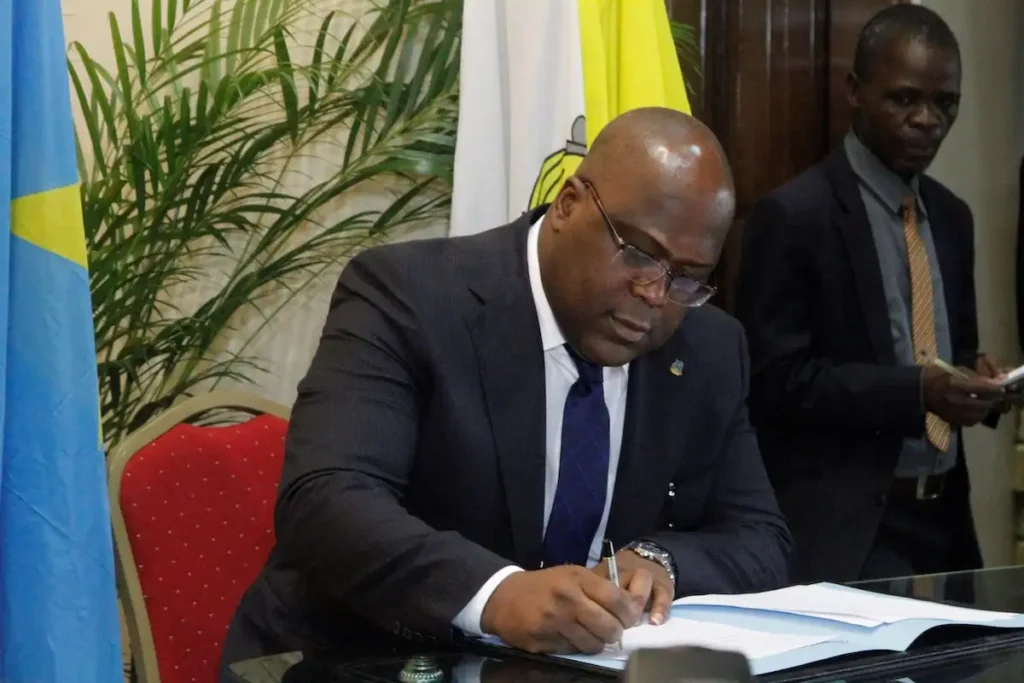
Opposition groups in the Democratic Republic of Congo have rejected President Félix Tshisekedi’s proposal for a national dialogue, arguing that the initiative does not go far enough to address the country’s political and security crisis. The opposition says it instead wants an inclusive national dialogue involving a broader range of political and social actors.
Tshisekedi announced the dialogue as tensions continue to rise over proposed constitutional reforms. Critics fear the changes could eventually allow the president to seek a third term when his current mandate expires in 2028. Tshisekedi has not publicly confirmed that he intends to pursue another term.
Opposition Questions the President’s Motives.
The main opposition coalition, known as C64, has accused Tshisekedi of using the consultation process as a political manoeuvre rather than creating a genuinely neutral dialogue. Opposition parties have argued that any credible process must address constitutional questions, governance and the broader political crisis.
The opposition has also called for wider participation, including figures and groups currently excluded from the government’s proposed process. Some opposition forces want representatives linked to former President Joseph Kabila and the M23 rebellion to be considered as part of a broader political settlement.
M23 Remains a Major Complication.
The political dispute is unfolding alongside the continuing conflict in eastern Congo, where the Rwanda-backed M23 movement controls significant territory. Tshisekedi has specifically ruled out allowing armed rebel groups to participate as political actors in the proposed dialogue.
That position creates another obstacle to an agreement. While the government views M23 as an armed group involved in an external-backed conflict, some political actors argue that resolving Congo’s crisis requires addressing both the military conflict in the east and the country’s internal political divisions.
Protests Could Follow.
The opposition has already announced plans for demonstrations in Kinshasa, with the C64 coalition moving its planned protest date to September 15. Earlier opposition demonstrations against constitutional changes were met with a heavy security response, raising concerns about further confrontation.
For Tshisekedi, the challenge is now to convince opponents that the dialogue is intended to reduce political tensions rather than strengthen his position ahead of the constitutional reform process.
The latest standoff shows how difficult it will be to build consensus in the DRC. Tshisekedi is presenting dialogue as a path toward stability, while his opponents fear it could become a mechanism for extending political power. With constitutional reform, the M23 conflict and possible protests all converging, the success of any national dialogue will depend largely on whether the government can make the process genuinely inclusive and trusted by its political rivals.

Comments (0)
No comments yet — be the first to share your thoughts.