

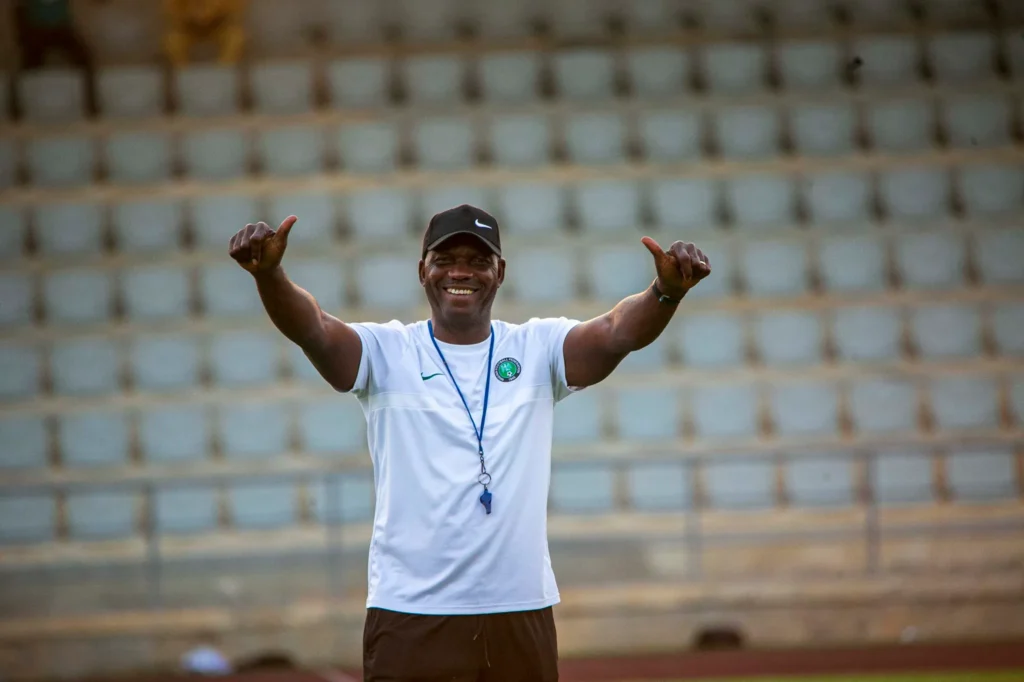
Augustine Eguavoen has been handed an unexpected assignment with Nigeria’s Super Falcons after the country’s disappointing campaign at the 2026 Women’s Africa Cup of Nations. The former Super Eagles coach has been appointed interim head coach of the women’s national team as Nigeria prepares for a crucial 2028 Olympic qualifying double-header against Comoros in October. The appointment gives Eguavoen an immediate opportunity to stabilise a team that has lost momentum and confidence following a tournament that fell well below Nigeria’s traditional standards.
A Team Searching for Direction.
Nigeria entered WAFCON 2026 carrying the expectations that come with being one of Africa’s most successful women’s football nations. Instead, the tournament exposed serious questions around the team’s preparation, tactical organisation and ability to compete consistently at the highest continental level.
The disappointing campaign ultimately contributed to changes within the technical structure. Following the tournament, the previous coaching arrangement was disrupted, leaving the Super Falcons without a permanent coach while the Nigeria Football Federation also went through its own leadership crisis. That uncertainty created the unusual situation of a major African national team approaching Olympic qualification without a settled technical direction.
Why Eguavoen?
Eguavoen brings something the Super Falcons desperately need at this moment: experience in Nigerian international football. He has coached the Super Eagles at senior level and understands the pressures that accompany the country’s national teams, particularly when results fall below expectations.

His strongest international achievement came in 2006, when he guided Nigeria’s Super Eagles to a bronze medal at the Africa Cup of Nations in Egypt. The experience does not automatically guarantee success with the women’s team, but it gives him familiarity with the country’s football environment, player management and the expectations surrounding national-team competitions.
The NFF has nevertheless made clear that Eguavoen is an interim solution. His immediate responsibility is to lead the Super Falcons through their October Olympic qualifiers while the federation continues its search for a permanent head coach.
The Olympic Qualifiers Cannot Wait.
The timing leaves Eguavoen with little room for experimentation. Nigeria will face Comoros twice in October, on October 7 and October 10, with the results determining whether the Falcons remain on course in the Olympic qualification process. The short preparation period means the interim coach must quickly establish a functional system rather than attempting a complete transformation of the squad.
His first challenge will be restoring confidence. A disappointing tournament can affect a national team psychologically as much as tactically, particularly when players return home facing public criticism. Eguavoen will need to create an environment in which experienced players regain confidence while younger members of the squad understand exactly what is expected of them.
Nigeria Still Has the Talent.
Despite the WAFCON disappointment, it would be premature to conclude that Nigeria’s women’s football programme has suddenly lost its strength. The country continues to possess players with significant international experience, including established stars who have competed in Europe and at previous major tournaments.
The problem is therefore unlikely to be a complete absence of talent. The bigger question is whether the talent is being organised effectively. Nigeria’s recent struggles have intensified conversations about coaching structures, player development, preparation and the strategic direction of the women’s national programme.
Eguavoen’s Biggest Test.
Eguavoen’s greatest challenge may be convincing the Falcons that the WAFCON failure does not define the next chapter of the team. Olympic qualification offers an immediate opportunity to change the narrative, but the margin for error is small.
The interim coach must also resist the temptation to make sweeping changes simply to demonstrate authority. With limited preparation time, continuity may be just as important as innovation. The best approach could be to identify the team’s strongest qualities, simplify the tactical structure and rebuild confidence around players capable of delivering immediately.
The appointment also gives the NFF valuable time to make a more considered decision on the permanent coaching position. Rather than rushing into another appointment after the WAFCON disappointment, the federation can use the Olympic qualifying window to assess what the Falcons actually need from their next coach.
Can He Change the Narrative?
Eguavoen cannot erase what happened at WAFCON 2026, but he can give Nigeria a chance to move beyond it. His immediate objective is simple: organise the team, win the Olympic qualifying tie against Comoros and restore belief in a programme that has been shaken.
Whether he can do more than that remains uncertain. The Super Falcons need a long-term technical strategy, not simply another short-term coaching change. But for now, Eguavoen has been given the responsibility of stopping the slide.
The October qualifiers will provide the first evidence of whether he can do it. If Nigeria responds with confidence and qualifies, Eguavoen may leave behind a team that is psychologically stronger and tactically more coherent. If the problems continue, the NFF will face even greater pressure to explain how one of Africa’s most decorated women’s teams reached such a difficult point.

Comments (0)
No comments yet — be the first to share your thoughts.