

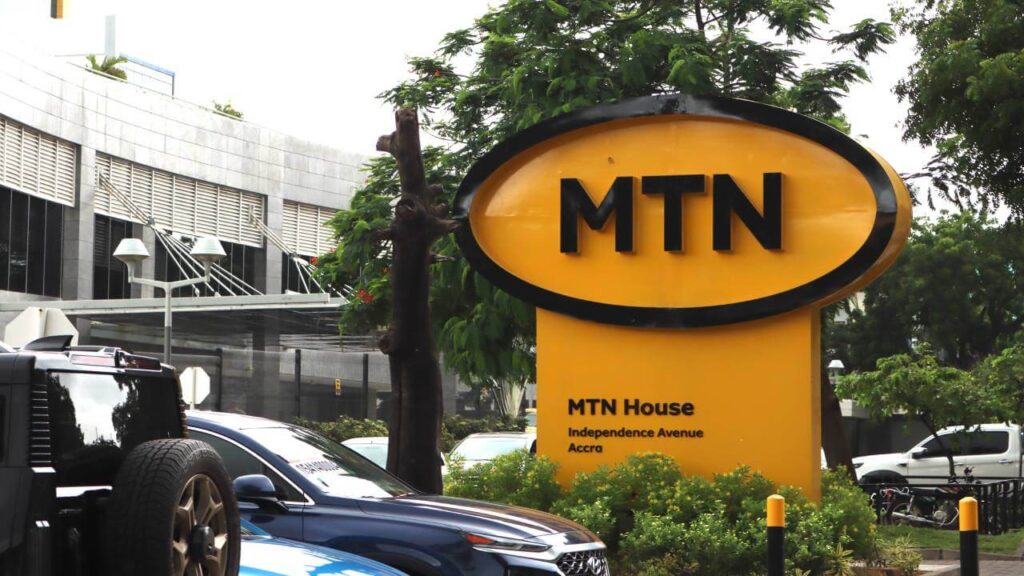
Ghana’s race to expand high-speed mobile connectivity has entered a new phase after MTN Ghana secured two lots of 700 MHz spectrum for a combined licence fee of US$100.9 million. The award, confirmed by Ghana’s National Communications Authority, gives the country’s largest mobile network operator additional spectrum capacity for mobile broadband services, including 5G, as Ghana pushes to expand next-generation connectivity across the country.
The agreement is significant because spectrum is one of the most important building blocks of a modern digital economy. Without sufficient spectrum, operators can struggle to deliver reliable high-speed services as more people connect smartphones, businesses move operations online and demand grows for cloud computing, artificial intelligence, streaming and other data-intensive services.
For Ghana, the latest award is therefore not simply a commercial transaction between the regulator and a telecommunications company. It is part of a broader national effort to strengthen digital infrastructure and make faster connectivity available to more people.
MTN Wins the 700 MHz Allocation.
The NCA announced on September 11 that Scancom Plc, which operates as MTN Ghana, was the sole qualified applicant for the 700 MHz band. The company applied for two lots, which was the maximum number that could be awarded to a single applicant under the licensing rules.

The two lots attracted a combined licence fee of US$100.9 million, bringing the 700 MHz portion of Ghana’s latest spectrum licensing exercise to a conclusion.
The development followed a competitive qualification process involving four applicants. Three companies — MTN Ghana, Telecel Ghana and Goal Telecommunications — qualified to proceed, while Infrava Ltd did not qualify for the next stage.
The outcome gives MTN Ghana additional spectrum at a time when demand for mobile data continues to grow across the country.
Why 700 MHz Matters for 5G.
The 700 MHz band is particularly valuable because lower-frequency spectrum can provide wider geographic coverage and better penetration into buildings than higher-frequency bands. That makes it useful for extending mobile broadband beyond densely populated urban centres.
For Ghana, this could become particularly important as the country attempts to ensure that 5G does not remain concentrated in Accra and other major commercial centres.
The NCA has previously said that the availability of new spectrum is intended to facilitate the timely deployment of 5G services across Ghana. The regulator has also emphasised that successful applicants will have to meet rollout obligations and timelines attached to their licences. That means the real test now moves from licensing to deployment.
Ghana Wants Faster and Wider Connectivity.
The spectrum award comes as Ghana’s digital economy continues to expand. Businesses increasingly depend on reliable internet for payments, communications, logistics, cloud services and digital commerce, while consumers are using more data for entertainment, education and remote work.
Faster networks could also create opportunities for sectors such as fintech, telemedicine, online education and digital media. For Ghanaian startups, better connectivity can reduce one of the barriers to building products and services that depend on real-time data.
The benefits could be even greater if improved network coverage reaches underserved communities.
That is why the NCA’s rollout requirements are important. The regulator has stated that spectrum assignments must translate into improved connectivity and not simply become valuable assets held by operators without sufficient investment in networks.
The 5G Licensing Process Is Not Over.
MTN Ghana’s victory does not mean Ghana’s entire spectrum allocation process has been completed. The NCA is also assigning spectrum in the 2.3 GHz and 3 GHz bands.
The 2.3 GHz band has five available lots, with four applications received, leaving it under-subscribed. The 3 GHz band has three available lots but attracted four applications, meaning demand exceeds the available spectrum. The NCA said the remaining stages of the process would determine the successful applicants in those bands.
Telecel Ghana and Goal Telecommunications are among the qualified applicants still involved in the process, meaning Ghana’s 5G market could become more competitive as additional spectrum is allocated.
Competition will matter because consumers ultimately need more than theoretical access to 5G. They need affordable data, reliable coverage, competitive pricing and networks capable of handling increasing demand.
MTN Faces the Bigger Challenge of Deployment.
For MTN Ghana, paying US$100.9 million for the spectrum is only the beginning. The company must now turn that investment into infrastructure and services that deliver measurable improvements for customers.
That will require additional spending on base stations, fibre connectivity, network equipment, power systems and maintenance. The company will also have to expand coverage while managing the commercial realities of operating one of Africa’s most competitive telecommunications markets.
The scale of the investment demonstrates how valuable Ghana’s digital market has become. Telecommunications companies are increasingly treating spectrum not simply as a regulatory requirement but as a strategic asset that determines their ability to compete in the next phase of digital growth.
Ghana’s Digital Economy Is Entering a New Phase.
The 5G spectrum award comes at a time when African countries are competing to build stronger digital economies. Governments across the continent are investing in data centres, cloud infrastructure, fibre networks, artificial intelligence and digital financial services.
Ghana’s advantage is that it already has a relatively developed telecommunications ecosystem and a growing technology and fintech sector. Expanding 5G could strengthen that foundation by providing businesses with faster and more reliable connectivity.
The technology could also support emerging applications that require low latency and high capacity, including industrial automation, smart-city systems, connected devices and advanced enterprise services.
But technology alone will not guarantee transformation. Ghana will need to combine 5G deployment with affordable access, digital skills, reliable electricity, strong cybersecurity and policies that encourage businesses to build services around the new infrastructure.
The $100.9 Million Question.
The size of MTN Ghana’s spectrum investment shows how seriously the company views the country’s next digital phase. But the most important measure of the deal will not be the amount paid to the government. It will be what Ghanaian consumers and businesses receive in return.
If the new spectrum leads to wider coverage, faster connections, better-quality services and more affordable digital access, the investment could become an important catalyst for Ghana’s digital economy. If deployment remains concentrated in already well-connected areas, much of the potential impact could be lost.
For now, however, Ghana has taken another significant step toward a broader 5G economy. MTN Ghana’s US$100.9 million spectrum award puts new capacity in the hands of the country’s largest mobile operator, while the unfinished licensing process leaves the door open for greater competition.
The next chapter will be measured not in megahertz or licence fees, but in how quickly that spectrum becomes useful connectivity for the people and businesses driving Ghana’s digital future.

Comments (0)
No comments yet — be the first to share your thoughts.