

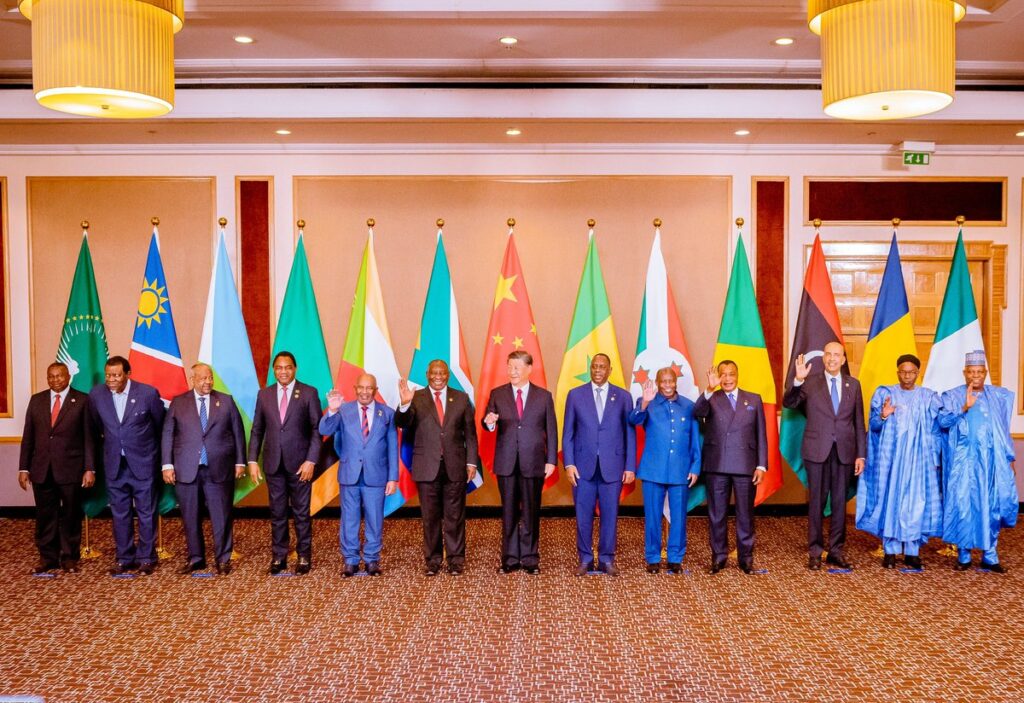
Nigeria is using its growing relationship with BRICS to demand more than a seat at the table. At the bloc’s 18th Leaders’ Summit in New Delhi, President Bola Ahmed Tinubu called for an overhaul of global governance structures and international financial institutions, arguing that the institutions shaping the world economy no longer adequately reflect today’s economic and demographic realities. The message was delivered on his behalf by Vice President Kashim Shettima, who represented Nigeria at the summit.
The intervention comes at a time when emerging economies are increasingly challenging the traditional distribution of power within institutions such as the United Nations Security Council, the International Monetary Fund and the World Bank. For Nigeria, the BRICS platform is therefore becoming an opportunity to argue for greater influence for Africa while simultaneously pursuing trade, investment and technology partnerships with some of the world’s fastest-growing economies.
Nigeria Wants the Global System Rewritten.
Speaking at the summit, Tinubu said Nigeria supports a more representative, equitable and responsive global governance architecture, including reforms to the UN Security Council and the international financial system. His argument was that global institutions should reflect contemporary political, economic and demographic realities rather than structures established decades ago.
The Nigerian president also connected the reform agenda to the wider rise of the Global South. BRICS, he argued, provides an important platform for emerging economies to increase their collective voice and push for a more inclusive international order. The position aligns with a broader debate across Africa about whether the continent should continue operating within international systems largely designed without its full participation.

The United Nations itself has acknowledged the need for institutional reform. Secretary-General António Guterres, speaking at the BRICS summit, called for changes to the UN Security Council, the Bretton Woods system and the wider international financial architecture, arguing that global institutions must reflect today’s economic, demographic and geopolitical realities.
From Dialogue to Investment.
Nigeria, however, is not presenting BRICS simply as a diplomatic platform. Tinubu called for a partnership that moves from dialogue to implementation and produces measurable development outcomes.
That means attracting investment into sectors that can strengthen Nigeria’s productive capacity, including manufacturing, agriculture, energy, infrastructure, healthcare and critical minerals. The government also highlighted opportunities in artificial intelligence, fintech, telecommunications, cybersecurity, biotechnology and advanced manufacturing.
The emphasis on technology is particularly important. Nigeria wants to position its large young population not simply as a consumer market for foreign technology but as a source of innovation, intellectual property and skilled labour.
The president’s message was blunt: developing countries need to produce technology and own the knowledge behind it. For Nigeria, deeper cooperation with BRICS could therefore become a route toward technology transfer, local manufacturing and the development of businesses capable of competing beyond the domestic market.
Nigeria Pitches Itself as Africa’s Gateway.
One of the strongest commercial messages from New Delhi was Nigeria’s attempt to position itself as an entry point into Africa’s wider market.
Tinubu urged foreign investors to view Nigeria as a gateway to Africa’s expanding market under the African Continental Free Trade Area. With Nigeria’s enormous population and strategic position in West Africa, the government believes investment in the country can provide access to opportunities beyond its own borders.
That argument is becoming increasingly important as African countries attempt to turn AfCFTA from a political agreement into a functioning economic market. If Nigeria can attract more manufacturing, technology and logistics investment, it could potentially serve as one of the continent’s largest production and distribution centres.
But the opportunity comes with a major challenge. Investors will ultimately judge Nigeria not by speeches at international summits but by the country’s infrastructure, regulatory environment, energy reliability, security, currency stability and ability to make businesses competitive.
BRICS Opens a Different Economic Door.
Nigeria became a BRICS partner country rather than a full member, giving it a platform to engage with the expanded grouping without becoming part of its core membership structure. The partnership nevertheless provides access to conversations involving some of the world’s most important emerging economies.
The wider BRICS agenda is also moving toward practical economic cooperation. The group’s leaders have backed greater use of local currencies in trade, stronger cross-border payment systems and reforms to international financial institutions. BRICS finance ministers and central bank governors had already called for changes to global development financial institutions before the leaders’ summit.
For African economies, these discussions could eventually have real consequences. Cheaper cross-border payments, greater use of local currencies and easier access to development finance could reduce some of the barriers that currently make African trade expensive.
The challenge, however, is converting declarations into functioning systems. BRICS itself remains a diverse grouping with significant differences between its members, meaning ambitious announcements do not automatically translate into coordinated action.
What Does This Mean for Africa?
Nigeria’s BRICS strategy reflects a broader shift in African diplomacy. Rather than relying primarily on traditional Western institutions and markets, major African economies are increasingly attempting to diversify their economic partnerships and negotiate from a stronger position.
For Nigeria, the strategy is also about domestic transformation. Tinubu’s government wants foreign partnerships to create jobs, expand infrastructure, strengthen manufacturing, improve technology capabilities and increase Nigeria’s ability to withstand global economic shocks.
That makes the real test much bigger than BRICS membership or diplomatic visibility. Nigeria must demonstrate that international partnerships can produce factories, digital businesses, energy projects, skilled jobs and stronger African trade.
If that happens, the country’s BRICS engagement could become an important component of its economic strategy. If not, the summit risks becoming another high-profile diplomatic moment without enough impact on ordinary Nigerians.
Nigeria Wants a Seat at the Table — and a Bigger Table for Africa.
The significance of Nigeria’s message in New Delhi is that it combines two ambitions. Tinubu is demanding greater African influence over the institutions that govern the global economy while simultaneously asking investors to see Nigeria as one of the continent’s most important commercial gateways.
The strategy is consistent with the wider push by emerging economies for a more multipolar international system. But Africa’s influence will ultimately depend on its ability to convert diplomatic demands into economic strength.
For Nigeria, that means using BRICS not simply to criticise the existing global order, but to secure investment, technology, trade opportunities and partnerships that can strengthen its productive economy.
The next stage will therefore be measured not by how strongly Nigeria speaks at global summits, but by what those partnerships deliver at home and across Africa.

Comments (0)
No comments yet — be the first to share your thoughts.