

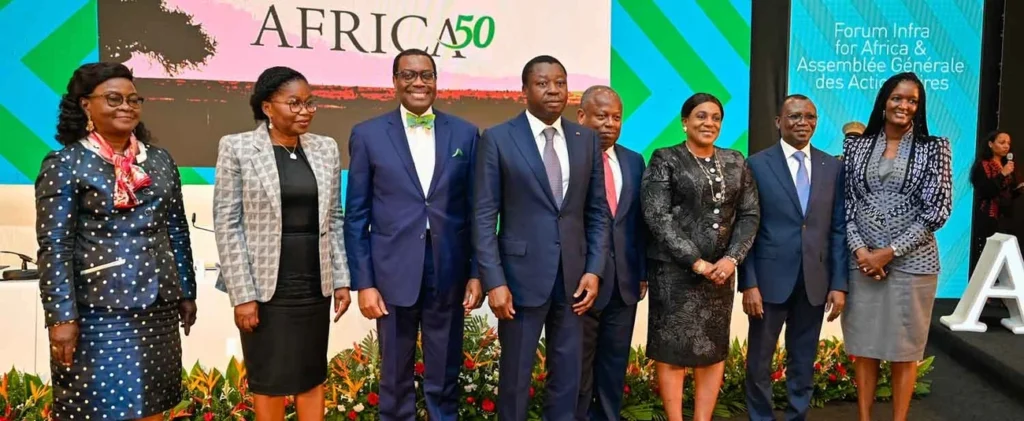
Africa is preparing for a major new wave of infrastructure investment as pan-African investment platform Africa50 targets at least $20 billion in infrastructure projects over the next five years, more than doubling the value of the projects it currently backs.
The Casablanca-based investment platform currently has interests in 36 projects with a combined value of about $9 billion, spanning power generation, transport, logistics, digital infrastructure and other strategic sectors. Africa50 itself has committed roughly $500 million in equity, using its capital to attract much larger pools of financing from governments, development institutions and private investors.
Africa50 Wants to Multiply Its Impact.
Africa50 Chief Operating Officer Tshepidi Moremong said the organisation wants to double or potentially triple the value of projects in which it participates. The target of at least $20 billion is therefore not simply an ambition to increase Africa50’s own direct investment, but to significantly expand the overall value of projects that its capital helps bring to financial close.
That distinction is important for African infrastructure. Large projects often require billions of dollars, meaning development institutions and investment platforms cannot finance the continent’s infrastructure needs through their own balance sheets alone. Africa50’s strategy is built around using its equity to reduce risks and attract additional investors.

Power Remains a Major Priority.
Electricity generation and transmission are expected to remain among Africa50’s most important investment areas. Reliable electricity remains one of the biggest constraints on industrialisation, manufacturing and digital expansion across the continent.
Africa50 has already invested in power-generation projects in countries including Nigeria, Egypt, Cameroon and Madagascar. Its portfolio also extends into information and communications technology, transport, logistics and healthcare, giving the organisation exposure to several of the sectors most closely connected to Africa’s economic transformation.
One major example is its partnership with India’s PowerGrid and the Kenyan government to develop approximately $311 million of high-voltage electricity transmission infrastructure through a public-private partnership. The project demonstrates the type of infrastructure financing model Africa50 is seeking to expand across the continent.
Africa Still Faces a Massive Infrastructure Gap.
Africa50’s expansion comes against a backdrop of enormous infrastructure needs. The African Development Bank estimates that Africa requires between $130 billion and $170 billion every year for infrastructure investment across areas such as energy, transport, water and sanitation, digital infrastructure, health and education.
The challenge is not simply finding money. African countries also need projects that are sufficiently structured and commercially attractive to convince private investors to commit capital over long periods. Currency risk, regulatory uncertainty, political risk and lengthy development periods can make infrastructure projects difficult to finance.
This is where Africa50’s model could become increasingly important. By participating at the project level and bringing development partners and private investors into the same structure, the platform can potentially help transform projects that might otherwise struggle to secure financing into investable opportunities.
Renewable Energy Becomes Another Growth Area.
Africa50 is also expanding its renewable-energy financing activities. Its Distributed Renewable Energy Fund recently secured $71 million in commitments from the International Solar Alliance, Nigeria Sovereign Investment Authority and the World Bank Group.
The fund is targeting a final size of $200 million and will invest in distributed renewable-energy companies across Africa. Such investments could help expand electricity access through smaller-scale systems and renewable-energy businesses, particularly in communities where extending conventional national grids remains expensive or technically difficult.
The renewable-energy strategy also reflects a wider shift in African infrastructure financing. Investors are increasingly looking beyond traditional large power plants and national grids toward solar, distributed energy, digital infrastructure and other technologies capable of supporting businesses and households more efficiently.
Africa50 Looks Beyond Traditional Infrastructure Financing.
Another part of Africa50’s strategy involves operating infrastructure assets rather than simply investing in their construction. The organisation has entered an agreement to operate the Senegambia Bridge, linking Senegal and The Gambia, under a model that allows it to collect tolls while maintaining and upgrading the infrastructure.
Africa50’s management expects this type of asset-recycling and infrastructure-operations business to potentially represent 20% to 25% of its portfolio in the future. The approach gives the platform another way to generate returns while remaining involved in strategic African infrastructure.
The Bigger Business Opportunity.
Africa50’s $20 billion target highlights a broader shift in African infrastructure financing. Governments remain critical players, but public budgets alone cannot meet the continent’s infrastructure requirements. The next phase will increasingly depend on partnerships between African governments, development finance institutions, pension funds, commercial investors and specialised infrastructure platforms.
For businesses, the implications extend well beyond construction. Better electricity networks can support manufacturing, while improved roads, ports and logistics systems can reduce the cost of moving goods. Digital infrastructure can expand financial services and technology businesses, while renewable-energy investment can create new markets for African companies.
Africa50’s ambition is therefore not simply about building a larger investment portfolio. If the platform succeeds in mobilising billions of dollars of additional private capital, its impact could be measured in power plants, transmission lines, roads, logistics networks, data infrastructure and businesses operating across multiple African markets.
The real test will be whether Africa50 can turn its $20 billion ambition into bankable projects, actual financing and completed infrastructure. For a continent facing one of the world’s largest infrastructure financing gaps, that conversion from investment ambition to physical assets could have a major effect on Africa’s next phase of economic growth.

Comments (0)
No comments yet — be the first to share your thoughts.