

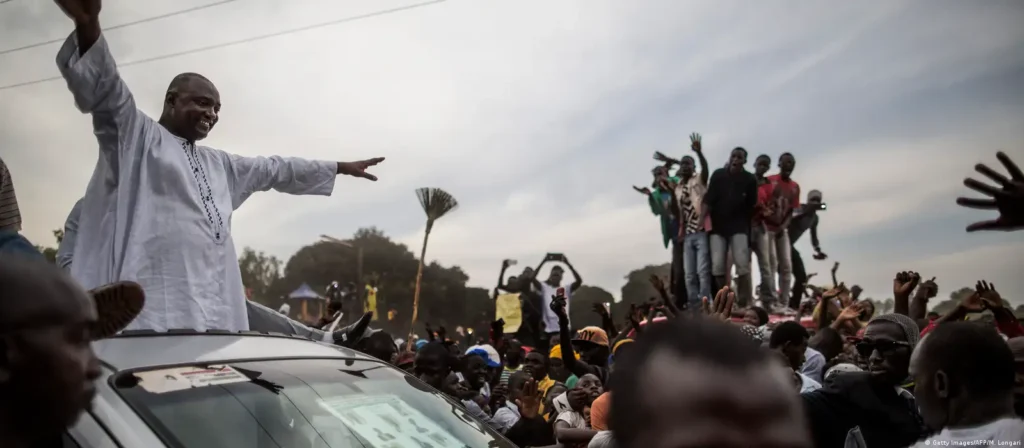
Protests erupted across parts of The Gambia overnight on September 7 and into September 8, with demonstrators burning tyres, erecting barricades and demanding an end to prolonged electricity shortages. The unrest has placed renewed pressure on President Adama Barrow’s government just months before the country is expected to hold presidential elections.
In the capital Banjul and surrounding areas, protesters gathered near the president’s official residence and chanted slogans calling for Barrow to leave office. Police used tear gas to disperse some of the demonstrators. Similar protests were reported in Farato, where demonstrators gathered outside the residence of Vice President Mohammed B.S. Jallow and vandalised a ruling National People’s Party office.
Electricity Crisis Fuels Public Anger.
The immediate trigger for the protests is a worsening electricity crisis that has left some residents without power for periods of up to 48 hours.
The National Water and Electricity Company, known as NAWEC, has attributed the disruption to a combination of unusually high electricity demand caused by hot weather and a technical problem affecting one of its major generating units. The utility had previously warned that load shedding would be necessary across several parts of the country.

For households and businesses, however, the technical explanations have done little to ease frustration. Electricity shortages affect commercial activity, refrigeration, communications, education and household life, making the reliability of the power supply one of the most visible measures of government performance.
Protesters Turn Energy Crisis Into Political Message.
What makes the latest demonstrations particularly significant is that they have moved beyond complaints about electricity and directly targeted the political leadership.
The chants of “Barrow must go” reflect a broader frustration with the government’s handling of basic services. In Farato, protesters also targeted symbols associated with the ruling party, suggesting that the power crisis is increasingly being interpreted through a political lens.
The protests were largely brought under control by Tuesday morning, with traffic returning to normal in Banjul. But the speed with which an electricity problem developed into a political protest demonstrates the sensitivity surrounding public services as the country moves toward another presidential contest.
Barrow Faces a Difficult Political Test.
President Barrow is seeking a third term in the presidential election expected in December. That makes the electricity crisis particularly uncomfortable for his administration.
Barrow came to power in 2017 after defeating longtime ruler Yahya Jammeh, bringing an end to more than two decades of authoritarian rule. He was re-elected in 2021 and has since sought to consolidate his political position.
The coming election will therefore provide another major test of public confidence in his administration. Persistent electricity shortages could become an important campaign issue if opposition parties succeed in connecting the crisis to broader questions about governance, economic management and public accountability.
Government Expected to Respond.
Barrow was scheduled to visit NAWEC facilities on Tuesday and address the nation later in the evening, according to Reuters reporting.
His response could be politically important. The government needs to demonstrate that it has a credible plan for restoring reliable electricity while convincing citizens that the latest disruption is temporary rather than evidence of deeper structural problems within the energy sector.
The challenge is not entirely new. The Gambia has struggled with electricity reliability for years, with limited generation capacity and dependence on imported electricity contributing to vulnerabilities in the national power system.
A Basic Service Becomes an Election Issue.
The political significance of the current crisis goes beyond the immediate blackouts.
Electricity is one of the services through which citizens experience government most directly. When supply becomes unreliable for days at a time, the consequences are felt by businesses, students, hospitals, households and public institutions.
That makes the energy crisis potentially more damaging politically than a conventional policy dispute. Voters do not have to follow political debates to understand the impact of electricity shortages; they experience the consequences in their homes and workplaces.
The Gambia’s recent political history also means authorities will be conscious of how public demonstrations are handled. The country has made significant progress since the end of Jammeh’s rule, but the latest protests demonstrate how quickly public frustration can become a political challenge.
The December Election Looms Larger.
The protests have arrived at a sensitive moment for President Barrow. If electricity supplies stabilise quickly, the government may be able to contain the political damage. But if prolonged outages continue, opposition parties could increasingly use the issue to argue that the government has failed to deliver basic services.
For Barrow, the immediate task is therefore twofold: restore electricity and restore public confidence.
The events of September 8 show that in The Gambia’s approaching election season, the politics of electricity may become almost as important as the politics of personalities and parties. What began as frustration over the absence of power has already developed into a direct challenge to the government’s authority, and how Barrow responds could influence the political atmosphere heading into December.

Comments (0)
No comments yet — be the first to share your thoughts.