

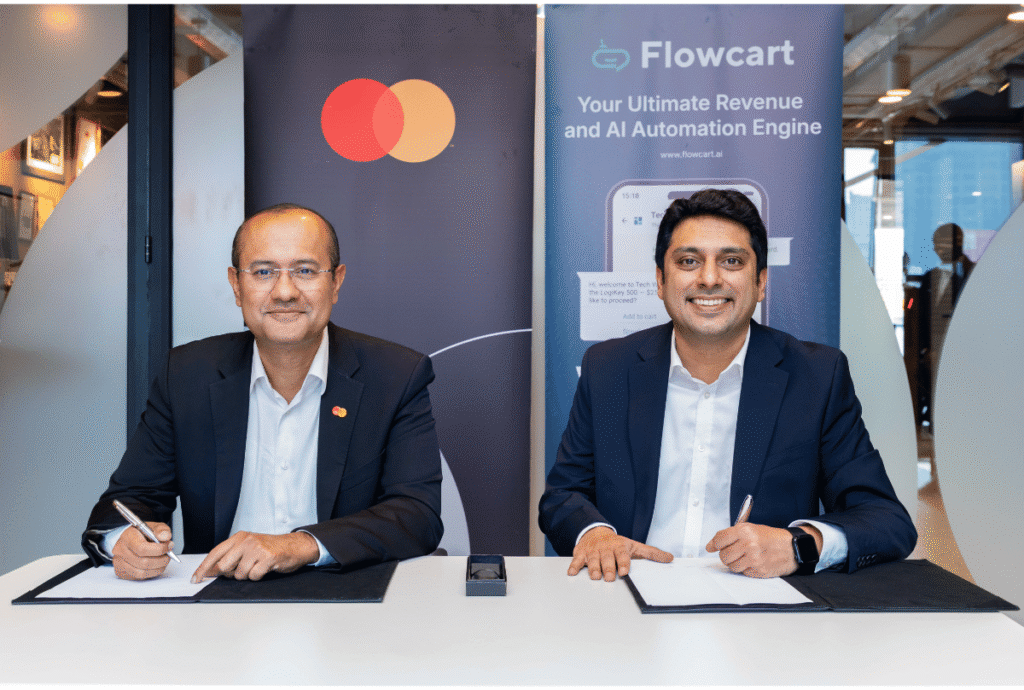
Mastercard has partnered with African commerce technology company Flowcart to introduce a new chat-based payment system that could change how consumers and small businesses buy and sell online across East Africa.
The collaboration, announced on September 7, will initially launch in Kenya before expanding to other East African markets and eventually to major African markets including South Africa, Nigeria and Côte d’Ivoire. The technology will allow customers to discover products, place orders and complete card payments within a conversation without being redirected to a separate website or application.
Turning Conversations Into Digital Shops.
The partnership reflects the rapid growth of social commerce across Africa, where businesses increasingly use platforms such as WhatsApp to communicate directly with customers, display products, receive orders and arrange payments.
Instead of asking customers to leave a messaging platform and visit an online store, the new system is designed to keep the entire purchasing journey inside the conversation.

A customer could discover a product, ask questions, place an order and make a payment without leaving the digital environment where the conversation began. Mastercard and Flowcart say this could reduce friction during the purchasing process and potentially improve the number of customers who complete transactions.
Kenya Becomes the Starting Point.
Kenya has been selected as the initial market for the collaboration, reflecting the country’s increasingly sophisticated digital commerce ecosystem.
WhatsApp has become an important channel for Kenyan businesses and informal sellers, with TechAfrica News reporting that more than 20 percent of online shopping orders in the country now take place through the platform. This growing dependence on conversational commerce has created demand for payment systems that can operate naturally within messaging environments.
The opportunity is particularly significant for small businesses that may not have the resources to build and maintain sophisticated e-commerce websites.
Under the new model, merchants can use embedded links, QR codes and checkout flows supported by Mastercard Gateway and its acquiring partners.
A New Opportunity for Social Sellers.
The partnership is also targeting Kenya’s growing creator economy. Social-media creators, influencers and independent sellers increasingly use their audiences to generate direct sales, but converting that attention into completed transactions can still require customers to move between multiple platforms.
Flowcart’s technology is designed to bring those stages together.
For a social seller, the process could eventually look much simpler: promote a product through a social or messaging platform, communicate with a customer, receive the order and complete payment within the same digital journey.
That could be particularly valuable for micro, small and medium-sized enterprises that rely on social media rather than conventional retail infrastructure.
AI Meets Digital Payments.
Flowcart brings an AI-powered commerce orchestration platform to the partnership, while Mastercard provides its global payments network and Mastercard Gateway infrastructure.
The combination reflects a broader movement in technology toward embedded commerce, where payment functions become part of the digital experience rather than a separate step at the end of a transaction.
Mastercard said the partnership is intended to support merchants ranging from independent social sellers and SMEs to larger enterprises, while also expanding digital payment acceptance among underserved and informal businesses.
The technology also uses tokenised card information to support repeat purchases, allowing customers to make subsequent transactions more smoothly while maintaining security protections.
Small Businesses Want Simpler Payments.
The initiative comes as Kenyan businesses continue to demand easier digital payment solutions. According to Mastercard’s 2026 SME Confidence Index, 80 percent of Kenyan SMEs identify simple, seamless and user-friendly payment methods as an important requirement for future growth.
That demand reflects a broader challenge across African markets. Digital payments have expanded rapidly, but many small businesses still operate across fragmented systems involving mobile money, bank transfers, card payments, messaging applications and physical cash.
Reducing the number of steps required to complete a transaction could make digital commerce more accessible to businesses that have traditionally operated outside formal e-commerce systems.
Expansion Beyond Kenya.
The Kenyan launch is only the beginning of Mastercard and Flowcart’s plans. The companies intend to expand the service across East Africa before moving into other high-growth African markets, including South Africa, Nigeria and Côte d’Ivoire.
That expansion could make the partnership significant beyond payments. If conversational commerce becomes increasingly integrated with digital financial services, messaging platforms could evolve into important commercial infrastructure for African businesses.
For millions of consumers already using mobile phones as their primary connection to financial services and commerce, the distinction between messaging, shopping and payment could become increasingly blurred.
Africa’s Commerce Is Moving Into the Conversation.
The Mastercard-Flowcart partnership points to a wider shift in how digital commerce is developing across Africa. Rather than simply reproducing traditional online shopping models, African technology companies are increasingly building around the platforms consumers already use every day.
In markets where WhatsApp and other messaging services have become important business channels, the next stage of e-commerce may not necessarily involve opening another website or downloading another application. It could happen directly inside the conversation.
For Kenya’s entrepreneurs and Africa’s growing social-commerce economy, Mastercard and Flowcart are betting that the future of digital payments will be less about moving customers from one platform to another and more about making the transaction almost invisible within the customer experience.

Comments (0)
No comments yet — be the first to share your thoughts.