

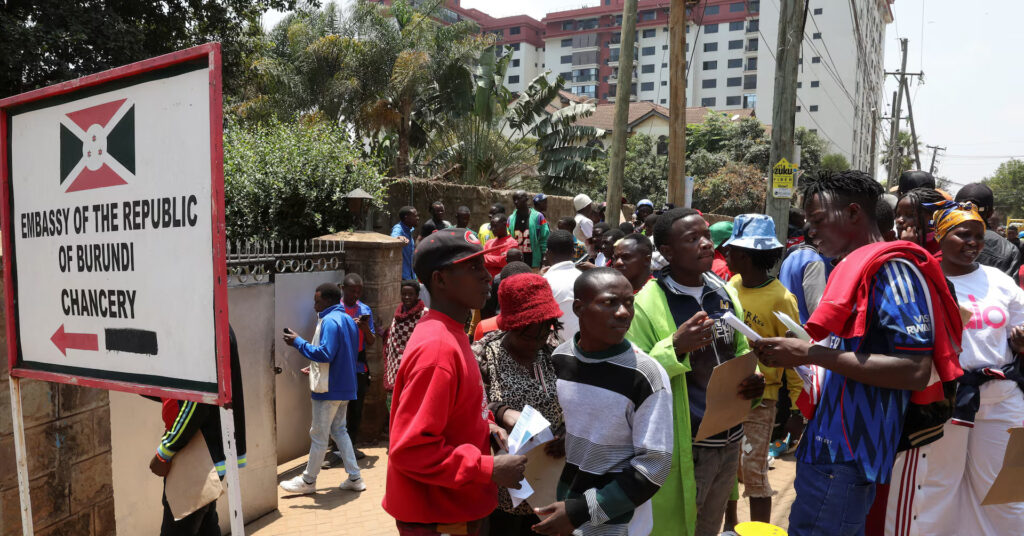
Hundreds of Burundians gathered outside their country’s embassy in Nairobi on Monday seeking travel documents to return home, as Kenya began implementing President William Ruto’s directive targeting foreign nationals operating small-scale businesses without the required permits.
The scenes in Nairobi have quickly turned a domestic economic policy into a wider political and diplomatic issue. Many of those seeking assistance arrived with suitcases and personal belongings, saying they feared losing their livelihoods or facing hostility as the government’s new measures take effect.
Ruto’s Directive Targets Small-Scale Foreign Traders.
Ruto announced the crackdown last week after meeting Kenyan traders who had been protesting against tax reforms and demanding greater protection for local businesses.
The President called for authorities to close small-scale businesses operated by foreign traders, including activities such as hawking and small retail. Kenya’s Trade Ministry subsequently clarified that the directive applies to foreigners operating without valid work permits.

The government has defended the policy as part of its effort to protect Kenyan entrepreneurs from competition in areas of the economy that it believes should primarily benefit citizens.
Ruto has previously argued that foreign investment remains welcome in Kenya, particularly in sectors requiring significant capital, but has drawn a distinction between major investment and small-scale activities where Kenyan citizens are directly competing for livelihoods.
Burundians Fear They Have Little Choice.
For many Burundians living in Nairobi, however, the announcement has created immediate uncertainty.
Reuters reported that long queues formed outside the Burundian Embassy on Monday as nationals sought travel documents and assistance to return home. Some said they had been forced to consider leaving despite having established businesses and lives in Kenya.
Among those affected are Burundian refugees and asylum seekers. The United Nations refugee agency estimates that around 16,000 Burundian refugees and asylum seekers are living in Kenya, with many involved in small-scale economic activities in Nairobi.
Some of those at the embassy also reported receiving threats from neighbours following Ruto’s remarks, adding a security dimension to what was initially presented as an economic and regulatory measure.
The situation has left some foreign traders facing an uncomfortable choice: attempt to regularise their businesses and remain in Kenya, or leave the country before enforcement becomes more widespread.
Opposition Warns of Wider Political Consequences.
The crackdown has already attracted criticism from Kenya’s opposition.
Wiper Patriotic Front leader Kalonzo Musyoka called for dialogue rather than what he described as a heavy-handed approach. He argued that Kenya could protect local businesses while still allowing foreign traders who comply with the law to operate.
Kalonzo also warned that the policy could have economic and diplomatic consequences, particularly because Kenya is approaching the 2027 general election.
The opposition’s criticism reflects a larger political question: whether the government’s measures are primarily about enforcing immigration and business regulations or whether the issue is increasingly being used to respond to economic frustration among Kenyan voters.
Critics of Ruto have accused his administration of making foreigners convenient targets for economic problems ahead of the election. Activist Hanifa Adan, writing in the Daily Nation, argued that governments facing economic difficulties can be tempted to identify outsiders as the source of public frustration.
A Regional Issue for East Africa.
The developments are particularly sensitive because Kenya is one of the major economic centres of the East African Community, where regional integration is intended to facilitate the movement of people, goods, services and capital.
The sudden movement of Burundians seeking to leave Kenya therefore raises questions about how national economic protection policies can coexist with East Africa’s broader integration agenda.
Kenya’s Foreign Affairs Principal Secretary Korir Sing’Oei has sought to reassure citizens of neighbouring countries and other African nationals amid concerns over the interpretation of Ruto’s comments.
The distinction between foreigners operating legally and those without the necessary permits is likely to become increasingly important as enforcement continues. Kenya has the right to regulate employment and business activity, but the manner in which those rules are implemented could determine whether the policy remains a regulatory exercise or develops into a broader diplomatic dispute.
The 2027 Election Adds Political Pressure.
The timing of the crackdown is also significant.
Ruto is expected to seek a second term in the 2027 presidential election, and economic pressure is likely to remain one of the defining issues of the campaign. Small businesses provide livelihoods for millions of Kenyans, making taxation, competition, access to markets and the cost of doing business politically sensitive subjects.
For the government, demonstrating that Kenyan entrepreneurs are being protected could strengthen its appeal among small-business owners.
But the political risks are equally clear. If the crackdown results in accusations of xenophobia, harassment or collective punishment, it could damage Kenya’s reputation as a regional economic hub and complicate relations with neighbouring countries whose citizens contribute to the Kenyan economy.
The immediate scenes in Nairobi suggest that the consequences are already extending beyond business regulation. As Burundians queue for travel documents and governments attempt to clarify the policy, President Ruto’s attempt to protect Kenyan small businesses has become a test of how Kenya balances economic nationalism with regional integration, migrant rights and diplomatic relations.
The coming days will determine whether the crackdown remains a targeted enforcement exercise against undocumented businesses or develops into a larger political and regional controversy.

Comments (0)
No comments yet — be the first to share your thoughts.