

Frontline workers face a painful battle between public health and traditional mourning.
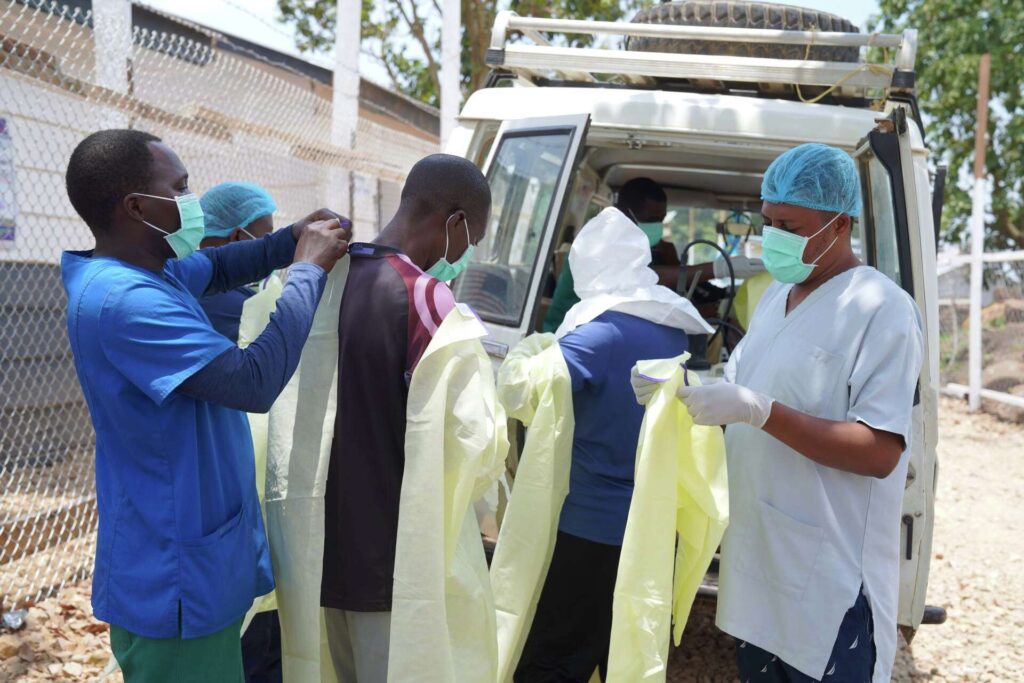
As Ebola continues to spread across eastern Democratic Republic of Congo, a group of workers is facing one of the most difficult responsibilities in the country’s health crisis: burying people who have died from the virus while protecting the living from further infection.
Members of safe and dignified burial teams in Ituri province are working almost every day to prepare bodies, disinfect coffins and conduct burials under strict infection-prevention procedures. But the teams are increasingly overwhelmed by the number of deaths and the emotional and physical pressure of their work.
The outbreak has now killed nearly 3,200 people among more than 6,500 confirmed cases, according to the latest reporting. It has spread across six provinces, with conflict, displacement and weak health infrastructure making containment increasingly difficult.
When public health clashes with tradition.
For families who lose loved ones, burial is an important part of mourning. In many Congolese communities, washing the body, touching the deceased and carrying out traditional ceremonies are important expressions of respect.

Ebola creates a painful conflict between those traditions and the need to prevent transmission. The virus can remain infectious after death, meaning that direct contact with the body can expose mourners to infection.
Burial teams therefore have to follow strict procedures. Bodies are placed in protective bags, surfaces are disinfected and trained workers wearing protective equipment handle the remains.
For grieving relatives, however, these procedures can make the final farewell feel distant and impersonal. Some families have complained that they cannot touch or properly prepare their loved ones before burial.
Burial teams are becoming targets of frustration.
The workers carrying out these burials are not only confronting the risk of infection. They are also facing anger from communities that sometimes view the procedures as a violation of cultural traditions.
Members of burial teams have reported verbal threats and, in some cases, physical attacks from relatives demanding access to the bodies of loved ones.
The hostility reflects a wider problem in epidemic response: when communities do not trust health authorities, even measures designed to protect them can be interpreted as threats.
The World Health Organization has warned that rumours, fear of treatment centres and resistance to safe burial practices can delay people from seeking care, reporting cases and cooperating with contact tracing.
Trust may be as important as medicine.
The Ebola crisis is therefore becoming a test of how effectively public health authorities can work with communities.
Health officials cannot rely only on medical teams and protective equipment. They also need local leaders, religious figures, community organisations and families to understand why certain restrictions are necessary.
In Ituri, community dialogue programmes are being used to explain Ebola prevention measures and address concerns about safe burials. The approach recognises that communities cannot simply be treated as recipients of instructions. They must be involved in the response.
That lesson is important beyond the current outbreak. Africa has repeatedly experienced health emergencies in which misinformation, fear and distrust have complicated efforts to contain disease.
The workers behind the statistics.
The Ebola crisis is often measured through numbers: infections, deaths, recoveries and affected health zones. But behind those statistics are workers who must repeatedly confront the human consequences of the outbreak.
For burial teams, every coffin represents a family that has lost someone. Their job requires them to protect the wider community while working in the middle of grief, fear and sometimes anger. That makes their role one of the most difficult in the entire Ebola response.
A crisis that requires more than containment.
The experience of Congo’s burial teams shows that controlling an epidemic is not simply a medical exercise. It is also a social and cultural challenge.
Authorities must protect communities from infection without ignoring the dignity of the people who have died. Families must be given opportunities to mourn while dangerous forms of physical contact are prevented.
The challenge is finding that balance. As Ebola continues to spread, the success of the response may depend not only on how quickly health workers identify cases, but also on whether communities trust the people asking them to change some of their most deeply held practices.
In eastern DRC, the people carrying out safe burials are therefore fighting two battles at once: against a deadly virus and against the fear, grief and mistrust that can allow it to spread.

Comments (0)
No comments yet — be the first to share your thoughts.