
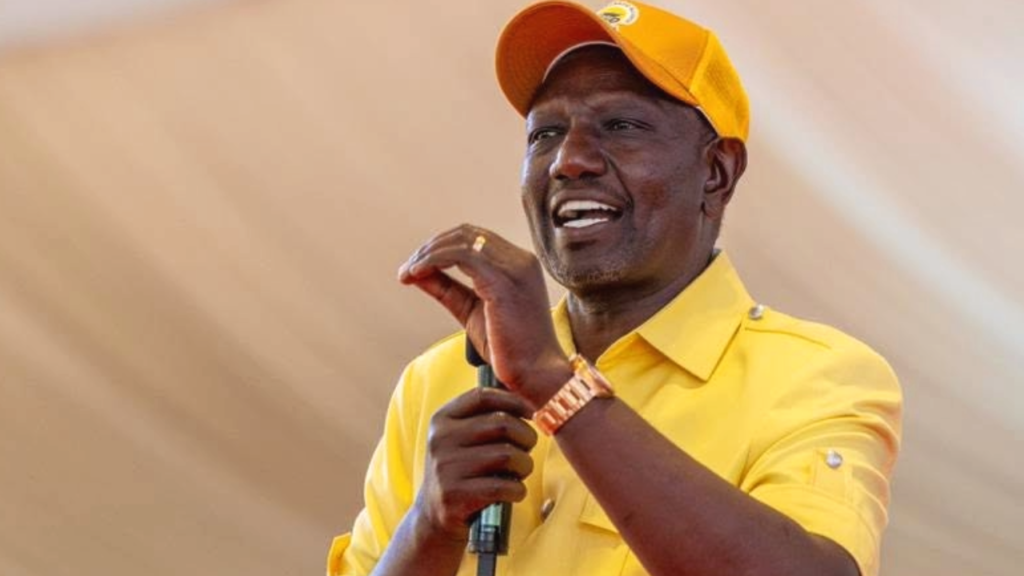
Kenya has ordered foreign nationals operating in parts of the country’s small-scale trading sector to shut down their businesses from September 7, in a major new move by President William Ruto to reserve selected economic opportunities for Kenyan citizens. The directive, announced on September 2 during a meeting with Micro, Small and Medium Enterprise traders at State House in Nairobi, targets activities including hawking and small retail businesses and has immediately raised questions about immigration enforcement, local economic protection and Kenya’s commitments to regional trade integration.
Ruto presented the decision as a measure to protect Kenyan entrepreneurs from what his administration considers unfair competition. The president argued that Kenya had worked to improve investor confidence in order to attract productive investment rather than foreign nationals coming into the country to compete with Kenyan citizens in low-capital businesses. He specifically questioned why foreigners should enter Kenya to operate as hawkers or run small shops when those activities can be undertaken by Kenyan traders.
Ruto Draws a Line Between Investment and Small-Scale Trade.
The president’s argument is based on a distinction between foreign investment and foreign participation in Kenya’s informal and small-business economy. Ruto has indicated that Kenya remains open to international investors but does not intend for foreign nationals to occupy commercial opportunities that the government believes should be available primarily to local entrepreneurs.
That distinction is politically important because small-scale trading is central to Kenya’s economy and provides livelihoods for large numbers of people. Hawkers, market traders, small retailers and other informal businesses operate at the heart of commercial activity in Nairobi and across the country’s towns and trading centres. For local traders who have complained about foreign competition, the government’s intervention is therefore being presented as a direct response to a long-standing economic concern.

Ruto has directed the Ministry of Investments, Trade and Industry to begin enforcement measures next week. Reports indicate that the government intends to start the operation on Monday, September 7, meaning affected foreign traders have only a few days to determine whether their businesses fall within the categories targeted by the directive.
Proposed Law Could Give the Crackdown a Broader Legal Framework.
The September 7 directive comes as Parliament considers legislation intended to define economic activities that could be reserved for Kenyan citizens. Ruto has called on National Assembly Majority Leader Kimani Ichung’wah and Trade Cabinet Secretary Lee Kinyanjui to accelerate work on the proposed Local Content Bill, 2025.
The president said the legislation would establish, in law, categories of businesses that foreigners would not be permitted to operate. Hawking and small retail shops were among the activities he specifically identified.
The timing creates an important legal and administrative question. The government appears determined to begin enforcement before the legislative process is complete, with reports indicating that administrative measures will be used rather than waiting entirely for Parliament to pass the proposed law. That raises questions about precisely which businesses will be affected, how authorities will identify foreign operators and what legal procedures traders will have to challenge enforcement actions.
For foreign nationals who have established businesses legally and invested capital in Kenya, the distinction between illegal trading and legitimate commercial activity could become particularly important. The government’s implementation will therefore be closely watched by business associations, immigration authorities, lawyers and Kenya’s regional partners.
East African Trade Integration Faces a New Test.
The policy could also have consequences beyond Kenya’s domestic economy. Kenya is a major member of the East African Community, whose Common Market framework is designed to facilitate the movement of people, goods, services, labour and capital across participating countries.
That regional framework makes the issue more complicated than simply deciding which businesses Kenyan citizens should control. Foreign traders from neighbouring East African countries may argue that restrictions on their commercial activities could conflict with the broader objective of regional economic integration. Recent reporting has already highlighted concerns that the Kenyan decision could put additional pressure on Kenya-Tanzania commercial relations, particularly after both countries have sought to reduce barriers to cross-border trade.
The issue is particularly sensitive because restrictions imposed by one country can quickly invite reciprocal measures. Kenyan traders operating in neighbouring countries could potentially face renewed scrutiny if governments conclude that their own citizens are being disadvantaged in Kenya. That could turn a domestic policy intended to protect small businesses into a wider debate about reciprocity and the future of cross-border commerce in East Africa.
Foreign Traders Are Becoming a Political Flashpoint.
The decision also comes at a time when economic pressure on Kenyan small businesses has become increasingly political. Traders have recently protested over import-related costs, arguing that higher customs benchmarks and other expenses were making it increasingly difficult to operate profitable businesses. Police used tear gas to disperse traders during demonstrations in Nairobi on August 28 following changes to customs valuation procedures.
Against that background, Ruto’s latest directive gives the government an opportunity to position itself as responding directly to the concerns of small traders. Protecting local businesses is an easily understood political message, particularly for entrepreneurs who believe they are competing against foreign operators with greater access to capital or cheaper supply chains.
The president’s language reflects that political calculation. His message is not simply that immigration laws should be enforced; it is that the government must decide who gets access to particular economic opportunities. By placing Kenyan citizens at the centre of the policy, Ruto is framing the issue around economic ownership and local participation.
Concerns Over Xenophobia Could Complicate the Policy.
The government will nevertheless have to manage the policy carefully to prevent legitimate economic regulation from developing into discrimination against foreign nationals. Kenya has a large expatriate and migrant population, including citizens from neighbouring African countries and major trading partners.
The immediate concern is whether enforcement will focus strictly on specific businesses and immigration or work-permit violations, or whether foreign nationals could face broader hostility because of their nationality. Anadolu Agency noted that the announcement has already generated concerns about anti-migrant rhetoric in a region where tensions over foreign traders have emerged elsewhere.
There is an important difference between reserving defined economic activities for citizens through transparent legislation and encouraging hostility toward foreigners. Kenya’s government will therefore face pressure to ensure that enforcement is based on clearly established rules rather than nationality alone, particularly where foreign nationals have valid immigration status, business registrations or other legal permissions.
Local Businesses Could Benefit, But Competition Is Not the Only Challenge.
If implemented effectively, restrictions on foreign participation in selected small-scale businesses could create additional space for Kenyan entrepreneurs. Local hawkers and retailers who have struggled to compete could gain access to customers, trading locations and commercial opportunities previously occupied by foreign operators.
But removing competitors will not automatically solve the structural problems facing Kenya’s small businesses. Traders continue to deal with taxation, customs costs, expensive logistics, access to credit, inflationary pressure, limited purchasing power and regulatory uncertainty. The government’s own negotiations with traders over customs charges demonstrate that the cost of doing business remains a much broader problem. On September 3, Ruto announced measures including a reduction in the customs benchmark for general consolidated cargo from KSh2.5 million to KSh2 million, alongside a major reduction in a Kenya Railways cargo transport charge.
That suggests that the foreign trader crackdown is only one part of a much larger economic challenge. If Kenyan traders are to become more competitive, they will need not only protection from certain forms of competition but also better access to finance, more predictable taxation, affordable logistics and stronger infrastructure.
September 7 Will Put the Policy to the Test.
The immediate test will come when enforcement begins on September 7. The government’s ability to clearly define the businesses covered by the directive, distinguish lawful businesses from prohibited activities and manage the process without unnecessary confrontation will determine whether the policy becomes a workable economic intervention or a source of prolonged legal and diplomatic disputes.
For Kenya’s foreign traders, the next few days are likely to be marked by uncertainty as they seek clarification on whether their businesses are affected and what options remain available to them. For Kenyan traders, the announcement represents a significant political victory after repeated complaints about competition and the rising cost of doing business.
For the wider East African Community, however, the implications are more complicated. Kenya is attempting to strengthen economic opportunities for its own citizens while remaining part of a regional project built around greater movement and commercial integration. How Nairobi balances those two objectives could determine whether the crackdown remains a narrowly targeted domestic policy or becomes a new fault line in East Africa’s increasingly interconnected economy.

Comments (0)
No comments yet — be the first to share your thoughts.