
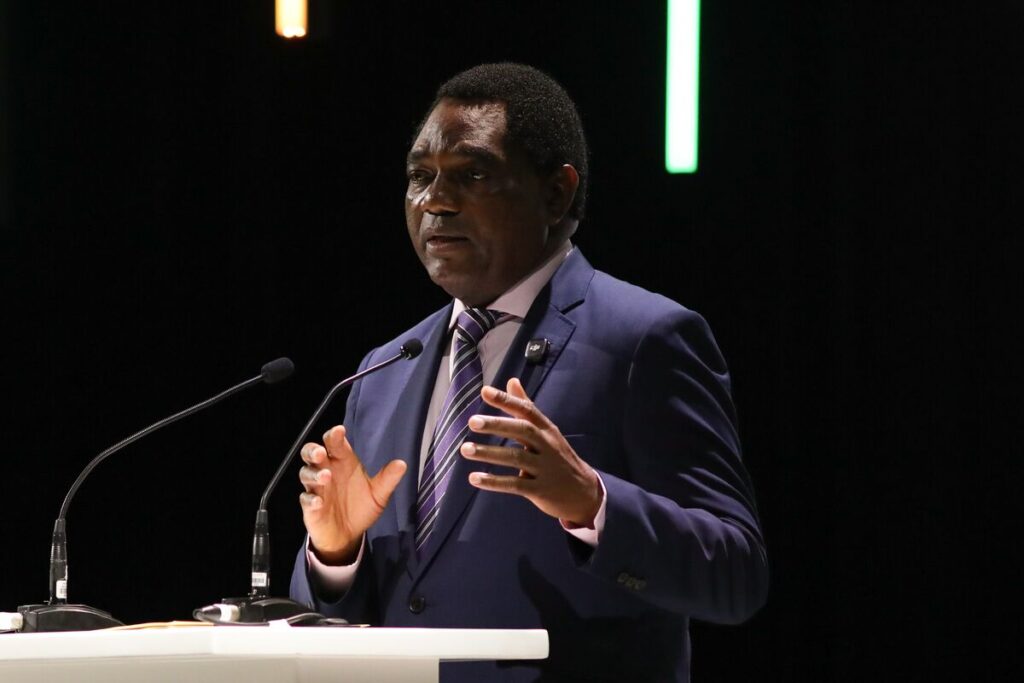
Global Bank Sees Stronger Investment Case for Zambia.
Citigroup has turned more positive on Zambia’s sovereign bonds following the re-election of President Hakainde Hichilema, signalling growing confidence among international investors in the country’s economic direction after a closely watched presidential election.
The US banking giant has upgraded Zambia’s international bonds to an “overweight” position and indicated that it expects to increase its exposure to the country’s local-currency government debt. The move comes shortly after Hichilema secured a second term, giving his administration another five years to pursue economic reforms, manage public finances and strengthen investor confidence.
For Zambia, the decision is significant because the country has spent several years dealing with one of Africa’s most difficult sovereign debt crises. The endorsement from one of the world’s major financial institutions suggests that investors are beginning to see a clearer path towards economic stability.
Hichilema’s Re-election Removes Some Political Uncertainty.
Hichilema’s return to office provides continuity at a time when Zambia is attempting to rebuild its economic credibility.

Since taking office in 2021, his administration has focused heavily on restructuring the country’s external debt, restoring relations with international creditors and creating conditions for renewed investment. Those efforts have included a lengthy restructuring process involving Zambia’s official creditors and private bondholders.
The successful conclusion of major parts of that restructuring has helped reduce some of the immediate pressure on the country’s public finances.
His re-election means investors are not facing an abrupt change in economic policy. Instead, the government is expected to continue with the reforms already underway. That continuity appears to be one of the factors behind Citi’s more optimistic assessment.
Zambia’s Debt Crisis Still Matters.
The renewed investor interest should not be interpreted as a declaration that Zambia’s economic problems are over. The country became the first African sovereign to default during the COVID-19 era after struggling to meet its external debt obligations. The subsequent restructuring process lasted several years and required difficult negotiations with creditors.
Zambia still faces significant fiscal pressures, and the government must maintain discipline if it wants to prevent the debt crisis from returning.
The challenge for Hichilema’s administration is therefore to turn debt restructuring into sustainable economic growth rather than simply temporary financial relief.
Mining Remains Central to the Investment Story.
Zambia’s economic prospects remain closely tied to its mining sector, particularly copper. The country is one of Africa’s leading copper producers, and the global transition towards electric vehicles, renewable energy and electrification has increased long-term demand for copper and other critical minerals.
The government has been seeking to increase mining production and attract fresh investment into the sector. Higher copper output could provide Zambia with additional export earnings, strengthen foreign-exchange reserves and increase government revenues.
For international investors, that creates a potentially attractive combination: improving fiscal conditions alongside exposure to a strategically important commodity sector.
But the benefits will depend on how effectively Zambia manages its mining industry, taxation policies and relationships with international investors.
Local-Currency Bonds Offer Another Opportunity.
Citi’s interest is not limited to Zambia’s international debt. The bank is also looking at local government securities, reflecting expectations that improvements in the broader economic environment could create opportunities in the domestic bond market.
Local-currency assets can become more attractive when investors believe that inflation, exchange-rate pressures and fiscal risks are becoming more manageable.
For Zambia, attracting foreign investment into domestic government debt would provide another source of financing while potentially improving liquidity in the country’s financial markets.
However, international investors remain sensitive to currency risk. Any significant depreciation of the Zambian kwacha could reduce returns for foreign investors even if local bond yields remain attractive.
The Election Result Has Sent a Broader Market Signal.
Citi’s decision comes at an important moment because political uncertainty can have a direct impact on financial markets. Investors generally prefer predictable policy environments. A clear election outcome gives businesses and financial institutions greater visibility over the direction of government policy.
Hichilema’s second term therefore provides continuity at a time when Zambia is trying to consolidate its economic recovery.
The challenge now is to convert political continuity into policy credibility. Investors will be watching government spending, debt management, monetary conditions, mining policy and progress on structural reforms.
Zambia Still Has to Deliver on the Optimism.
The most important part of Citi’s decision may not be the upgrade itself but what happens next.
A more positive investor outlook can help reduce borrowing costs and attract capital, but those benefits are not automatic. Zambia will need to demonstrate that the reforms undertaken during Hichilema’s first term can produce sustained economic improvements. The government will also face pressure to ensure that economic recovery reaches ordinary citizens.
Debt restructuring and improved investor sentiment are important, but they do not necessarily translate immediately into lower living costs, more jobs or higher household incomes. That will remain one of the central political challenges of Hichilema’s second term.
A New Chapter for Zambia’s Economy.
Citi’s more optimistic position represents an important vote of confidence in Zambia’s economic trajectory. After years of debt distress, default and difficult negotiations with creditors, the country is now attempting to rebuild its reputation among international investors. Hichilema’s re-election provides policy continuity, while the government’s economic reforms have created the foundation for renewed market confidence.
But optimism comes with responsibility. Zambia must now demonstrate that the progress achieved through debt restructuring can be converted into sustainable growth, stronger public finances and greater economic resilience.
Citi’s decision to turn bullish on Zambia’s bonds is therefore more than a market recommendation. It is an indication that international investors are beginning to believe that Zambia has moved beyond the worst of its debt crisis. Hichilema now has five more years to prove that confidence is justified.

Comments (0)
No comments yet — be the first to share your thoughts.