

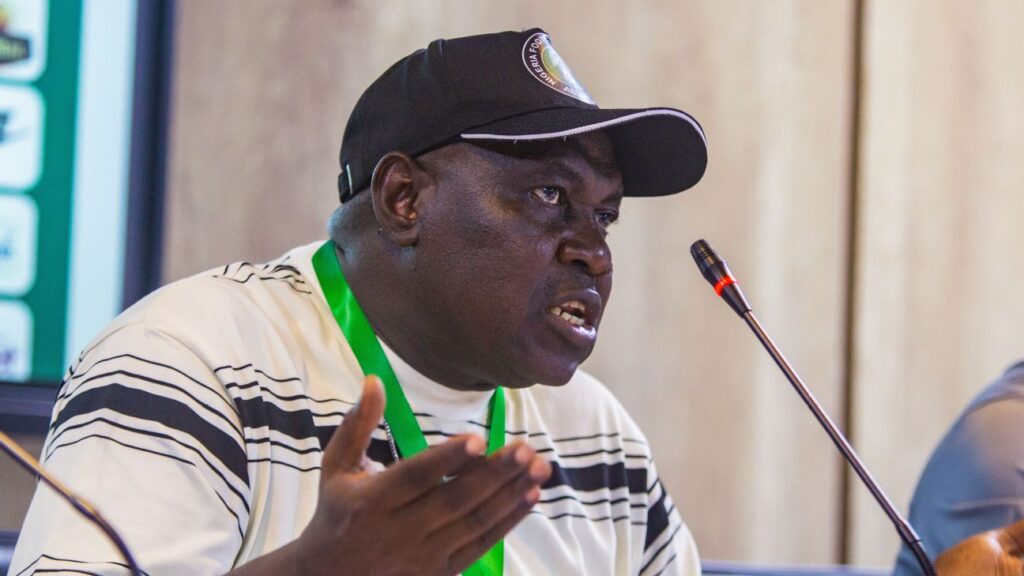
NFF Takes Drastic Action After Double Disappointment.
The Nigeria Football Federation has dismissed Super Falcons head coach Justine Madugu and his entire technical crew, bringing an immediate end to the coaching team’s tenure following Nigeria’s disastrous 2026 campaign. The decision, announced on Monday, comes days after the Super Falcons suffered a 2–1 defeat to South Africa in a World Cup qualification play-off, ending Nigeria’s extraordinary record of appearing at every FIFA Women’s World Cup since the competition began in 1991.
The dismissal represents a dramatic reversal for Madugu, who had taken charge on an interim basis in September 2024 following the departure of American coach Randy Waldrum. Just one year ago, Madugu was part of the team that guided Nigeria to a record-extending 10th WAFCON title. The collapse of the reigning African champions in 2026 has therefore transformed what appeared to be a successful coaching project into one of the most difficult periods in recent Nigerian women’s football history.
From African Champions to World Cup Absence.
Nigeria’s failure is particularly painful because of the country’s historic dominance of women’s football on the continent. The Super Falcons have won more WAFCON titles than any other African nation, and their presence at every Women’s World Cup since 1991 had been regarded as one of the most remarkable records in international women’s football.
Their 2026 campaign, however, fell well below those standards. Nigeria failed to reach the WAFCON semi-finals and subsequently lost to South Africa in the play-off that represented their final route to the 2027 FIFA Women’s World Cup in Brazil. The defeat officially ended their World Cup qualification hopes.

The consequences go beyond one disappointing tournament. Nigeria will now miss the Women’s World Cup for the first time in the history of the competition, removing one of the continent’s most established teams from the global tournament and raising serious questions about the state of the country’s women’s football programme.
NFF Launches Investigation.
The coaching dismissal is being accompanied by a broader investigation. NFF President Ibrahim Gusau inaugurated a fact-finding committee on Monday to investigate the reasons behind the Super Falcons’ failure and wider concerns surrounding the performance of Nigeria’s national teams. The committee has been given two weeks to complete its work and submit its findings.
The panel is chaired by former NFF general secretary Fanny Amun and includes former Super Falcons captain Desire Oparanozie and former Super Eagles captain Mutiu Adepoju. The committee has been asked to examine both the immediate and underlying causes of the recent failures, while Amun has indicated that public submissions will be accepted as part of the investigation.
That broader investigation could prove more consequential than the dismissal of the coaching staff. Nigeria’s problems cannot automatically be attributed to one coach when the national team has experienced instability across several cycles. Questions about player development, preparation, administration, coaching appointments and the overall management of women’s football are likely to form part of the debate.
Pressure Also Mounts on the NFF.
The crisis is extending beyond the technical bench. The NFF itself is facing political and administrative pressure ahead of its scheduled elections on 27 September 2026. Reports indicate that officials within Nigeria’s National Sports Commission are considering whether to ask President Bola Tinubu to halt the election process and establish a temporary normalisation committee. Any such intervention would require FIFA involvement because football governing bodies are expected to operate independently of government interference.
That development adds another layer of uncertainty to Nigerian football. The federation must now oversee an investigation into the Super Falcons while simultaneously dealing with questions surrounding its own leadership and the direction of the country’s national teams.
For the Super Falcons, the immediate priority will be rebuilding. A new coaching structure will have to restore confidence, identify the next generation of players and establish a pathway capable of returning Nigeria to the top of African women’s football.
A Historic Record Has Finally Been Broken.
Nigeria’s World Cup record had long been treated as almost untouchable. The Super Falcons had appeared at every edition since the inaugural Women’s World Cup in 1991, surviving changes in generations, coaches and competition formats.
That streak has now ended.
The significance of the failure is therefore greater than missing one tournament. It represents the loss of a defining symbol of Nigeria’s status in women’s football and forces the country’s football authorities to confront weaknesses that have accumulated beneath the success of previous generations.
The NFF’s decision to remove the entire technical crew is the first major response. The more difficult task will be determining whether Nigeria’s football leadership can use the crisis to rebuild the Super Falcons rather than simply replacing one coaching team with another.
For a nation accustomed to seeing its women’s team on the world’s biggest stage, the next rebuilding project will be about much more than finding a new coach. It will be about restoring a football culture that has made Nigeria the continent’s most consistent women’s football power.

Comments (0)
No comments yet — be the first to share your thoughts.