

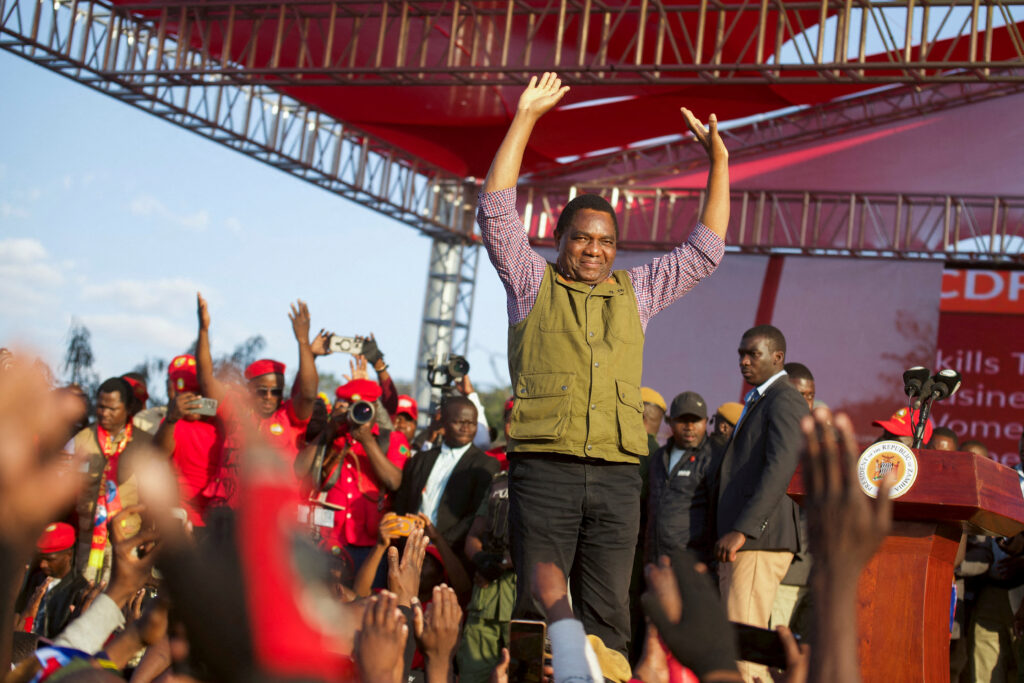
President Moves Closer to Second Term.
Zambian President Hakainde Hichilema has strengthened his position in the country’s presidential election, with partial results released on Monday, 17 August 2026, showing the incumbent holding a clear lead as vote counting continues. Results from approximately 71% of constituencies put Hichilema at about 62% of valid votes, up from 59% reported late Sunday, while his main challenger, opposition candidate Brian Mundubile, stood at approximately 36%. The figures place Hichilema comfortably above the 50% threshold required to win the presidency without a second-round runoff, although the Electoral Commission of Zambia has yet to declare a final result.
The developing result is significant because Thursday’s election was widely viewed as a referendum on Hichilema’s economic record since he came to power in 2021. The president inherited an economy struggling under a sovereign debt crisis and has made debt restructuring, investment attraction and economic stabilisation central to his first-term record. Zambia remains one of Africa’s most strategically important mineral economies, particularly because of its copper resources, placing the election under close international scrutiny as China and the United States compete for influence in Africa’s critical-minerals sector.
Opposition Challenges the Integrity of the Vote.
While Hichilema’s lead has widened, the political atmosphere surrounding the count has become increasingly tense. Mundubile said on Monday that his campaign had received information suggesting that results forms from polling stations may have been altered and called for an independent investigation into the alleged irregularities. His allegations have not been independently established, and Hichilema’s spokesperson, Clayson Hamasaka, rejected the claims, describing the opposition’s complaints as false.
The dispute comes after the vote-counting process itself was temporarily disrupted following incidents of violence and the reported theft of ballot materials. The Electoral Commission subsequently resumed counting after authorities said the security situation had been brought under control. The developments have increased scrutiny of an election that was already politically charged, with opposition groups and civil-society organisations raising concerns about restrictions on political activity and the treatment of opposition figures.

Arrests Add to Political Tension.
The election aftermath has also been marked by arrests of opposition figures. Zambian authorities said several opposition leaders were detained on election night because they allegedly posed a threat to state security. According to the government, police operations resulted in the arrest of 11 people who were allegedly found with military-grade weapons and were suspected of planning an insurrection. Opposition representatives have disputed the government’s account and raised concerns about individuals connected to Mundubile’s political circle.
Mundubile has separately alleged that heavily armed personnel raided his residence after the election, describing the incident as a threat to his life. Government authorities have offered a different account, saying security personnel came under fire during the operation. The competing narratives have added another layer of uncertainty to an election already facing questions over the transparency of the counting process.
An Election With Economic Stakes.
Beyond the political contest between Hichilema and Mundubile, Zambia’s election carries significant economic implications. The country is Africa’s second-largest copper producer after the Democratic Republic of Congo, making its political stability and economic policies important to international mining companies and global powers seeking secure supplies of critical minerals.
Hichilema has argued that his administration has made progress in restoring economic stability after the debt crisis that confronted Zambia when he took office. However, the economic recovery has not eliminated public concerns about the cost of living, employment and household finances. The election therefore represents a complicated judgment on his first term: supporters point to macroeconomic improvements and increased investor confidence, while critics argue that ordinary citizens have yet to feel the full benefits of the recovery.
Zambia Waits for the Final Result.
For now, Hichilema remains firmly in control of the presidential count. With approximately 71% of constituencies reporting and the incumbent holding around 62% of valid votes, the mathematics currently favour a first-round victory. However, the opposition’s allegations mean that the credibility of the final result could become almost as important as the result itself.
Zambia has historically been regarded as one of Africa’s more stable multiparty democracies, and the peaceful transfer of power in 2021, when Hichilema defeated then-President Edgar Lungu, was widely seen as an important democratic moment. The 2026 election is therefore being watched not only for who wins but also for whether Zambia can maintain confidence in its electoral institutions during a contested political transition.
If Hichilema maintains his current advantage and is officially declared the winner, he will secure a second and final five-year presidential term. If the opposition successfully challenges the process, however, the election could enter a new phase of legal and political confrontation.
For Zambia, the immediate priority is therefore clear: complete the count transparently, address credible complaints through the appropriate institutions and ensure that political disagreements do not escalate into instability. The final result will determine who governs Zambia for the next five years, but the manner in which that result is delivered could have an equally lasting impact on the country’s democratic reputation.

Comments (0)
No comments yet — be the first to share your thoughts.