

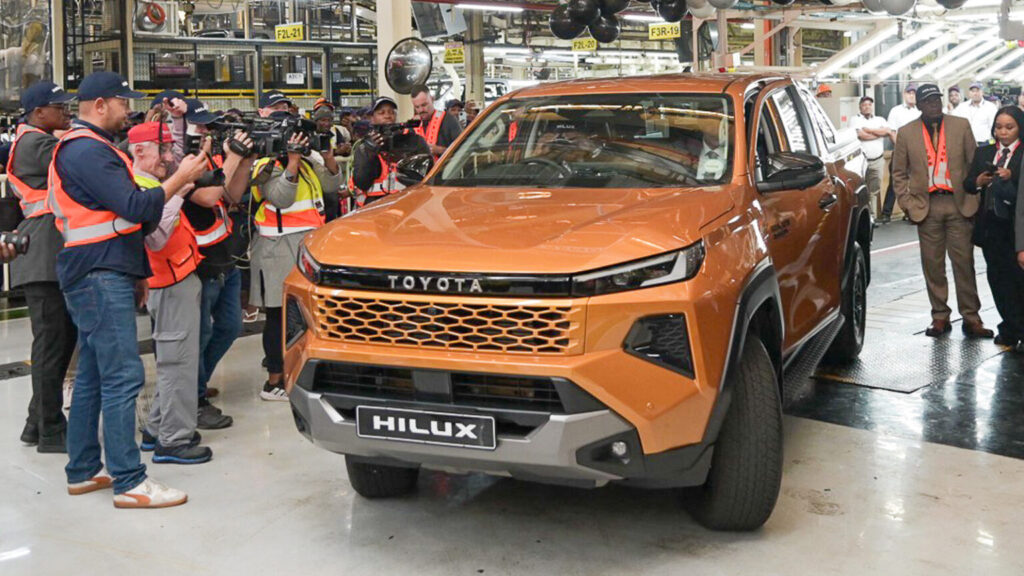
Toyota South Africa Motors has officially started pilot production of its next-generation Hilux pickup truck at its manufacturing plant in Durban, marking a significant milestone in the company’s 10.4 billion rand (approximately US$634 million) investment programme.
The launch signals the beginning of a new chapter for South Africa’s automotive industry, reinforcing the country’s position as one of Africa’s leading vehicle manufacturing hubs. The investment, which is more than 77% complete, is expected to modernise Toyota’s production facilities and prepare the Durban plant for large-scale manufacturing of the new Hilux.
A Major Investment in South African Manufacturing
Toyota’s investment is one of the largest recent commitments to South Africa’s automotive sector.
The programme includes 3.2 billion rand dedicated to upgrading factory infrastructure, including the construction of a new logistics centre for imported vehicle components and a modern chassis treatment and coating facility.

An additional 7.2 billion rand is being invested in production readiness, covering advanced robotics, automated manufacturing equipment, supplier tooling, and assembly systems needed to produce the next-generation Hilux.
A new chassis frame welding facility, equipped with advanced welding technology, is also under construction and is expected to be completed by June 2027.
Preparing for Global Markets
Toyota plans to gradually phase out production of the current Hilux model and replace it with the new generation as production ramps up.
Once full production is achieved, the Durban plant is expected to manufacture approximately 140,000 Hilux vehicles each year, supplying both the domestic market and export destinations across Africa, Europe, and other international markets.
The Hilux remains one of Toyota’s most successful global models and has consistently ranked among South Africa’s best-selling vehicles due to its reputation for durability and reliability.
Competing in a Changing Auto Industry
The launch comes at a time when South Africa’s automotive industry is undergoing rapid transformation.
Chinese manufacturers, including GWM and Chery, have expanded aggressively across the South African market, offering competitively priced pickup trucks and sport utility vehicles. At the same time, tightening vehicle emission standards in Europe are forcing manufacturers to modernise production facilities and introduce cleaner, more technologically advanced vehicles.
The new Hilux will feature improved safety systems, enhanced driver-assistance technologies, and updated manufacturing processes designed to meet international regulatory standards and customer expectations.
Confidence in South Africa
Speaking during the launch ceremony, Toyota South Africa Motors President and Chief Executive Officer Andrew Kirby described the investment as a strong vote of confidence in South Africa’s manufacturing capabilities.
Kirby said the automotive industry is experiencing profound global change driven by technological innovation, stricter environmental regulations, and increased competition. Despite these challenges, Toyota believes South Africa remains an important production base for its global operations.
Government officials attending the event also welcomed the investment, saying it demonstrates continued international confidence in the country’s industrial sector and its skilled workforce.
Economic Benefits Expected
The expanded production programme is expected to generate significant economic benefits for South Africa.
In addition to safeguarding thousands of existing jobs at the Durban manufacturing plant, the investment is expected to support employment throughout Toyota’s extensive supplier network, logistics companies, engineering firms, and component manufacturers.
Industry analysts say increased Hilux production will also strengthen South Africa’s vehicle exports, which remain one of the country’s largest manufacturing export industries.
The investment is expected to stimulate further technological development within the automotive sector while improving local manufacturing capabilities through the introduction of advanced production systems.
Looking Ahead
With pilot production now underway, Toyota will continue testing and refining the manufacturing process before full-scale production begins.
The remaining phases of the investment programme are scheduled for completion by June 2027, after which the Durban facility is expected to become one of Toyota’s most advanced pickup truck manufacturing plants globally.
As competition in the global automotive industry intensifies, Toyota’s latest investment positions South Africa to remain a key player in vehicle manufacturing while strengthening the country’s role as an export hub serving markets across Africa and beyond.

Comments (0)
No comments yet — be the first to share your thoughts.