

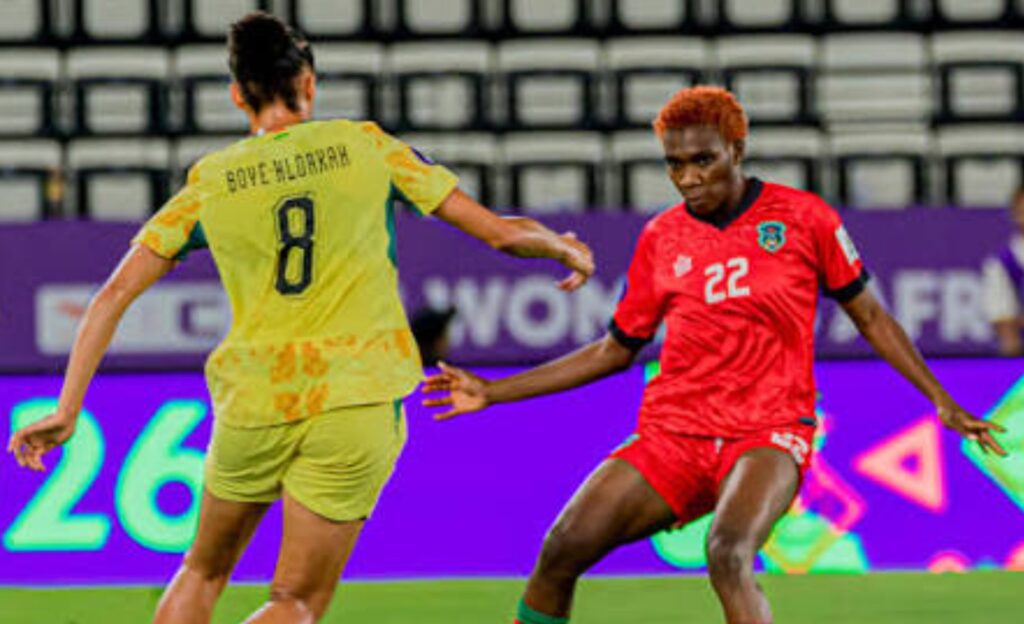
Few teams have entered the Women’s Africa Cup of Nations with fewer expectations and left with a bigger story than Malawi’s Scorchers.
Making their first-ever appearance at WAFCON, Malawi arrived as newcomers among some of the biggest names in African women’s football. Nigeria had won a record 10 titles, Ghana had decades of continental experience, while South Africa had established itself as one of Africa’s leading women’s football nations.
Malawi had never previously played at the tournament. Yet within days, the Scorchers had turned the established order upside down.
They defeated Nigeria, reached the semi-finals and secured Malawi’s first-ever qualification for the FIFA Women’s World Cup. What began as a historic debut has become one of the most remarkable stories in African women’s football.

A Historic First Appearance.
Malawi’s qualification for WAFCON was already a major achievement.
The Scorchers secured their place by defeating Angola 2–0 in October 2025, with Faith Chimzimu scoring both goals.
For a country making its first appearance on Africa’s biggest women’s football stage, simply reaching the tournament represented years of work and ambition. The expectation was that Malawi would gain experience against stronger and more established opponents.
Instead, they arrived ready to compete.
The Night Malawi Shocked Nigeria.
The defining moment came in Malawi’s opening Group C match against Nigeria.
The Super Falcons entered the tournament as defending champions and the most successful team in African women’s football, with 10 continental titles. Malawi entered as debutants.
But on July 28, 2026, the Scorchers produced one of the biggest shocks of the tournament, defeating Nigeria 3–2 in Rabat.
After a goalless first half, Temwa Chawinga opened the scoring in the 73rd minute. Six minutes later, her sister Tabitha Chawinga doubled Malawi’s advantage.
Nigeria responded through captain Rasheedat Ajibade, but Temwa Chawinga struck again deep into stoppage time to restore Malawi’s two-goal advantage.
Nigeria managed another goal, but Malawi held on for a famous victory.
The result immediately changed the way the continent viewed the Scorchers.
They were no longer simply tournament debutants.
They had become serious contenders.
The Chawinga Sisters Become Symbols of the Journey.
At the centre of Malawi’s remarkable campaign are sisters Tabitha and Temwa Chawinga.
Their partnership has become one of the defining stories of the tournament, combining experience, pace and attacking quality.
Both sisters have developed their careers beyond Malawi and gained valuable experience in international women’s football. That exposure has proved important as the Scorchers have faced opponents with considerably more tournament experience.
Tabitha provides creativity and leadership, while Temwa brings speed and a constant attacking threat.
Together, they have helped give Malawi something that cannot be measured in statistics: belief.
Their performances also highlight the importance of African players gaining international experience and bringing that knowledge back to their national teams.
Ghana Could Not Stop the Scorchers.
After their historic victory over Nigeria, Malawi faced another major challenge in the knockout stages.
Ghana’s Black Queens represented another experienced African football nation with a long history at the continental level.
But once again, Malawi refused to follow the expected script.
On August 9, 2026, the Scorchers defeated Ghana 2–1 in the quarter-finals to reach the WAFCON semi-finals.
The victory delivered another historic achievement.
Malawi had officially qualified for the 2027 FIFA Women’s World Cup in Brazil, marking the country’s first-ever appearance at the senior Women’s World Cup.
A team playing at WAFCON for the first time had suddenly secured a place among the world’s elite.
Malawi Challenges Africa’s Football Hierarchy.
For decades, African women’s football has been dominated by a relatively small group of nations.
Nigeria has traditionally been the continent’s powerhouse, while Ghana, South Africa, Cameroon and Equatorial Guinea have also established strong women’s football traditions.
Malawi’s campaign challenges that hierarchy.
Their success demonstrates that emerging football nations can compete with established powers when talent is combined with preparation, determination and opportunity.
It could also encourage other African countries to invest more seriously in women’s football.
A Victory for the Next Generation.
The importance of the Scorchers’ achievement goes beyond the current generation of players.
Thousands of young Malawian girls are now watching a national team that has reached the highest levels of African football and qualified for a World Cup.
That changes the perception of what is possible.
A girl dreaming of becoming a professional footballer can now look at the Scorchers and see a realistic pathway from local football to the biggest international stage.
The success could also increase pressure for better facilities, stronger youth development programmes, improved coaching and greater investment in the domestic women’s game.
The Bigger Transformation in African Women’s Football.
Malawi’s breakthrough comes at a time when women’s football across Africa is gaining greater attention.
CAF competitions are attracting larger audiences, while the expansion of the Women’s World Cup has created more opportunities for African nations to qualify.
But participation alone is not enough.
The real challenge is turning moments of success into sustainable football structures.
National teams need strong domestic leagues behind them. Young players need academies and professional development. Coaches need better training, while women’s football requires stronger commercial partnerships and investment.
Malawi has shown what is possible when an emerging nation gets the opportunity to compete.
The next challenge is ensuring that the achievement becomes the beginning of something bigger.
The Fairytale Is Still Being Written.
The Scorchers have already achieved what no previous Malawian women’s team had done.
They have played at WAFCON, defeated Nigeria, eliminated Ghana, reached the semi-finals and qualified for the Women’s World Cup.
Whatever happens next, their place in Malawian football history is secure.
But the story is not finished.
Malawi now have an opportunity to go even further and compete for the continental title.
They arrived in Morocco as debutants.
They leave the tournament as World Cup pioneers.
And in the process, the Scorchers have delivered one of the most extraordinary debut stories African women’s football has ever seen.

Comments (0)
No comments yet — be the first to share your thoughts.