

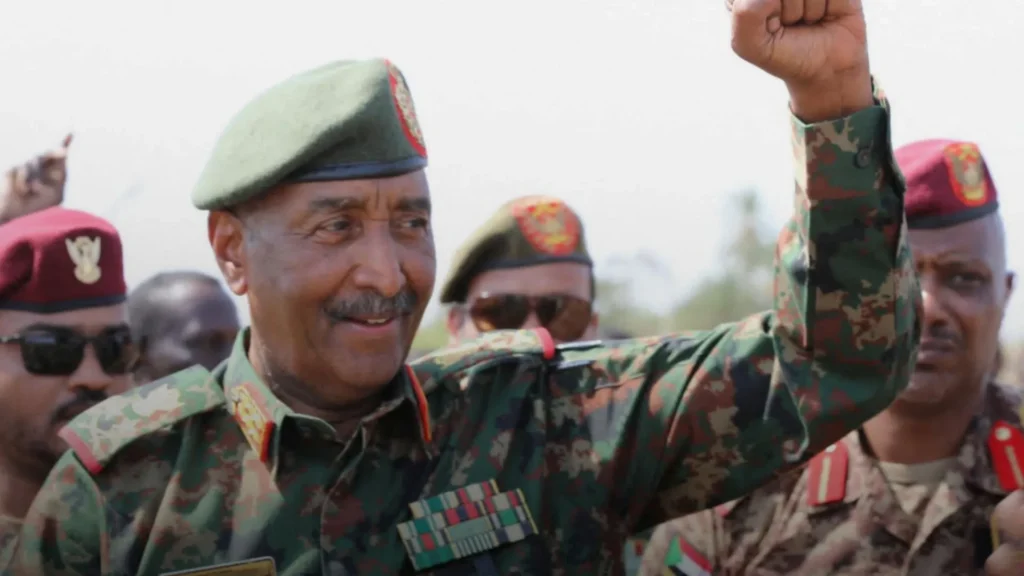
Sudan’s army chief Abdel Fattah al-Burhan has rejected negotiations with the Rapid Support Forces, insisting that his forces will continue fighting until they recover territory controlled by the paramilitary group.
The position represents another setback for diplomatic efforts to end Sudan’s devastating civil war, which has continued for more than three years and created one of the world’s largest displacement and humanitarian crises.
Burhan’s message was unequivocal: the Sudanese Armed Forces intend to continue their military campaign rather than enter into a political settlement with the RSF while the paramilitary group still controls significant territory.
A war that keeps expanding.
The latest declaration comes as fighting continues across several parts of Sudan.

West Kordofan has experienced renewed clashes, while violence has also spread toward Blue Nile State. Drone warfare has become increasingly prominent, with attacks targeting military positions, cities and even humanitarian operations.
The expanding geography of the conflict has made it increasingly difficult for civilians to find safe areas.
Millions of Sudanese have been displaced inside the country or forced to cross international borders. Humanitarian organisations continue to warn about hunger, disease and shortages of basic medical supplies, while access to many communities remains restricted by fighting.
Why Burhan is rejecting negotiations.
The Sudanese military has consistently argued that the RSF must be defeated or dismantled before Sudan can return to a stable political system.
From the army’s perspective, the existence of a powerful paramilitary organisation operating independently of the regular armed forces represents a threat to the state itself.
The RSF, meanwhile, has built significant military and territorial influence, particularly in western Sudan. It has also maintained political and external relationships that have allowed it to continue fighting despite sustained military pressure.
This has created a fundamental obstacle to negotiations.
Neither side has yet demonstrated a willingness to accept a settlement that could significantly reduce its political or military power.
Civilians are paying the highest price.
The military calculations being made by Sudan’s rival factions have devastating consequences for ordinary people.
Markets have been destroyed, health facilities have been damaged and millions of families have been separated from their homes.
The humanitarian situation has also become increasingly difficult in areas where fighting prevents aid agencies from reaching vulnerable communities.
In some regions, food insecurity has reached extreme levels, while displaced families often depend almost entirely on humanitarian assistance.
Every additional month of fighting increases the difficulty of rebuilding the country’s economy and public institutions.
The diplomatic challenge.
The African Union, United Nations and regional governments have repeatedly called for a ceasefire and political negotiations.
Several diplomatic initiatives have attempted to bring the army and RSF to the negotiating table, but efforts have repeatedly stalled.
Burhan’s latest rejection suggests that the army still believes battlefield gains can produce a more favourable outcome than negotiations.
The RSF has also shown little willingness to abandon territory without guarantees concerning its political and military future.
That leaves Sudan caught between two competing calculations: the belief among military leaders that victory is possible, and the growing humanitarian evidence that continued war is destroying the country.
What happens next.
The most immediate question is whether the army can convert its recent military pressure into lasting territorial gains.
Even if it succeeds in recapturing additional areas, however, controlling territory will not automatically resolve Sudan’s political crisis.
The country will still need a political settlement capable of addressing the future of the armed forces, civilian government, regional power structures and the millions of people displaced by the war.
For now, Burhan’s refusal to negotiate points in the opposite direction.
As the conflict enters another phase, Sudan faces the danger that military victory will become the only language accepted by its rival factions, making a negotiated peace increasingly difficult to achieve.

Comments (0)
No comments yet — be the first to share your thoughts.