

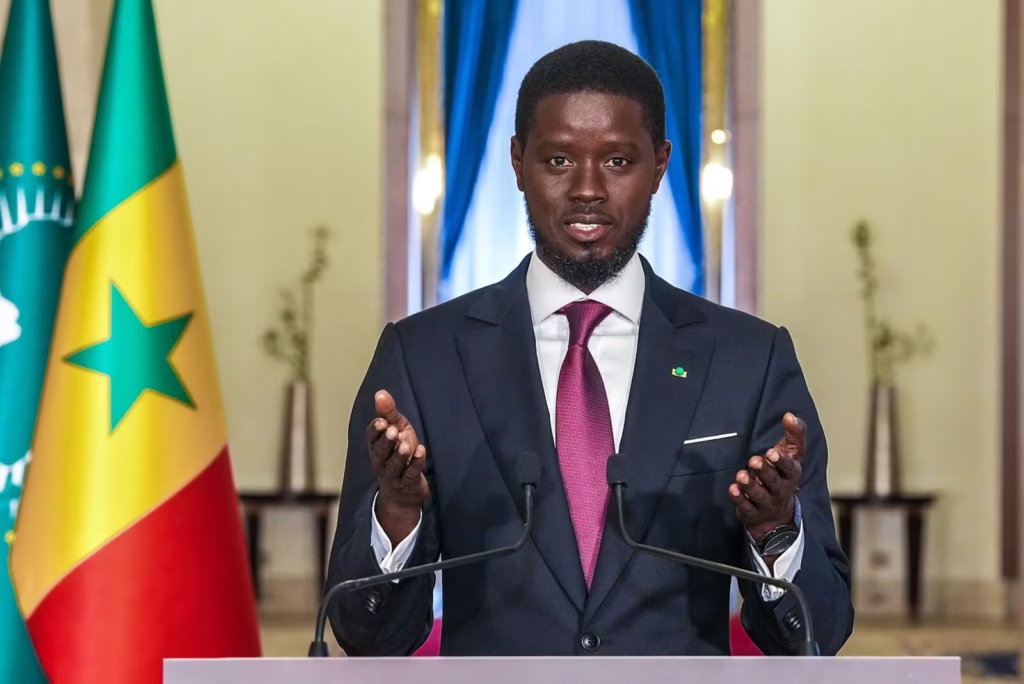
Senegal’s government is pressing ahead with an ambitious programme of governance and institutional reforms as President Bassirou Diomaye Faye seeks to consolidate his administration following months of political uncertainty and a dramatic reshaping of the country’s leadership.
The reform agenda, which includes decentralisation, public sector modernisation, social dialogue and institutional restructuring, comes at a crucial moment for one of West Africa’s most stable democracies. While the government says the changes are necessary to improve transparency, strengthen public institutions and accelerate development, they are unfolding against the backdrop of an evolving political landscape that has attracted attention across the continent.
A Government Seeking to Reset
Since taking office in 2024, President Faye promised a government built on accountability, justice and national sovereignty.
His administration inherited high public expectations after campaigning on reforms aimed at tackling corruption, improving governance and making state institutions more responsive to citizens.

In recent weeks, the government has intensified those efforts.
During an extraordinary Council of Ministers meeting, President Faye instructed ministers to accelerate reforms across key sectors, including decentralisation, infrastructure, agriculture, governance and public administration. He also emphasised the importance of maintaining social dialogue with workers and civil society as reforms move forward.
According to the presidency, the objective is to improve how government functions while ensuring reforms translate into tangible benefits for ordinary Senegalese.
Decentralisation Takes Centre Stage
One of the government’s biggest priorities is the next phase of Senegal’s decentralisation programme, known as Act IV.
The initiative aims to strengthen local governments by giving them greater responsibility for development planning while improving coordination between national and regional authorities.
Speaking to local government officials earlier this month, President Faye said decentralisation should bring government closer to citizens rather than simply create additional administrative structures.
He assured elected officials that the reforms are intended to improve efficiency and cooperation without eliminating existing territorial entities.
Supporters argue that stronger local governments can respond more quickly to community needs, improve service delivery and stimulate regional economic development.
Politics Behind the Reforms
The reform agenda is unfolding during a period of significant political change.
Earlier this year, President Faye dismissed his longtime political ally and Prime Minister Ousmane Sonko, ending one of the most influential political partnerships in recent Senegalese history. The split exposed divisions within the governing movement and created uncertainty about the direction of future reforms.
Soon afterwards, Faye announced plans to establish his own political party, signalling his intention to build an independent political base ahead of future elections. Analysts believe the move could reshape Senegal’s political landscape by redefining alliances within the country’s governing majority.
Political observers say the president now faces the dual challenge of maintaining reform momentum while managing a more competitive domestic political environment.
Constitutional Debate
Institutional reform has also sparked constitutional debate.
Earlier this month, Senegal’s Constitutional Council struck down a proposed constitutional amendment that would have altered the balance of power between the presidency and parliament.
The court ruled that the legislative process used to adopt the amendment violated constitutional requirements after President Faye requested an emergency review. The decision halted one of the most significant institutional proposals advanced by the parliamentary majority and reaffirmed the Constitutional Council’s role as an independent arbiter of constitutional disputes.
While supporters viewed the ruling as evidence that democratic institutions are functioning effectively, others argued it highlights the need for broader political consensus before undertaking major constitutional reforms.
Economic Expectations
Governance reforms are closely linked to Senegal’s economic ambitions.
The country recently joined the ranks of African oil and gas producers, creating new expectations that energy revenues could finance infrastructure, education, healthcare and industrial development.
However, economists caution that stronger institutions will be essential if Senegal is to avoid the governance challenges that have affected other resource-rich countries.
Transparency in public finance, effective decentralisation and accountable public institutions will play a critical role in determining whether future economic growth benefits the wider population.
Business groups have also welcomed efforts to improve governance, arguing that predictable institutions encourage investment and strengthen confidence in the economy.
Public Expectations Remain High
Despite broad support for reform, many Senegalese remain focused on practical outcomes rather than political announcements.
Citizens continue to expect improvements in employment, education, healthcare and the cost of living.
For young people in particular, governance reforms will ultimately be judged by whether they create economic opportunities.
Political analysts note that Senegal has built a strong democratic reputation over decades through peaceful transfers of power and relatively resilient institutions.
Maintaining that reputation while implementing ambitious reforms will require careful political management and continued dialogue between government, opposition parties and civil society.
Regional Importance
Events in Senegal are being closely watched across West Africa.
At a time when several countries in the region are experiencing political instability or military rule, Senegal continues to demonstrate that institutional disputes can be addressed through constitutional processes and political dialogue.
The country’s experience may influence governance debates elsewhere on the continent, particularly as governments seek to balance reform with democratic stability.
Looking Ahead
President Faye’s administration has entered a decisive phase.
Its ability to implement reforms, maintain political cohesion and deliver measurable improvements in governance will shape not only its legacy but also Senegal’s future trajectory.
The reforms promise a more efficient, transparent and decentralised state.
Whether they succeed will depend on effective implementation, political consensus and the confidence of citizens that change is improving their daily lives.
For now, Senegal remains one of Africa’s most closely watched democracies—a country attempting to modernise its institutions while navigating a rapidly evolving political landscape.

Comments (0)
No comments yet — be the first to share your thoughts.