

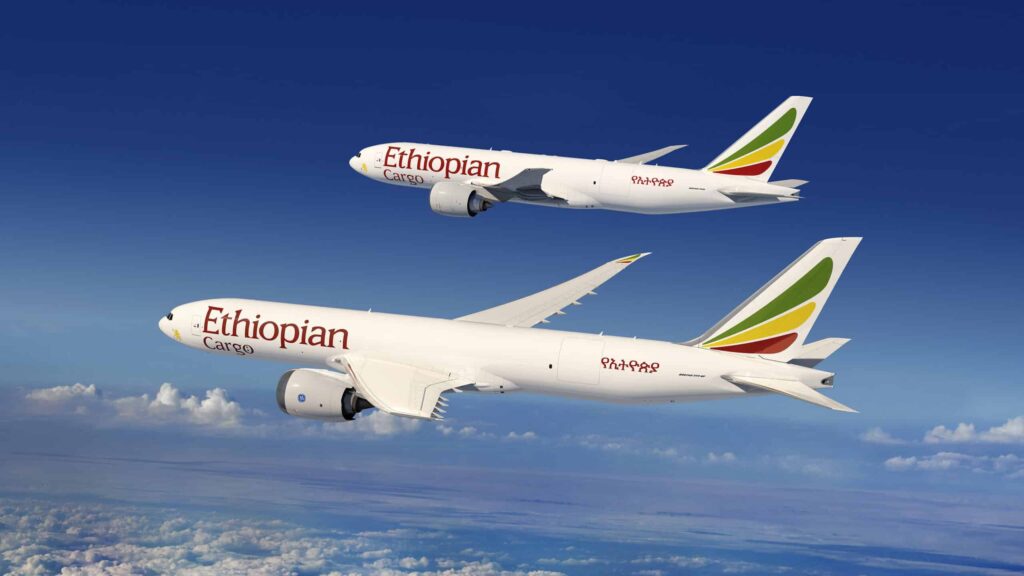
Ethiopian Airlines has signed an agreement with Boeing to acquire 10 new cargo aircraft, strengthening its position as one of Africa’s leading aviation and logistics players and signalling an ambitious expansion of its international freight operations.
The agreement, announced on September 30, covers eight Boeing 777-8 Freighters and two current-generation Boeing 777 Freighters. Ethiopian Airlines has also secured an option to acquire eight additional freighters, potentially taking the future expansion to 18 aircraft.
A Major Expansion of Ethiopian Cargo.
The deal represents another major investment in Ethiopian Airlines’ cargo business at a time when demand for international air freight continues to grow.
The airline already operates one of the largest dedicated cargo fleets on the continent, with 12 Boeing 777 Freighters, two Boeing 767 Freighters and four Boeing 737-800 converted freighters.

Its dedicated cargo network currently connects more than 70 destinations across Africa, Asia, Europe, the Middle East and North America.
The new aircraft will give Ethiopian Airlines additional capacity to transport high-value and time-sensitive goods between Africa and major global markets.
Ethiopia Becomes the First African 777-8F Customer.
One of the most significant aspects of the agreement is Ethiopian Airlines’ decision to become the first African carrier to order Boeing’s new 777-8 Freighter.
The aircraft belongs to Boeing’s next-generation 777X family and is designed to combine long-range capability with substantial cargo capacity. Boeing lists its maximum structural payload at 118 tonnes, making it one of the largest twin-engine freighters currently being developed.
The aircraft is intended to provide greater range and payload flexibility while reducing operating costs compared with previous generations of large cargo aircraft.
For Ethiopian Airlines, acquiring the 777-8F gives the carrier access to newer technology while allowing it to build on its existing experience operating the 777 Freighter.
Deliveries Will Come In Stages.
The 10 aircraft will not arrive at the same time.
The two current-generation 777 Freighters are scheduled for delivery in 2027 and 2028, providing Ethiopian Airlines with additional cargo capacity relatively quickly.
The eight 777-8 Freighters are scheduled for delivery between 2033 and 2035, reflecting the longer development and production timeline for Boeing’s next-generation freighter.
Ethiopian Airlines has also said it will acquire four additional Boeing 777 freighters converted from passenger aircraft, further expanding its cargo capacity.
Building Africa’s Global Cargo Gateway.
The expansion fits into Ethiopian Airlines’ broader strategy of positioning Addis Ababa as a major international cargo hub.
The airline has increasingly used its geographic location between Africa, Asia, Europe and the Middle East to develop connections that allow goods to move through Ethiopia rather than relying entirely on established hubs outside the continent.
That strategy is particularly relevant as African economies increase exports of agricultural products, pharmaceuticals, manufactured goods and other time-sensitive commodities.
A stronger cargo network could also make it easier for African businesses to connect with international markets without routing as much freight through hubs in Europe or the Gulf.
The New Hub Ambition.
Ethiopian Airlines’ cargo expansion also comes as the carrier develops longer-term plans to increase its overall aviation infrastructure.
The airline has been pursuing the development of a new international airport hub outside Addis Ababa, intended to eventually accommodate significantly more passenger and cargo traffic than the existing Bole International Airport.
The cargo aircraft order therefore forms part of a broader strategy rather than being an isolated fleet purchase.
The carrier is preparing for an aviation market in which Africa’s growing population, expanding trade and increasing integration with global supply chains could generate substantial demand for both passenger and freight services.
A Strategic Boost for Ethiopian Airlines.
For Boeing, the Ethiopian order is also significant. The company has been working to build demand for the 777X family while dealing with delays affecting the programme.
Ethiopian Airlines was already the first African customer for the passenger version of the 777X after ordering eight 777-9 aircraft. The latest agreement deepens that relationship and makes the airline the first African carrier to commit to the new 777-8 Freighter.
The decision also reflects Ethiopian Airlines’ long-standing preference for Boeing widebody aircraft, particularly for its long-haul and cargo operations.
Africa’s Air Cargo Market Is Changing.
The expansion of Ethiopian Airlines comes as African countries increasingly look toward aviation as part of their broader trade and economic strategies.
Air cargo can play a critical role in moving products that cannot efficiently travel by sea or road, particularly fresh agricultural produce, medicines, electronics and other high-value goods.
For Ethiopia, strengthening its cargo fleet could also support the country’s ambition to become a major logistics gateway connecting African producers to consumers around the world.
The new aircraft will take years to enter service fully, but the scale of the order shows that Ethiopian Airlines is preparing for long-term growth rather than simply responding to current demand.
The Next Phase of Ethiopian Aviation.
With 10 new freighters on firm order and an option for eight more, Ethiopian Airlines is laying the foundation for a significantly larger cargo operation.
The immediate additions of the two 777 Freighters will increase capacity over the next two years, while the arrival of the 777-8F aircraft from 2033 onward could transform the airline’s long-haul freight capabilities.
For Ethiopia, the investment strengthens its ambition to remain one of Africa’s most important aviation and logistics centres. For the continent, it reflects a wider push to build stronger African-controlled connections to global trade.
The aircraft may take years to arrive, but Ethiopian Airlines is already positioning itself for the next phase of Africa’s air cargo economy.

Comments (0)
No comments yet — be the first to share your thoughts.