

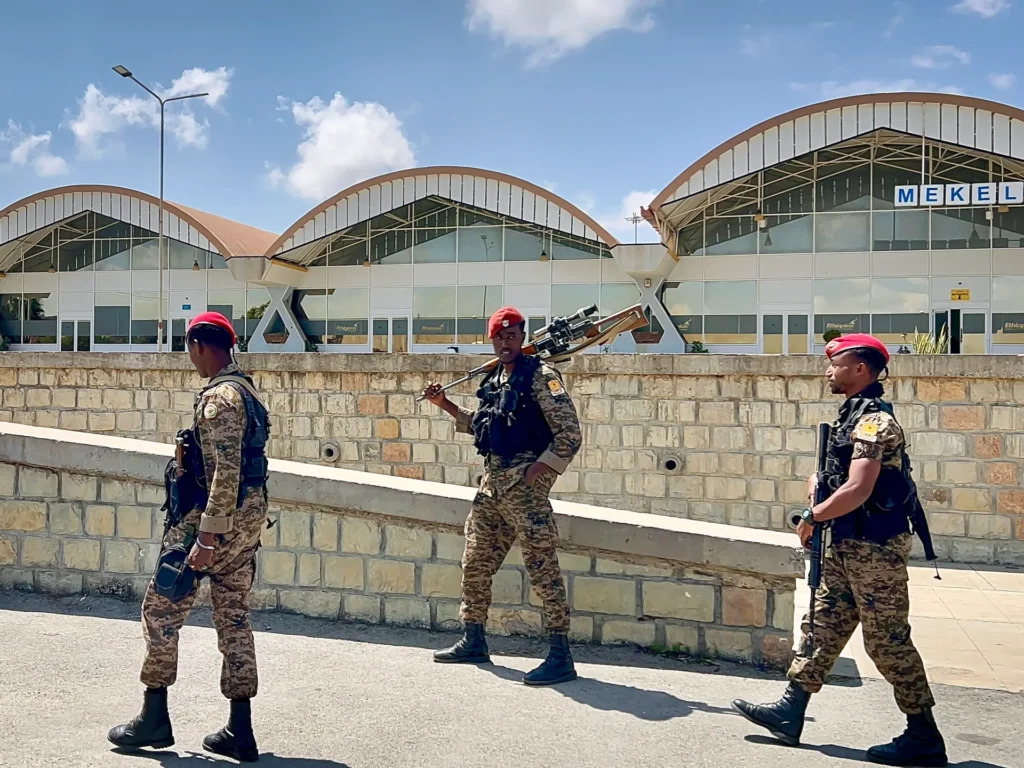
Reports that Eritrean troops have entered northern Ethiopia have added a dangerous new dimension to renewed tensions in the Tigray region, raising fears that a conflict that devastated the area only a few years ago could once again become a broader regional crisis.
Local sources have reportedly seen Eritrean soldiers in and around Adigrat and Idaga Hamus, while conflict monitors have reported movements across the Eritrean border. Eritrea, however, has denied involvement and accused Ethiopia of fabricating allegations that could be used to justify military action.
The reports come as fighting has intensified in parts of Tigray despite the peace agreement signed in 2022 that formally ended the devastating war between Ethiopia’s federal government and the Tigray People’s Liberation Front. The renewed violence has involved military movements, drone activity and clashes around strategically important areas.
Why Eritrea’s alleged involvement matters.
Eritrea’s alleged military presence is significant because the country was deeply involved in the previous Tigray war. Eritrean forces fought alongside Ethiopian federal troops during that conflict, which lasted from 2020 to 2022 and produced one of Africa’s most severe humanitarian crises.

Relations between Addis Ababa and Asmara have since deteriorated sharply. Diplomatic tensions have increased alongside disagreements over security and Ethiopia’s ambitions to regain reliable access to the Red Sea.
Prime Minister Abiy Ahmed has repeatedly described access to the sea as an important strategic and economic objective for landlocked Ethiopia. Eritrea, which controls a long Red Sea coastline, has strongly opposed any suggestion that Ethiopia could obtain sovereign control over Eritrean territory.
That disagreement has added another layer to an already complicated relationship between the two countries.
A fragile peace under pressure.
The 2022 Pretoria peace agreement brought an end to large-scale fighting in Tigray, but it did not resolve every political and security dispute that had contributed to the war.
Questions surrounding the future of Tigray, the status of contested territories, the disarmament of armed forces and relations between regional and federal authorities have remained sensitive.
The return of fighting therefore carries consequences beyond the battlefield.
For civilians who survived the previous conflict, renewed violence raises fears of another cycle of displacement, shortages and destruction. Communities across Tigray are still dealing with the consequences of the previous war, including damaged infrastructure and disrupted livelihoods.
Ethiopia and Eritrea face a wider regional problem.
The latest developments also have implications for the wider Horn of Africa.
Ethiopia is one of the continent’s most populous countries and a major regional power. Eritrea occupies a strategically important position along the Red Sea, close to some of the world’s most important maritime trade routes.
A serious military confrontation between the two countries could therefore have consequences far beyond their shared border.
It could affect trade routes, neighbouring countries and regional diplomatic efforts while creating additional pressure on an area already dealing with conflicts in Sudan and Somalia.
The danger of another Tigray war.
For now, important details surrounding the reported Eritrean military movements remain disputed. Eritrea has denied that its troops are involved, while some local and conflict-monitoring sources have reported their presence.
That uncertainty makes independent verification particularly important. What is already clear, however, is that the political environment in the Horn of Africa has become increasingly tense.
The Tigray peace agreement prevented a return to the devastating levels of violence seen between 2020 and 2022. Preserving that peace will now depend on whether Ethiopia, Eritrea and Tigray’s political actors can prevent the latest confrontation from developing into another prolonged war.
For a region already facing multiple security crises, the stakes could hardly be higher.

Comments (0)
No comments yet — be the first to share your thoughts.