
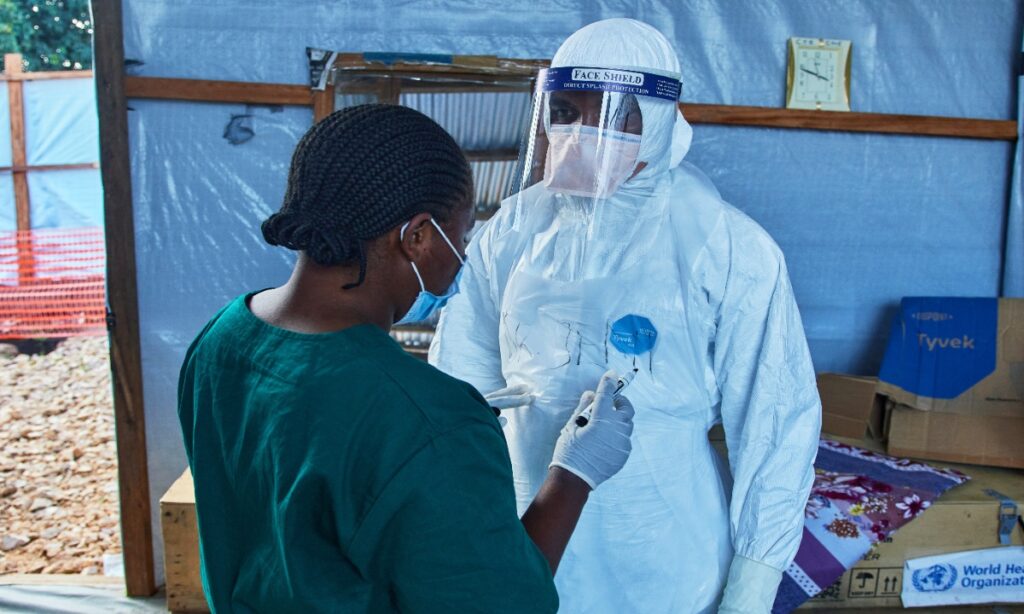
A local politician in the Democratic Republic of Congo has been beaten to death after publicly defending the government’s response to the country’s devastating Ebola outbreak, highlighting the growing tensions between health authorities and communities struggling with fear, misinformation and distrust.
Marie-Célestin Karondwa, an official of the ruling Union for Democracy and Social Progress (UDPS), was attacked at his home in Butembo, North Kivu province, on Sunday. He later died from his injuries at a local hospital. His home was also set on fire, according to accounts from his family and political party.
Karondwa’s killing comes as health workers and other responders face resistance while trying to contain the country’s 17th Ebola outbreak, which has become its deadliest on record.
Attacked After Speaking About Ebola.
Karondwa had appeared on a local radio programme where he discussed Ebola prevention and defended the government’s response measures. His political party said he was attacked because he had supported its position on the existence of the virus and the threat it posed to the population.

His granddaughter, Sagesse Kavira, told the Associated Press that attackers beat him before setting the house alight. The precise circumstances of the assault, including the identities of those responsible and their motives, had not been established in the initial reports.
The killing has prompted calls for an investigation and renewed concerns about the safety of people involved in public health communication.
Karondwa’s death also illustrates how discussions about Ebola have become entangled with wider political tensions and longstanding public distrust of state institutions in eastern Congo.
Ebola Outbreak Passes 8,000 Cases.
The attack occurred as the Democratic Republic of Congo continued to battle a major outbreak of the Bundibugyo strain of Ebola.
As of September 26, health authorities had recorded 8,067 confirmed cases and 3,901 deaths, according to figures released by the country’s public health institute. The outbreak was declared in May and has spread across multiple provinces, placing significant pressure on an already strained healthcare system.
The scale of the crisis has made community cooperation essential. Health workers need residents to report symptoms, seek treatment promptly, follow infection-prevention guidance and cooperate with response teams.
However, those efforts have been complicated by shortages of medical personnel and supplies, insecurity, and scepticism among some residents who question whether the disease is real or believe the response is being used for financial or political purposes.
Distrust Complicates the Fight Against Ebola.
In parts of eastern Congo, public-health workers are operating in communities shaped by years of conflict, displacement and mistrust of government authorities.
Some residents have dismissed Ebola as a hoax, while others have accused officials and health teams of exploiting the outbreak for financial gain. Health responders reject those allegations and warn that misinformation can delay treatment and put more people at risk.
The distrust has contributed to attacks on health workers and facilities during the current outbreak. It has also made it harder for response teams to work in remote communities, where access to healthcare is already limited.
The World Health Organization has warned that conflict and community resistance are obstructing efforts to contain the disease. In areas controlled by armed groups, insecurity further restricts access to patients and complicates the delivery of medical supplies.
A Dangerous Environment for Health Workers.
Karondwa was a political official rather than a frontline medical worker, but his death reflects the risks facing people who publicly support Ebola prevention measures.
Health workers, local officials and community advocates often have to persuade residents to adopt measures that can be disruptive to daily life, including isolation, restrictions on contact and changes to burial practices.
When those measures are viewed with suspicion, the people explaining them can become targets of anger.
The challenge for authorities is therefore not only to provide medical care but also to build trust. Public communication, transparency about how response funds are used, and engagement with local leaders are important to ensuring that communities understand why prevention measures are necessary.
Karondwa’s killing could make that task more difficult if residents become more fearful of speaking publicly about the outbreak.
The Human Cost of Misinformation and Violence.
The Ebola crisis is unfolding alongside persistent insecurity in eastern Congo, where armed conflict has displaced communities and weakened access to essential services.
The outbreak has placed additional pressure on hospitals and healthcare workers, while fear of infection and distrust of official information have discouraged some people from seeking care.
The consequences extend beyond those infected. Families may lose relatives, communities can face restrictions on movement and trade, and health facilities must divert resources from other essential services to respond to the outbreak.
The killing of a local official who was encouraging people to take Ebola seriously adds another layer to that crisis.
Calls for Answers After Karondwa’s Death.
Karondwa’s family and political colleagues are seeking answers about who carried out the attack and why. His party has called for an investigation, while the circumstances surrounding the killing remain under scrutiny.
The case also raises broader questions about how authorities can protect health workers and public figures who support disease-control efforts without deepening tensions with the communities they serve.
Containing the outbreak will require more than medical supplies and treatment centres. It will also depend on whether residents trust the information they receive and feel safe cooperating with health teams.
For the Democratic Republic of Congo, Karondwa’s death is both a criminal case demanding accountability and a warning about the consequences of allowing mistrust and misinformation to undermine the response to a deadly public-health emergency.

Comments (0)
No comments yet — be the first to share your thoughts.