

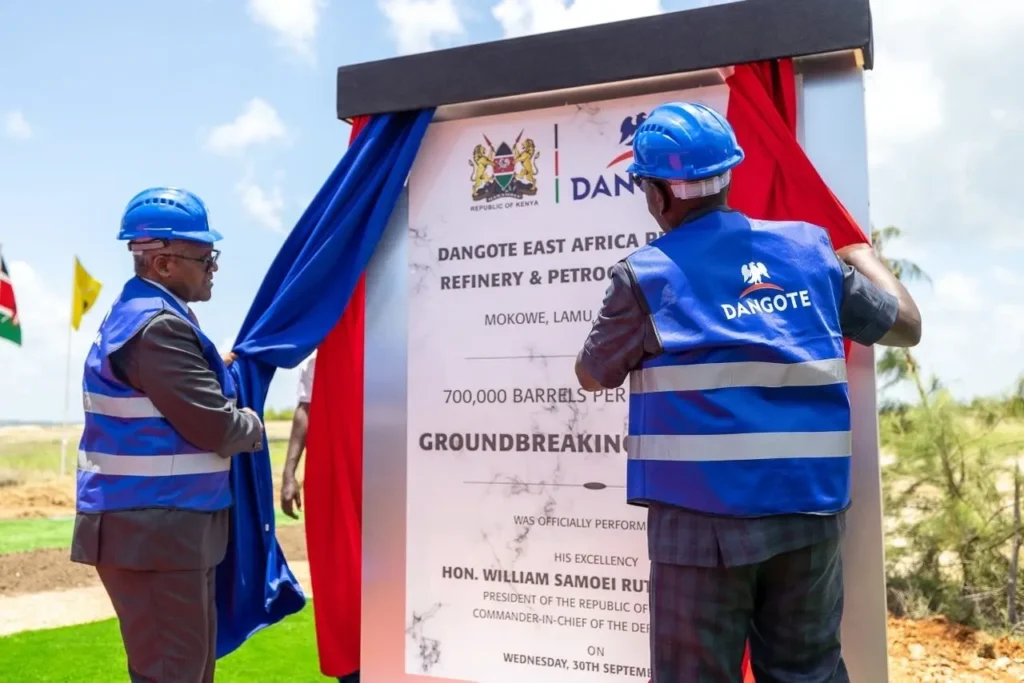
Nigerian billionaire Aliko Dangote and Kenyan President William Ruto have officially broken ground on a $16 billion oil refinery in Kenya, launching one of Africa’s most ambitious new energy and industrial projects. The refinery, planned for Lamu County on Kenya’s northern coast, is designed to process 700,000 barrels of crude oil per day and supply refined petroleum products across East Africa.
The September 30 groundbreaking brought together several African leaders, including Ugandan President Yoweri Museveni and Ethiopian Prime Minister Abiy Ahmed, highlighting the regional significance of a project that is expected to extend beyond Kenya’s domestic fuel market. The facility is being developed as part of a wider industrial complex intended to strengthen manufacturing and energy infrastructure around the Lamu port and LAPSSET corridor.
A 700,000-Barrel-A-Day Ambition.
The proposed refinery is expected to become the largest refinery in East and Central Africa by processing capacity if completed as planned. Its 700,000-barrel-per-day capacity would put it on a scale comparable to Dangote’s flagship refinery in Lagos, which the Nigerian industrialist is seeking to replicate in East Africa.
The project is expected to take roughly 40 months to complete. Alongside the refinery itself, the planned industrial complex will include a 1,000-megawatt power plant and facilities for fertilizer, chemical and plastics production. Kenya’s government says the investment could stimulate industrial activity, develop local skills and create new opportunities along the LAPSSET corridor.

The project is therefore being presented as more than a refinery. Its supporters see it as an industrial hub that could connect crude production, energy generation, manufacturing and regional fuel distribution.
Why East Africa Wants More Refining Capacity.
East African countries remain heavily dependent on imported refined petroleum products, exposing their economies to international oil prices, shipping costs and foreign-exchange pressures.
The new refinery is intended to change part of that equation by allowing crude oil from the region and other sources to be processed closer to the markets where fuel is consumed. Reuters reported that the project is aimed at reducing East Africa’s dependence on imported refined products and saving foreign currency used to purchase fuel from overseas.
That regional dimension is particularly important because countries such as Uganda are developing their own crude-oil production. Kenya itself does not currently produce crude commercially, meaning the refinery will need to source crude from regional producers as well as international markets.
Dangote has said the crude will be sourced regionally and abroad, while regional governments have been offered a 30% stake in the refinery.
Kenya Sees a New Industrial Corridor.
For Kenya, the project fits into a broader effort to transform Lamu into an important regional logistics and industrial centre.
The refinery will be located near Lamu Port, a major component of the LAPSSET infrastructure corridor connecting Kenya with neighbouring countries. Government officials expect the investment to increase economic activity around the port and attract additional businesses and infrastructure.
The Kenyan government says the refinery could create jobs, develop local technical expertise and generate opportunities for young people. The wider industrial complex is also expected to support activities beyond petroleum refining.
Regional leaders attending the groundbreaking have consequently presented the project as an opportunity to deepen economic integration and strengthen Africa’s capacity to process its own natural resources.
Dangote’s East African Expansion.
The Kenyan refinery represents another major step in Dangote’s strategy of building large-scale industrial assets across Africa.
The businessman already operates the 650,000-barrel-per-day Dangote refinery in Lagos, which has become one of Nigeria’s most important industrial projects. The planned Kenyan facility would give the group another major refining base on the continent and place it closer to fast-growing East African fuel markets.
The timing is also significant. Dangote is simultaneously pursuing an initial public offering for his Nigerian refinery and has said investor demand for that offering has been exceptionally strong. He has also outlined plans for substantial additional investment across Africa.
The Kenyan project therefore forms part of a much larger industrial expansion rather than standing alone as a single investment.
The Land and Environmental Dispute.
Despite the project’s scale, the development has not been without opposition.
Residents and landowners in Lamu have raised concerns over land rights and compensation, with a legal case challenging aspects of the project continuing in Kenya’s courts. A Kenyan High Court ruling allowed the groundbreaking ceremony to proceed, although legal proceedings relating to the land dispute remain ongoing.
Environmental groups have also expressed concerns about the potential impact of a large industrial project on Lamu’s marine ecosystem and surrounding environment. Lamu is home to sensitive coastal habitats and the historic Lamu Old Town, a UNESCO World Heritage site.
These concerns mean that the project’s success will not be measured solely by how quickly construction advances. Questions surrounding land ownership, environmental protection and the distribution of economic benefits will remain part of the debate.
A New Energy Map for Africa.
If the refinery is completed at its planned scale, it could alter the petroleum supply structure of East Africa. A 700,000-barrel-per-day facility would provide substantial refining capacity for Kenya and neighbouring markets while creating a new industrial base around Lamu.
For Dangote, it extends a refining strategy that began in Nigeria into another major African economic region. For Kenya, it represents a potentially transformative industrial investment. And for East Africa, it offers the possibility of reducing dependence on imported refined fuel while keeping more processing activity within the continent.
The challenge now moves from the groundbreaking ceremony to construction, financing, crude supply, environmental safeguards and regional distribution. The $16 billion project has officially begun, but its ultimate impact will depend on how successfully those challenges are managed over the next several years.

Comments (0)
No comments yet — be the first to share your thoughts.