

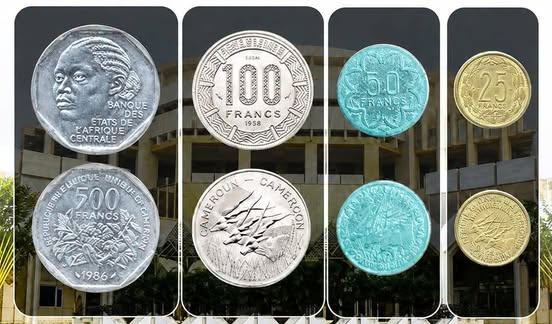
A currency transition intended to modernise cash transactions across Central Africa is already creating confusion in Cameroon, where some traders and transport operators are reportedly refusing older CFA franc coins weeks before they officially lose their legal-tender status. The situation is raising concerns for consumers, particularly people who depend on small cash payments for food, transport and everyday purchases.
The Bank of Central African States, known by its French acronym BEAC, has announced that five older series of coins will be withdrawn from circulation across the Central African Economic and Monetary Community (CEMAC) from November 1, 2026. However, reports from Cameroon on October 19 indicate that some businesses are already rejecting affected coins, leaving customers uncertain about which money remains acceptable.
The distinction is important: the withdrawal takes effect on November 1, not before. Until October 31, coins covered by the measure remain legal tender. Rejecting them prematurely risks turning an administrative transition into an avoidable problem for ordinary consumers and small businesses.
What Is Changing on November 1?
The decision concerns five historical series of CFA franc coins issued in 1958, 1959, 1971, 1976 and 1985. The measure applies across all six CEMAC countries: Cameroon, Chad, the Central African Republic, the Republic of the Congo, Gabon and Equatorial Guinea.

The decision was adopted by the Ministerial Committee of the Central African Monetary Union on October 7, 2026, in N’Djamena, Chad, following a proposal from the BEAC.
From November 1, the affected coins will lose their legal-tender status and can no longer be used to pay for goods and services. The measure does not mean that every old-looking coin is invalid, nor does it affect all coins of a particular denomination. The coin’s series matters, meaning that people need to distinguish between the older issues and the newer ones.
Coins belonging to the 2006 and 2024 series will remain valid. This includes denominations that may look similar to older coins, making clear public information particularly important.
The change forms part of the central bank’s efforts to renew the region’s currency in circulation and improve the availability and management of coins used in everyday transactions.
Why Are Traders Refusing Coins Before the Deadline?
The early rejection of affected coins appears to reflect uncertainty about the implementation of the measure. Some traders may fear that if they accept older coins before November 1, banks or other financial institutions will refuse them later. Others may be struggling to identify which series remain valid.
Reports from Cameroon describe disagreements between customers and sellers as the deadline approaches. In markets and other cash-dependent settings, even a small dispute over a coin can disrupt a transaction, especially when people have no alternative means of payment immediately available.
Yet the official timetable provides a clear distinction between the announcement and the effective date. The fact that certain coins are scheduled to lose their validity does not mean they have already lost it.
Premature rejection can disproportionately affect low-income consumers, street vendors, transport users and small businesses that handle large numbers of low-value cash transactions. People may be left carrying money that remains legally valid but is refused by individual sellers because of uncertainty or fear.
The situation also highlights a communication challenge for monetary authorities. Announcing a deadline is not enough if consumers and traders do not understand which coins are affected, when the rules change and how the exchange process will work.
One Year to Exchange the Withdrawn Coins.
The BEAC has established a transitional exchange period running from November 1, 2026, to October 31, 2027. Holders of the affected coins will be able to exchange them for coins from the 2006 or 2024 series, subject to the published timetable.
From November 1, 2026, through July 31, 2027, exchanges will be available through participating banks, microfinance institutions and BEAC branches. During the final three months, from August 1 to October 31, 2027, exchanges will be handled exclusively at BEAC counters.
From November 1, 2027, the old coins will no longer be exchangeable under the announced programme.
This transition gives households and businesses time to identify the affected coins and replace them. However, it also makes early public education essential. People should not assume that every old coin must be discarded immediately or that all coins of the same denomination are being withdrawn.
Consumers should check official BEAC information or consult their financial institutions before exchanging coins. Traders should also familiarise themselves with the different series so that valid money is not rejected unnecessarily.
The Impact on Cameroon’s Cash Economy.
Coins remain important to everyday economic activity in Cameroon. They are used for small purchases, market transactions, transport fares and other payments where bank transfers or digital wallets may not be practical.
For businesses operating on narrow margins, uncertainty over the acceptability of coins can complicate cash management. Sellers may hesitate to accept money they believe could become difficult to deposit, while customers may find it harder to complete transactions if their coins are refused.
The problem could become more serious if misinformation spreads faster than official clarification. Rumours that all old coins are already invalid, for example, could encourage unnecessary disputes and reduce confidence in cash transactions.
The authorities therefore need to make the transition easy to understand. Public notices should show examples of affected and valid coins, explain the precise dates and identify where exchanges can be conducted. Banks, microfinance institutions, market associations and transport operators can help communicate the rules directly to people who handle cash every day.
A Test of Public Communication and Trust.
The withdrawal of older coins is a regional monetary decision, but its success will be measured partly by how smoothly it affects ordinary transactions. A well-managed transition should allow people to continue using valid money until the official deadline while giving them sufficient time and access to exchange affected coins.
The immediate concern is that confusion could undermine this process before it formally begins. If traders continue rejecting coins that remain legal tender, the cost of uncertainty will fall on consumers who may have little ability to challenge the refusal.
The BEAC and national authorities must therefore reinforce the official timetable and clarify the responsibilities of financial institutions during the transition. Traders also need accurate information to avoid making decisions based on rumours or incomplete understanding.
For Cameroon, the lesson extends beyond coins. Changes to currency rules require timely communication, practical guidance and consistent implementation. The November 1 deadline is approaching, but the authorities still have an opportunity to prevent further confusion by ensuring that citizens know exactly which coins remain valid, which ones are being withdrawn and how to exchange them.
Until the deadline takes effect, the central message is straightforward: the measure targets specific older coin series, not every coin in circulation, and the affected coins remain legally valid through October 31, 2026.

Comments (0)
No comments yet — be the first to share your thoughts.