

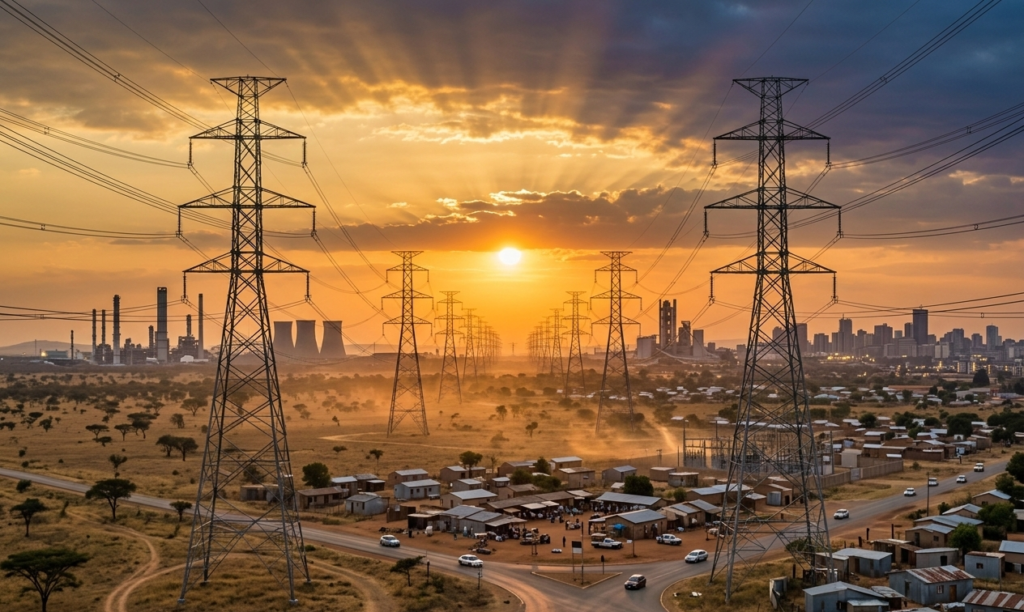
Africa is racing to build a digital future. Governments are investing in technology, businesses are adopting artificial intelligence, startups are creating innovative solutions, and global companies are expanding their presence on the continent.
But behind Africa’s digital ambition lies a fundamental challenge: energy.
Without reliable and affordable electricity, Africa’s dreams of becoming a major player in artificial intelligence, cloud computing, digital services and advanced technology could remain limited.
The question facing the continent is no longer whether Africa can create digital solutions. The question is whether it can generate enough power to support them.

The Digital Future Requires Energy
The global technology economy is powered by electricity.
Artificial intelligence systems, data centres, cloud platforms and digital infrastructure require enormous amounts of energy to operate.
As Africa seeks to participate in the AI revolution, the continent faces a difficult reality: many countries still struggle with unreliable electricity supply, high energy costs and limited access.
According to the International Energy Agency (IEA), hundreds of millions of people in sub-Saharan Africa still lack access to electricity, making the region one of the biggest energy access challenges in the world.
For Africa to compete in the digital economy, expanding internet access alone will not be enough. The continent must also solve its electricity challenge.
Africa’s Technology Ambition Meets an Energy Reality
Africa has made impressive progress in technology.
Countries such as Nigeria, Kenya, South Africa, Egypt and Rwanda have developed strong startup ecosystems, attracted technology investments and produced innovative digital solutions.
However, technology companies increasingly require stronger infrastructure.
Data centres, which support cloud computing and AI services, depend on stable electricity. Frequent power interruptions increase operating costs and make African markets less attractive for some investors.
The contradiction is clear:
Africa wants to become an AI and technology hub, but many businesses are still forced to rely on generators and alternative power sources to operate.
Experts Warn of the Infrastructure Gap
The African Development Bank (AfDB) has repeatedly identified energy access as one of the biggest barriers to Africa’s economic transformation.
AfDB President Dr Sidi Ould Tah has emphasised that reliable energy infrastructure is essential for industrialisation, job creation and economic growth.
The bank estimates that Africa needs massive investment in energy infrastructure to close the electricity gap and support long-term development.
The challenge is not a lack of resources. Africa has some of the world’s greatest renewable energy potential, including solar, hydro and wind power.
The challenge is turning that potential into reliable electricity for homes, businesses and industries.
The AI Race Could Expose Africa’s Weakness
Artificial intelligence is becoming one of the most important economic competitions of the 21st century.
Countries around the world are investing billions of dollars into AI research, computing power and data infrastructure.
Africa has talented engineers, young innovators and a growing digital economy. But without sufficient energy capacity, the continent risks becoming mainly a consumer of foreign technology rather than a producer of its own.
AI development requires:
- powerful computing systems,
- advanced data centres,
- reliable electricity,
- affordable connectivity.
Energy shortages threaten every part of this chain.
Renewable Energy: Africa’s Biggest Opportunity
Africa’s energy challenge could also become its greatest opportunity.
The continent receives some of the highest levels of sunlight in the world and has enormous potential for solar energy development.
Countries such as Morocco, Egypt, Kenya and South Africa have already expanded renewable energy projects aimed at reducing dependence on traditional energy sources.
The opportunity is not only providing electricity. Renewable energy could support manufacturing, digital infrastructure and new industries across Africa.
The continent does not need to repeat the energy path taken by older economies. It can build a cleaner and more sustainable energy system.
The Private Sector Must Play a Bigger Role
Governments cannot solve Africa’s energy crisis alone.
Private investment will be critical in building power plants, renewable energy projects, transmission networks and digital infrastructure.
Technology companies, financial institutions and international investors must view energy not only as a development challenge but as a business opportunity.
Without stronger partnerships between governments and businesses, Africa risks falling behind in the industries shaping the future economy.
Africa Cannot Build a Digital Future in the Dark
Africa’s digital transformation is one of the continent’s biggest opportunities.
Young entrepreneurs are creating technology solutions. Businesses are adopting digital tools. Artificial intelligence is opening new possibilities.
But every digital innovation depends on one basic requirement: electricity.
The future of Africa’s technology sector will not be decided only by software developers, investors or policymakers.
It will also be decided by engineers building power systems, renewable energy experts creating solutions and leaders willing to invest in infrastructure.
Africa has the talent. It has the resources. It has the ambition.
But if the continent cannot solve its energy challenge, its digital revolution may never reach its full potential.
Africa cannot build the future of technology without first powering the present.

Comments (0)
No comments yet — be the first to share your thoughts.