

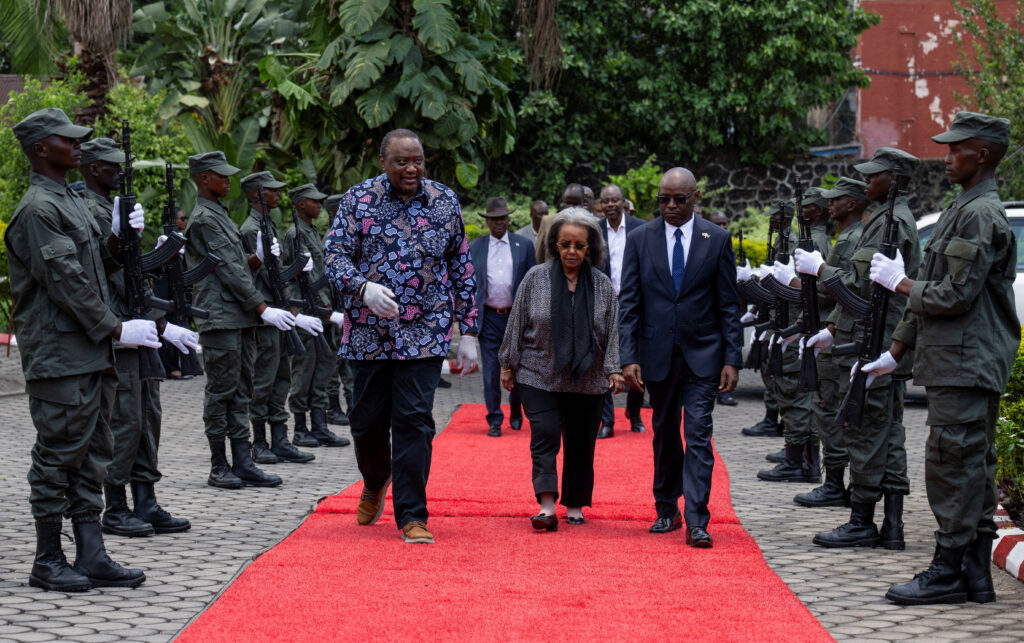
The African Union has intensified diplomatic efforts to address the conflict in eastern Democratic Republic of Congo, with a high-level delegation meeting representatives of the AFC/M23 movement as fighting continues to threaten civilians and complicate attempts to secure a lasting political settlement.
The delegation included former Kenyan President Uhuru Kenyatta, former Ethiopian President Sahle-Work Zewde and former Botswana President Mokgweetsi Masisi. Their engagement with the rebel movement comes as regional and international actors attempt to keep a fragile ceasefire process alive and prevent the conflict from developing into a wider regional confrontation.
The talks focused on the need to respect the Doha ceasefire framework, establish mechanisms for verifying compliance, protect civilians and ensure humanitarian access to communities affected by the fighting.
Why the AU is getting involved.
Eastern Congo has experienced decades of instability involving armed groups, competing political interests and disputes over land and mineral resources.

The resurgence of M23 has transformed the conflict into one of the most serious security crises in Central Africa. The group has captured substantial territory and has repeatedly clashed with the Congolese army and allied forces.
The Congolese government has accused Rwanda of backing M23, an allegation Kigali has consistently rejected. Rwanda has instead pointed to security threats along its border and accused armed groups operating from Congolese territory of threatening its interests.
The result has been a conflict in which local grievances have become intertwined with regional security concerns.
The Doha process faces a difficult test.
Diplomatic negotiations have produced important commitments, but implementing those commitments has remained difficult.
Previous ceasefires in eastern Congo have repeatedly broken down after accusations of military violations. Each new clash creates further mistrust and makes the next round of negotiations more difficult.
That is why the AU delegation’s emphasis on verification is particularly important.
A ceasefire is difficult to sustain if the parties cannot agree on what happened when fighting resumes. An effective monitoring mechanism could provide a way to establish facts, identify violations and prevent every incident from immediately triggering another cycle of retaliation.
Civilians remain at the centre of the crisis.
For communities in North and South Kivu, the conflict is not an abstract geopolitical dispute.
Families have been forced from their homes, schools and businesses have been disrupted, and access to healthcare and food has become increasingly difficult in areas affected by fighting.
Large-scale displacement has also placed pressure on neighbouring communities that are already struggling with limited resources.
Humanitarian organisations have repeatedly called for safe access to affected populations, but insecurity continues to make relief operations extremely difficult.
The mineral question.
Eastern Congo’s enormous mineral wealth is another factor that makes the conflict particularly complicated.
The region contains deposits of minerals that are important to global technology and manufacturing supply chains. Control over territory can therefore carry significant economic value.
But reducing the conflict to minerals alone would overlook the political and historical grievances that have fuelled instability for decades.
Land disputes, ethnic tensions, governance failures, regional security concerns and competition for political influence all contribute to the crisis.
Any sustainable peace agreement will therefore need to address more than military positions.
What the AU wants to achieve.
The African Union’s latest engagement reflects a growing recognition that the Congo conflict cannot be resolved through military pressure alone.
Direct engagement with AFC/M23 provides the continental body with an additional channel for communicating ceasefire expectations and encouraging the movement to participate in the political process.
At the same time, the Congolese government will face pressure to demonstrate its own commitment to the diplomatic process and civilian protection.
The success of the effort will ultimately depend on whether the parties are prepared to accept compromises that they have so far resisted.
A crucial moment for eastern Congo.
The latest talks do not guarantee an end to the fighting, but they provide another opportunity to move the crisis away from the battlefield.
For the African Union, the challenge is to turn diplomatic engagement into a process that can be monitored, enforced and trusted by all sides.
For civilians in eastern Congo, the hope is much simpler: that the agreements being negotiated in diplomatic rooms will finally translate into fewer attacks, safer communities and a realistic path toward returning home.

Comments (0)
No comments yet — be the first to share your thoughts.